GDPR Data Erasure Policy for Regulated Industries
GDPR-Compliant Deletion Policy:
—Reliable Management in a BI Context
Insurance companies and financial service providers typically have data deletion policies in place. The real challenge arises during day-to-day operations: when personal data is further processed in BI systems, reports, derived data, and data landscapes that have evolved over time.
ISR and mip help companies establish GDPR-compliant data deletion as a manageable governance process—one that is traceable, controllable, and audit-ready.
's Typical Challenges The Problem: Data Keeps Moving
GDPR-compliant deletion becomes challenging as soon as personal data is further processed beyond operational systems—for example, in data warehouses, BI systems, reports, data marts, or analytical derivations. In such structures, a deletion strategy defined once is not sufficient. The key factor is whether all relevant data objects are permanently identified, monitored, and verifiably deleted or anonymized.

Why This Is a Critical Issue
What Risks Arise Without Fire Extinguishing Monitoring?
Data deletion risks rarely arise all at once. They develop gradually during day-to-day operations and often only become apparent when auditors, data protection authorities, or regulators require reliable evidence.
Data remains undetected
Personal information may remain in BI structures, reports, or data marts even after it has been deleted from the source system.
Evidence is missing
In an audit, what matters is not the concept, but solid evidence of which data was deleted or anonymized, when, how, and with what results.
Manual effort is increasing
IT, data protection, and business units must manually review and document deletion runs, configurations, and exceptions, often under time pressure.
Compliance risks are on the rise
If discrepancies are not detected until late in the process, regulatory risks, internal escalations, and the effort required for retroactive corrections all increase.
This is exactly where controlled expense management comes into play: It highlights variances before they become a matter for audit.
Implement. Verify. Monitor. Manage.
From Firefighting Strategy to Governance Process
ISR and mip combine data protection requirements, technical implementation, and ongoing monitoring into a single, end-to-end process. This makes GDPR-compliant data deletion verifiable, controllable, and properly documented for audits.
Fire Extinguishing Application
Technically implements defined deletion and anonymization rules and integrates them into existing data and BI processes.
Fire Report
Documents deletion processes, configurations, and results in a traceable manner for data protection, audits, and financial audits.
Fire Control
Continuously checks whether all relevant objects have been recorded, detects discrepancies, and identifies risks early on.
Governance
Establishes roles, responsibilities, and escalation procedures between IT, business units, data protection, compliance, and management.
From the practical project with HUK-COBURG
A key factor in our success is the close collaboration between the various departments, IT, and mip.
The solution was developed with a practical focus, closely aligned with existing processes, and implemented in a way that ensures its long-term viability in day-to-day operations.
Frank Blatt
Team Leader, Business Intelligence Development I, HUK-COBURG
Watch the video
A glimpse into the customer presentation
Why Traceability Is Crucial During Operations: A short video clip from HUK-COBURG's customer presentation.
Flyer
GDPR Data Erasure: A Practical Example
Using HUK-COBURG as an example, learn how regulatory compliance, auditability, and operational efficiency can be integrated into data landscapes that have evolved over time.
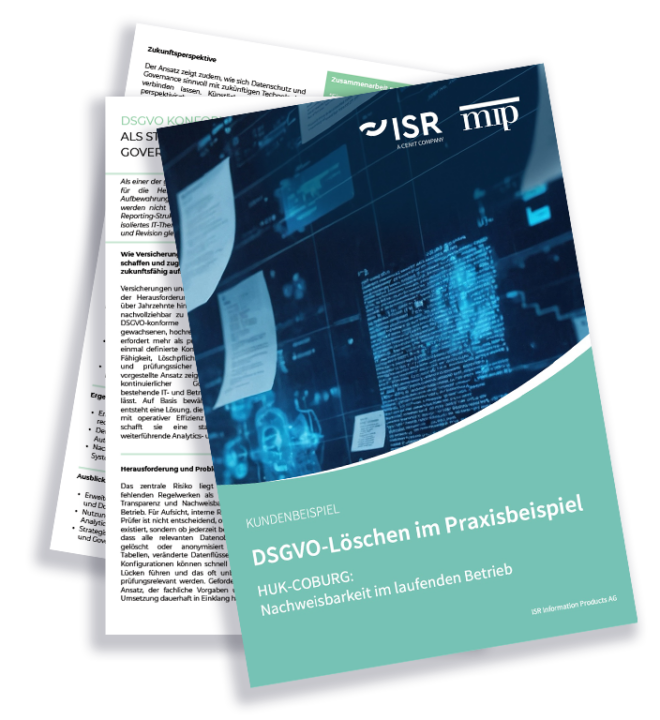
Practice Materials
Flyer and customer presentation in one download
Request the practice flyer and the client presentation from HUK-COBURG to learn how GDPR-compliant data deletion can be implemented in complex data environments in a sustainable, traceable, and audit-proof manner.
More Than Just Compliance
What Regulated Companies Gain
The added value lies not only in compliance with regulatory requirements. A controlled deletion process creates transparency, reduces risks, and eases the burden on IT, data protection, and business units during day-to-day operations.
Audit Assurance: Reliable evidence for data protection, audits, financial audits, and regulatory oversight.
Risk Mitigation
Discrepancies are identified earlier, before they become subject to audit or require reporting.
Reduces Operational Burden: Less manual documentation, fewer special audits, and less ad hoc work.
Governance Stability
IT, business units, data protection, compliance, and management all work from a shared information base.
Technical Efficiency
Depending on the initial situation, a controlled extinguishing process can help data volume, system load, and operational processes more effectively.
FAQ
: Frequently Asked Questions About GDPR-Compliant Data Deletion
Because audit assurance does not stem from the concept itself, but rather from robust evidence gathered during ongoing operations. Personal data is often scattered across data warehouses, BI systems, reports, data marts, and analytical derivations. It is therefore crucial that all data objects subject to deletion are consistently identified, processed, and documented in a traceable manner.
GDPR-compliant deletion means removing personal data after the relevant retention periods have expired or in response to specific requests for deletion, or anonymizing it in such a way that it can no longer be linked to an individual.
In practice, this involves more than just the actual deletion process. Other critical factors include identifying data objects that need to be deleted, the technical implementation of the deletion logic, documenting the results, and continuously monitoring whether new tables, derived fields, or reports need to be included in the process.
Deletion monitoring provides transparency into whether deletion processes are complete, accurate, and consistently effective. It helps identify whether objects relevant to deletion are missing, configurations are incorrect, or processes are not running as intended.
This transforms GDPR-compliant data deletion from a mere mandatory process into a manageable governance tool. Companies gain greater assurance in dealing with regulatory oversight, internal audits, and external audits, while at the same time reducing the workload on IT, data protection, and business units during day-to-day operations.
ISR and mip combine their expertise in data and analytics, governance, IBM technologies, and operations. Together, we help companies establish GDPR-compliant data deletion as an end-to-end process—from business design and technical implementation to reporting and controlling.
The goal is an approach that not only works once but remains controllable over the long term: Deletion logic is technically implemented, deletion processes are documented in a traceable manner, deviations are systematically identified, and responsibilities are made transparent.
This approach is particularly relevant for insurance companies, financial service providers, and regulated companies with complex, legacy data environments.
Typical scenarios include large BI and data warehouse environments, numerous derived data sets, high traceability requirements, and collaboration among IT, data protection, compliance, business units, and management.
Uncontrolled or only partially documented deletion processes can result in personal data remaining in BI structures, reports, or derived data sets. This often only comes to light during audits, internal reviews, or in response to inquiries from the audit, data protection, or financial audit departments.
The consequences can include a high volume of manual rework, missing documentation, unclear responsibilities, and increasing compliance risks. It is particularly critical that gaps in ongoing operations can grow over time if new data objects are not consistently integrated into the deletion process.
GDPR Data Erasure Strategies with ISR and mip
Let’s assess your current situation
Would you like to know whether your existing data deletion processes can be reliably verified even during ongoing operations? In an initial discussion, we’ll work together to identify where personal data is further processed within your data environment, what verification risks exist, and what the next logical steps should be.
Talk directly with our experts in Data & Analytics and Governance.
Get in touch with us now
We would be pleased to advise you.
Let’s assess your current situation!
Can you provide reliable proof today that personal data has been completely deleted across all systems?
If not, it’s worth taking a look at your current situation together.



Sandra Daikhi
Client Solution Manager
mip Management Informationspartner GmbH
Sandra.Daikhi@mip.de
+49(0)175 878 32 261