Workflow Management System
Workflow Management System
Our Proprietary Software Solutions
Definition
What is a Workflow?
In short: A workflow provides technical enablement for a business process.
For those seeking more detail: Thousands of processes occur daily in all organizations. These include business processes that pursue an overarching objective, as well as sub-processes that ensure individual work steps are completed. Workflows can provide technical support for all these processes. Workflows are, so to speak, the background enablers that ensure defined processes are adhered to.
In this context, a workflow is a sequence of work steps defined by the organization that frequently recur in daily operations. A workflow describes the path that tasks and their associated information take through the organization to complete work efficiently. Various individuals, departments, and systems are often involved in a workflow. A workflow can be executed manually or automatically.
A workflow typically comprises:
- Tasks: Tasks consist of individual steps that must be completed.
- Roles and Responsibilities: Workflows define who is responsible for which task at each step.
- Sequence: Workflows are characterized by a defined starting point, a logical and temporal progression, and an endpoint. This ensures the efficient transfer of relevant information between departments and systems.
- Rules and Conditions: Workflows adhere to internal corporate guidelines (e.g., approval policies, deadlines, document-driven processes) that dictate their execution.
- Automations: Modern workflows are either partially or fully automated (e.g., email notifications or data transfers between systems).
Definition
What is a Workflow Management System?
To control and technically implement the aforementioned workflows within an enterprise, a Workflow Management System is indispensable.
A Workflow Management System manages and optimizes all digital workflows within your organization. It enables the definition, control, monitoring, and automation of workflows to execute recurring processes efficiently and without errors. The software ensures that tasks are processed and completed in the correct sequence by the designated individuals or systems. This not only supports task management but also enhances process transparency, efficiency, and consistency. Workflow Management Systems minimize human errors and ensure that workflows proceed smoothly and purposefully.
Proficiency in a graphical specification language (e.g., BPMN) is essential for utilizing a workflow system to accurately model and implement processes. This enables the modeling of even highly complex processes.
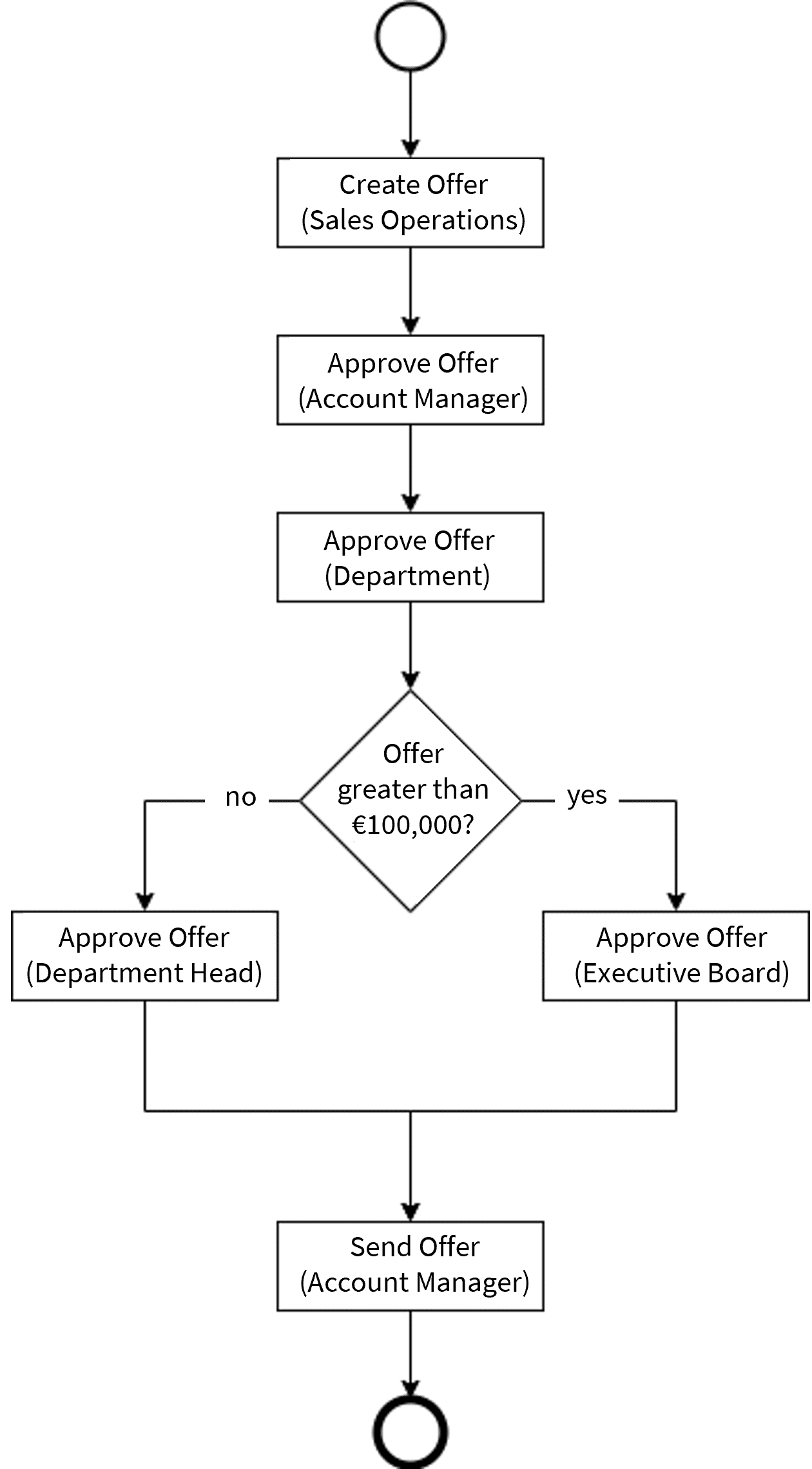
To illustrate a process, we have created a Flow Chart. It depicts a simple, fictitious offer approval process. Here, the offer is created by the "Sales Operations" department and submitted for approval via the system. The workflow then routes the offer to the Account Manager, who reviews it based on the key details discussed with the client and Sales Operations. In our scenario, we assume that offers have always been created correctly, which is why the specialized department subsequently receives the offer for review. The department's task is then to examine the content details. If the offer sum is less than €100,000, approval goes to the Division Management. However, if the sum exceeds €100,000, it is forwarded to the Board of Directors. Following approvals, the Account Manager receives a system notification indicating that the offer can be sent to the client. This is merely a highly simplified example of an offer approval workflow, which would certainly not be practical in reality. Please consult us for advice!
The Four Most Important
Functions of a Workflow Management System
Modeling
A Workflow Management System enables the creation, visualization, and customization of workflows, including the definition of tasks, dependencies, responsibilities, and process rules.
Monitoring
A workflow system provides insight into the status of ongoing processes, enabling the early identification and resolution of bottlenecks or delays. This ensures transparent task progress for all process participants.
Automation
Workflow software offers the capability to automate routine tasks. Examples include sending emails, obtaining approvals, or forwarding data.
Optimization
A Workflow Management Tool generates reports and analyses on process execution. This enables the monitoring of process performance and the identification of optimization potentials. Workflows are continuously improved, and their overall efficiency is enhanced.
Advantages of a Workflow System
Why does a Workflow Management System provide value?
A Workflow Management System offers numerous advantages for organizations by optimizing and automating work processes.
The key advantages include:
- Error Minimization: Standardized and automated processes minimize human errors and ensure adherence to rules and regulations.
- Control and Transparency: The status of tasks can be monitored at any time, enhancing process control and transparency while highlighting bottlenecks.
- Cost Reduction: Through process automation and optimization, organizations can significantly reduce costs associated with manual labor, delays, and errors.
- Speed and Productivity: Automating routine tasks alleviates employee workload, saves time, and reduces manual interventions, thereby making workflows faster and more productive.
- Collaboration: A clear distribution of tasks and a central platform for information exchange foster collaboration and transparency between teams and departments.
- Compliance with Regulations: A workflow tool facilitates adherence to internal and external regulations, as well as quality standards, by standardizing processes and ensuring their accurate execution.
Workflow Examples
Which operational processes can be represented using a workflow?
Document Approval
By utilizing workflows, the entire document approval process can be managed. The workflow ensures that the document requiring approval moves digitally through the organization. This is achieved through relevant email notifications sent to the process participant, requesting their review and approval. Once this individual approves the document (e.g., a proposal), it automatically proceeds to the next person in the approval chain. Document authors are notified as soon as the approval is granted. In this manner, all steps, from document submission and review to final approval, can be efficiently digitized.
Request Approval
Workflows can also provide significant value in processing applications, particularly in sectors such as banking. Here, numerous loan applications are processed daily by employees who often work in different departments and are geographically dispersed. A workflow management system provides process participants with a task list. As soon as an employee selects an application from the list, it is locked for others, preventing duplicate processing. Furthermore, the workflow system guides and controls the subsequent processing of the loan application through defined and standardized steps.
Set Up Reminders
Furthermore, reminders are a classic, straightforward example of workflows. A system user can automatically bring tasks or documents back into focus at a later time. This functionality is frequently employed to meet deadlines, set reminders, or automatically resume a workflow after a waiting period (e.g., for external information). Reminders ensure that no task is overlooked and that all processes continue to run efficiently.
Automate Purchase-to-Pay Process
A complex example of a workflow is straight-through processing within the Purchase-to-Pay process. Following the ordering of goods, the order confirmation, invoice, and goods delivery with its delivery note are automatically processed. These four document types are handled by the workflow up to automated invoice payment. Based on available information such as quantity, price, and order number, the underlying Document Management System (DMS) determines whether the invoice can be posted without manual review by an employee. The workflow proceeds through various verification steps and transmits the invoice document to an ERP system for posting before it is archived.

Our strength lies in understanding the client's business processes in their own language and then implementing them technically. This approach results in straightforward workflows, even for complex challenges.
In the realm of workflow management, we leverage these
TECHNOLOGIES



Workflow Management System
Our References


M&C TechGroup: Process Optimization as part of an ERP Modernization
Workflow Integration
Workflow Management Systems and Interfaces to Other Systems
How do we provide concrete support to enterprises?
As an IT consultancy, we assist companies in making their operational processes more efficient and transparent with customized workflow management solutions. Our focus is on the digitization, optimization, and automation of business processes.
We analyze your existing workflows (as-is state) and collaboratively develop a target vision (to-be state) with you. Based on your requirements, we develop and implement tailored workflow systems. Naturally, we integrate the system into your existing IT landscape to ensure seamless information exchange and enable automations across various systems. We implement monitoring and tracking functionalities for your processes to identify and realize future optimization potentials proactively. We provide comprehensive support, including long-term assistance post-implementation.
Let us collaborate on your business processes – for enhanced efficiency, transparency, and success.
IT Operations for Your Workflow Management System – Efficiency Guaranteed
A smoothly functioning workflow management system is critical for the efficiency of your business processes. At ISR, we manage the IT operations of your systems, allowing you to concentrate on your core business. From continuous monitoring to maintenance and adaptations, we ensure that your system consistently operates optimally and is future-proof.
Our comprehensive support encompasses not only technical maintenance but also flexible adaptation to new business requirements. This ensures your workflow management system remains current and supports your processes efficiently and reliably.
6 Frequently Asked Questions
Workflow Management System
Workflows are deployed in virtually all areas of an enterprise to manage recurring processes efficiently and systematically. They are particularly beneficial in domains where tasks require standardization and execution in a predefined sequence.
Here are some of the most common application areas:
- Accounting | Invoice Approvals: Automated approval processes for incoming invoices, including authorization workflows across various departments.
- Human Resources | Employee Onboarding: Coordination of all requisite steps for integrating new employees (e.g., contract signing, training, IT setup).
- Sales | Quote and Order Processing: Automated workflows for generating quotes and processing customer orders through to invoicing.
- Customer Support | Customer Complaints and Support: Processing and tracking of customer inquiries and complaints via structured workflows.
- Product Development | Change Management: Tracking of modifications in product requirements, design, or production plans.
- Legal Department | Contract Management: Workflows for the creation, review, and approval of contracts, including tracking of contract fulfillment.
- Office Management | Maintenance Management: Automated planning and execution of maintenance operations in buildings or facilities.
There are numerous other application areas. Let us collaborate to innovate and future-proof your (core) processes!
Ideally, all enterprise workflows are governed by a digital Workflow Management System. A Workflow Management System is a software solution designed to assist organizations in planning, automating, monitoring, and optimizing their operational workflows. It facilitates the coordination and management of recurring tasks and processes within an enterprise to improve efficiency and transparency. Key functionalities include workflow design and modeling, monitoring and control, and automation and optimization.
Various types of workflows are employed by organizations, depending on the specific use case and process complexity. The six primary workflow types are:
- Sequential Workflows: Steps are executed in a fixed order, with each step initiating the subsequent one. Example: An approval process where a document sequentially progresses through various departments.
- Parallel Workflows: Multiple steps are executed concurrently before being reconverged to trigger the subsequent process step. Example: In a project, team members process distinct tasks in parallel and subsequently consolidate the outcomes.
- Rule-Based Workflows: The process flow is governed by predefined rules that dictate the subsequent step. Example: An application process where the submission is either advanced to the next round or declined based on specific criteria (e.g., qualification).
- Static Workflows: Defined processes that are immutable and consistently adhere to the same sequence. Example: The onboarding process for new employees, which comprises a fixed progression of steps such as contract generation, IT setup, and training.
- Dynamic Workflows: These workflows are flexible and can adapt to evolving conditions or requirements. Example: A customer service workflow where processing steps are adjusted based on customer responses and inquiries.
- Case-Based Workflows: These workflows are predicated on specific cases or events and are heavily reliant on individual decisions. Example: A legal case where the steps and determinations are based on the unique characteristics of the respective case.
You can combine various workflow types to optimally fulfill your specific process requirements.
Workflow Management is the process of planning, organizing, automating, and optimizing workflows within an enterprise. It encompasses the management of various tasks to be completed, along with their associated processes and resources, defining who performs what, when, and how. The objective of workflow management is to enhance process efficiency, ensure consistency in repeatable processes, and significantly minimize errors from manual inputs.
Business Process Management (BPM) and Workflow Management are approaches for improving and managing processes within organizations, yet they differ in their objectives, scope, technological support, and target audience.
- Objective: BPM focuses on the design, analysis, and optimization of entire business processes. It aims to understand and continuously improve processes at a strategic level to foster operational efficiency and corporate objectives. Workflow Management, conversely, pertains to the administration and automation of individual, often repeatable sequences within a process, with the goal of ensuring the efficient and structured execution of tasks.
- Scope: BPM is deployed at a strategic level to govern an organization's overall process management and drive continuous improvements, addressing complex and often cross-departmental processes. Workflow Management is implemented at an operational level, typically concerning sub-tasks of a larger process, with the objective of optimizing defined sequences within individual processes.
- Technological Support: BPM is often supported by BPM suites that offer complex functionalities such as process modeling, simulation, automation, and analysis. BPM software is designed for managing end-to-end processes and may include interfaces to other systems. Workflow Management Systems, conversely, focus on the automation and control of individual tasks within a process, assisting in task distribution, status tracking, and the reduction of manual effort.
- Target Audience: BPM is aimed at executives and process managers responsible for the overall performance and strategic alignment of business processes. Workflow Management is frequently utilized by operational teams focusing on the execution of specific tasks and the implementation of individual process steps.
In summary: BPM is geared towards the optimization and continuous improvement of entire business processes at a strategic level, whereas Workflow Management focuses on the efficient implementation and automation of individual tasks within a process.
This distinction might suggest that systems must be categorized exclusively as either Business Process Management or Workflow Management. However, this is not always the case. Many Workflow Management Systems integrate both approaches. They can both model and automate technical processes independently of their business context, and structuredly map and support complex business processes. This duality enables the management of both operational workflows and strategic objectives with a single system, making them flexibly deployable and adaptable to diverse requirements.
Workflows are structured sequences of tasks designed to efficiently complete a specific assignment or a segment of a process (operational level). They focus on smaller, repeatable steps, often automated and standardized through a predefined sequence.
Business Processes , on the other hand, are more comprehensive operations that may encompass multiple workflows and aim to achieve an overarching corporate objective (strategic level) – such as the complete fulfillment of a customer order.
The distinction essentially lies in scope and purpose: While workflows structure and technically execute individual tasks within a larger process, business processes encompass the entire chain of activities necessary to achieve corporate objectives.
Read more in the ISR Blog
Valuable content on workflows and processes

Automating Invoice Processing: Your Process Is Digital, but Is It Truly Automated?
Digital doesn't automatically mean automated: Learn how e-invoicing, AI, and business automation are transforming invoice processing …

From Document to Data-Driven Process
Insights from the video interview between André Vogt, spokesperson for the Executive Board, and Mark Hommola, head of document logistics. Document logistics …

The Evolution of Document Processing – From Paper to AI

Efficiency through Simulation: Leveraging Process Mining in Approval Workflows

BPM, BPA, RPA – The Process Automation Family
Contact us now
We are ready to assist you!
We optimize and automate your workflows with the appropriate expertise and the right software solution. In doing so, we always keep your requirements in mind and provide optimal consultation. We would be pleased to discuss your current challenges with you in a personal consultation. Contact us now!

Angelina Jordan
Account & Marketing Manager
Document Logistics
angelina.jordan@isr.de
+49(0)151 422 06 942