
Analytics requires continuous improvement rather than an endless stream of new projects. Managed Capacities provide predictable capacity and clear lines of responsibility to support this.
Modern analytics rarely fails because of the technology itself, but rather because of the way development, operations, and further development are organized.
Companies are investing in modern analytics platforms, cloud technologies, and artificial intelligence. Expectations are high: data should be available more quickly, dashboards should be generated in real time, and decisions should be made based on a reliable data foundation.
In practice, however, the reality is often quite different. The data warehouse is up and running, but the next data source is slow in coming. Power BI has been implemented, yet the backlog of new dashboards continues to grow. An AI initiative has been approved, but the necessary data pipelines cannot be delivered on time. While the business units wait for results, the analytics team is already working at full capacity.
A shortage of skilled workers and increasing demands are exacerbating this situation. Often, however, the root cause runs deeper: The chosen delivery model is no longer aligned with the continuous evolution of modern analytics environments.
Technology itself is not the bottleneck. Rather, it is the way IT services are organized and delivered that is reaching its limits. In many companies, IT delivery is too slow, too inflexible, and too project-centric—and that is precisely what is holding back numerous analytics initiatives today.
When Analytics Becomes Part of the Backlog
For many IT and analytics managers, this has become part of their daily routine. New dashboards, additional metrics, and more data sources are on the business units’ wish lists, while the backlog of projects continues to grow.
A new data source for the data warehouse has to wait because incidents need to be handled and platform operations need to be maintained at the same time. After a successful Power BI rollout, every additional dashboard request is initially added to the project backlog. And with many AI or data science initiatives, there is a lack of capacity for data preparation, data pipelines, and ongoing operations once the project is complete.
The problem here is not primarily the complexity of the technology. More often than not, development, operations, and further development are competing for the same resources. New requirements are postponed, priorities shift, and backlogs grow. The result: data is not available when it is needed, and analytics teams are increasingly working reactively rather than in a way that adds value.
The problem isn't the team
The shortage of skilled workers exacerbates the situation, but it does not explain it on its own. Even well-equipped IT and analytics teams repeatedly run up against the same limitations. The reason lies in the delivery model.
Today, analytics is not a task with a clear endpoint. Data platforms are continuously expanded, dashboards are customized, and new use cases are implemented. Nevertheless, many of these tasks are still organized like traditional projects.
A project is planned, implemented, and then handed over to operations. New requirements are gathered, reprioritized, and not implemented until the next project. This leads to inefficiencies, long wait times, and growing backlogs.
This contradiction is particularly evident in the analytics environment. A BI platform is up and running, but every new requirement competes with day-to-day operations. The data warehouse is in place, but there is a lack of time and resources for the next expansion.
The challenge, therefore, is not to increase employees’ workloads or to introduce additional tools. The key is to organize IT delivery in a way that enables continuous improvement.
Modern analytics requires the right delivery models
A modern delivery model does not result from a single tool. It combines the right approach with an operating model that enables continuous performance and a strategic alternative to purely project-based delivery.
In Enterprise Information Management, this also means considering data and analytics alongside operations.
DevOps: The Methodology
DevOpsWhat is DevOps? The term DevOps is a combination of the words… More describes how development and operations work together. Shared responsibility, automation, and continuous delivery ensure that changes can be implemented faster and with fewer bottlenecks.
In the analytics environment, for example, this means automating the deployment of data pipelines, rolling out dashboards in a controlled manner, and factoring in platform operations from the very beginning.
What are Managed Capacities?
ISR defines “Managed Capacities” as a delivery model in which a well-coordinated team with an agreed-upon capacity continuously provides services for a defined scope of work. Requirements are not organized repeatedly as individual projects, but are continuously prioritized and implemented.
Managed Capacities thus step in where DevOps alone is not enough: They integrate development, operations, and continuous improvement into a predictable delivery structure. For analytics services, ISR provides a dedicated team and predictable capacity for this purpose.
Managed Capacities: A Delivery Model
The collaboration begins with a coordinated handover and onboarding phase, during which existing tasks, structures, and relevant knowledge are transferred to the team. Subsequently, new requirements are added to a continuously updated backlog and implemented in delivery cycles with defined outcomes.
Depending on the agreed-upon scope, the service can include both the implementation of new requirements and application operations and support. In the context of analytics, for example, this ranges from data models and data pipelines to reports and dashboards, as well as monitoring, troubleshooting, and continuous optimization. Resources, roles, and responsibilities can be adjusted to actual needs within the agreed-upon framework.
Alternative Delivery: Strategic Classification
At ISR, “Alternative Delivery” refers to alternative forms of service delivery that can effectively supplement or replace traditional models such as consulting or operations. Rather than organizing services exclusively within individual projects or separate operational structures, the focus shifts to continuous, needs-based delivery.
Managed Capacities is the delivery model ISR uses to implement this approach: with predictable capacity, stable teams, and clear accountability for the agreed-upon performance.
This creates a synergy between the working methods and the delivery model: DevOps provides the methodological foundation, while Managed Capacities enables continuous and predictable service delivery. ISR classifies this offering under the Alternative Delivery category.
Clear Structure of Management and Accountability
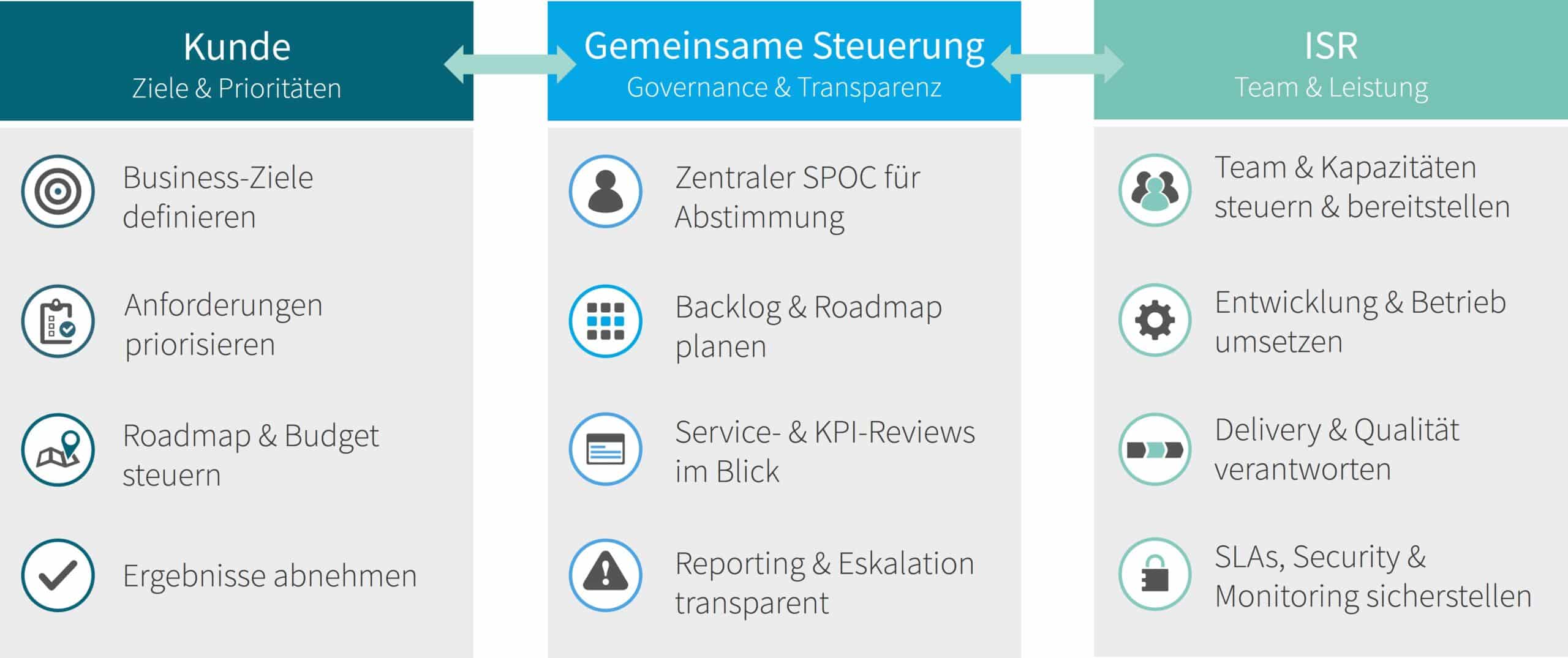
A key difference lies in who assumes which responsibilities.
The client sets the goals and priorities. ISR manages the team and is responsible for delivering the agreed-upon service. This includes providing and managing the agreed-upon resources, ensuring the quality of the results, and overseeing the delivery process. Defined quality, documentation, and handover standards support the traceability of results and the preservation of knowledge. Regular capacity, progress, and performance reports provide transparency regarding the current status and the results achieved.
This allows the customer to maintain professional control without having to coordinate individual resources in day-to-day operations.
Customer
Goals & Priorities-
Define Business Goals
-
Prioritize Requirements
-
Manage the Roadmap & Budget
-
View Results
Together
Governance & Transparency-
Central SPOC for Coordination
-
Planning the Backlog & Roadmap
-
Service & KPI Reviews at a Glance
-
Transparent Reporting & Escalation
ISR
Team & Performance-
Manage & Allocate Capacity
-
Implement Development & Operations
-
Responsible for Delivery & Quality
-
Ensuring SLAs, Security, and Monitoring
ISR manages the team and performance. Our clients set the goals and priorities.
How Managed Capacities Benefits Analytics
For analytics, this model means, above all, that teams, processes, and capacities do not have to be rebuilt from scratch for every new requirement. New data sources, dashboards, or AI applications can be continuously developed, while operations, updates, and data quality remain assured within the agreed-upon scope.
The customer receives predictable capacity that can be scaled as needed. At the same time, the effort required for repeatedly recruiting, training, and managing individual specialists is reduced. A well-coordinated team provides technical and domain expertise, while the backlog, delivery cycles, reporting, and documentation ensure that progress and results are transparent.
When Managed Capacities Make Sense
Managed Capacities are particularly well-suited for analytics organizations where demand consistently exceeds available implementation capacity, where operations and further development compete for the same resources, or where different analytics skills are regularly required.
This model is also a good fit for companies that want to continue setting their own goals and priorities but wish to delegate the composition and operational management of the team, as well as responsibility for the agreed-upon performance, to ISR.
The process begins with a clearly defined scope, the necessary resources, roles, and competencies, as well as shared guidelines for prioritization, quality, reporting, and delivery cycles. Building on this foundation, a continuous delivery process emerges that is aligned with actual needs and can evolve alongside them.
Is Managed Capacities the right model for your analytics organization?
In a no-obligation discussion, we’ll review your current delivery situation and work with you to determine whether Managed Capacities aligns with your requirements, responsibilities, and goals.

Jens Brettschneider
Head of Business Unit
Application Management
jens.brettschneider@isr.de
+49(0)151 422 05 425