Cloud technologies have become an indispensable part of digital entrepreneurship, with more and more companies moving "to the cloud" to optimize their business processes.
Cloud transformation offers companies a variety of benefits, including scalability of IT resources, higher application availability, improved data security, and reduced infrastructure and maintenance costs. In addition, companies that successfully implement cloud transformation can benefit from new opportunities for innovation and faster time to market for products and services.
Overall, cloud transformation is an important step toward a connected and powerful economy that can revolutionize businesses.
What is cloud transformation?
Cloud transformation refers to the process by which companies partially or completely migrate their IT infrastructure and applications from a traditional on-premises infrastructure to the cloud.
This process usually involves an assessment of the company's current IT systems and applications. The aim is to determine which resources can be migrated to the cloud and which cannot. It also involves defining the adjustments required to ensure the migration is successful.
The basis for operating services in the cloud are the so-called cloud hyperscalers, which primarily provide the necessary infrastructure and platform resources.
How is cloud transformation revolutionizing your business?
The cloud provides you with an agile and scalable IT infrastructure, enabling you to respond quickly to changing business requirements and drive innovation. By moving your IT infrastructure to the cloud, you can ensure that your company remains efficient in the future.
Benefits of cloud transformation
- Cost savings The cloud can help reduce the costs of operating and maintaining on-premises infrastructure. With flexible pay-as-you-go billing, you no longer need to purchase or maintain physical hardware.
- scalability The cloud allows you to scale resources as needed without having to purchase expensive hardware or maintain excess capacity.
- availability Cloud providers generally offer high availability and reliability, enabling you to use applications and data securely and reliably anytime, anywhere.
- Security Cloud providers often offer a high level of security and compliance support. This ensures the security of your data and applications without you having to worry about maintaining security infrastructures yourself.
- Collaboration and innovation The cloud enables you to collaborate more quickly and effectively and drive innovation. This seamless connection between users and applications promotes faster time to market for products and services.
- decision-making Cloud transformation enables you to leverage powerful analytics tools to identify trends and patterns in your data, helping you make better business decisions.

In summary, cloud transformation can help modernize your company's IT infrastructure and improve your business capabilities by enhancing the agility, scalability, and availability of your IT resources.
Cloud transformation enables you to focus on innovation and growth, revolutionizing your business.
At ISR, we support your company with a high level of expertise in leading hyperscalers and various cloud operating models.
Cloud transformation—yes, but how do I get started?
In addition to selecting the right hyperscaler, successful cloud transformation requires careful planning, preparation, and implementation. We offer support in this area with our framework based on proven best practices from various cloud hyperscalers such as Microsoft AzureWhat is Azure? Azure is a cloud computing platform from Microsoft. It... More or Amazon AWS.

Successful cloud transformation with ISR
Our framework is based on the experience gained from many successfully implemented projects. Working with the framework clearly highlights the technical, financial, and innovative advantages of the cloud for your company, for example by analyzing your existing digital resources in advance and only then developing a target scenario.
The following are examples of steps in the individual migration phases that we at ISR take into account as part of a cloud transformation project. This ensures that your cloud transformation is successful:
Strategy
- Analysis of motives
- Assessment of the current IT infrastructure and applications
- Identification of IT resources that can be migrated to the cloud, optional upstream PoC projects
- Selecting a suitable hyperscaler
plan
- Streamlining and identifying digital inventory
- Planning the migration to the cloud
enablement
- Employee education and training
- Review of the company's security and compliance requirements with regard to the cloud environment
- Development of the target scenario
migration
- Creating a guideline & project plan
- Use of best practice methods during migration
- Adaptation of applications to the cloud environment as necessary
- Direct implementation of potential process improvements
Operations
- Takeover of the entire cloud environment according to the XaaS model
- Implementation of cloud management tools for monitoring and administration
- Continuous optimization and adaptation of the cloud infrastructure to the changing needs of the company
We divide the activities described above into several interlinked modules, with our Managed Service Kit forming the basis for operations:
- Asses & Design
- Migration & Operation
- Control & Innovate
- Basis: Managed Service Kit
Shared Responsibility Model – an important basis for cloud security
The Shared Responsibility Model is an important foundation for cloud security, as it clearly defines and regulates the responsibilities for security between the hyperscaler and the customer. The hyperscaler is responsible for the security of the cloud infrastructure, networks, and hardware, while the customer is responsible for the security of applications, data, and access rights.
ISR is hereinafter referred to as the customer in the context of a takeover of the entire cloud environment for you as the end customer according to the XaaS principle. Any further separate agreements not shown here will be made between ISR and the end customer—i.e., you.
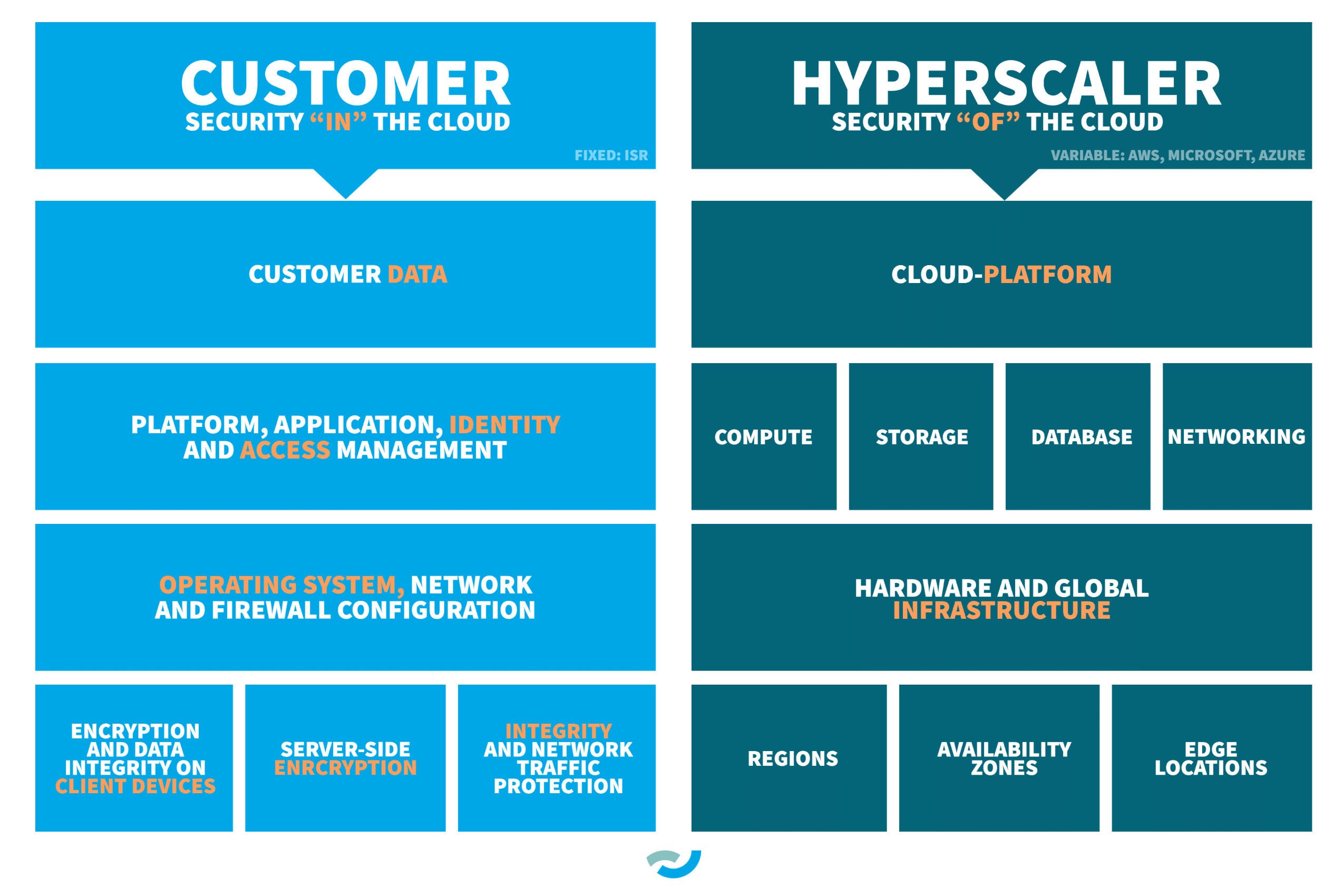
The Shared Responsibility Model helps to create clarity and transparency with regard to responsibilities for cloud security. Clear regulations are also defined for service level agreements (SLAs). At the same time, it obliges the hyperscaler to take the necessary security measures with regard to its infrastructure and services.
Working together in accordance with the shared responsibility model can minimize security risks and prevent attacks on cloud infrastructure and data. This contributes to improving overall cloud security.
Our conclusion
Considering all of the aspects listed above, it is clear that cloud transformation represents a revolution for businesses. Regardless of company size, the advantages of the cloud are indisputable.
Moving services, production, and applications to the cloud offers the potential for significant cost savings, improved scalability, increased flexibility, and high availability.
Security risks are also reduced through the use of cloud solutions. All these factors make cloud transformation one of the best investments companies can make today. Saying "yes" to digital transformation in combination with the right choice of cloud technologies is the cornerstone of future competitiveness. As your transformation partner, we at ISR will work with you to ensure a successful economic future for your company.
You may also be interested in:
Posts not found
Would you like to learn more about our services?

Jörg Fester
Head of IT
joerg.fester@isr.de
+49(0)151 422 06 957