Optimize your business processes with the help of an effective document management system. Take advantage of the synergies between ECLISO and Accounts Payable Flow to increase efficiency and reduce costs.
A document management system (DMS) is a software application that helps companies manage, organize, and share their documents. This includes functions such as document capture, workflow management, document storage, information security, and the ability to retrieve information. This article covers the following topics:
A DMS can store and manage various electronic documents such as PDFs, Word files, and images. However, the real "gold" lies in the accompanying information, the so-called metadata that makes up each document (in addition to the content). This includes, among other things:
- document name
- creation date
- Version
- status
- cost center
- Examiner, etc.
This metadata can either be extracted automatically from the document or added to the DMS through manual tagging. If this is done consistently and uniformly, it helps to speed up document searches. In addition, documents relating to a particular process can be easily grouped together in so-called files, also known as electronic files or e-files. An efficient document management system is therefore the basis for any successful and sustainable company.
The importance of DMS in companies
Document management systems (DMS) are indispensable for companies and offer numerous advantages. One important benefit is the reduction in physical storage space required for paper documents, which saves space, costs, and time. Security also plays a major role, as DMS provides effective protection for sensitive information against unauthorized access and data breaches. In addition, automation increases efficiency by automating everyday tasks such as manual filing and form processing. This allows employees to focus on more productive tasks.
It facilitates collaboration between team members through seamless communication, review processes, and approval workflows. In addition, it allows for easy input, suggestions, and comments on documents to ensure smooth collaboration. The DMS ensures compliance with legal and regulatory requirements, thereby reducing the risk of errors, misunderstandings, and compliance issues. It creates transparency throughout the entire organization by allowing employees to quickly and easily access the documents they need, which improves decision-making and eliminates confusion due to outdated or inconsistent information. This saves time and money, optimizes work processes, increases security, and ensures compliance with regulations. That is why a document management system is an indispensable tool for modern companies.
How does a modern DMS work?
Modern document management systems should have several functions in order to meet the requirements of companies in a digital business world. Some of the most important functions are:
A DMS should be able to capture documents from various sources such as scanners, emails, and file uploads, breaking down complex tasks into smaller parts if necessary.
A DMS should provide secure, centralized storage of electronic documents and image files with access controls and user-based permissions.
The requirements for retrieving documents should be clearly defined to enable fast and effective searching. Document management systems should enable easy searching for documents using metadata, keywords, and full-text search.
Document management systems should facilitate collaboration, communication, review, and approval of work, and enable team members to easily add comments, suggestions, and annotations.
DMS are designed to automate various document-related tasks, such as workflows, approvals, and notifications, in order to eliminate the manual processing of documents and forms.
Document management systems should provide functions for version control, metadata, indexing, and retrievability to facilitate the organization and tracking of documents.
A document management system (DMS) should offer a certain degree of customization so that users can create individual windows and data records, generate fields and reports, customize document attributes, and define workflows and dashboard reports.
Document management system meets digital invoice processing: an example
Modern document management systems should have functions for easy capture, storage, retrieval, backup, sharing, collaboration, workflow automation, version control, and document customization. All of this (and much more) comes into play when using a DMS in combination with digital invoice processing. This results in many advantages through shared synergies, such as reduced paper and manual data entry, increased efficiency, improved security, better collaboration, faster invoice retrieval, integration with accounting or ERP systems, and lower costs.
As a company, we use the ISR Information Office—our own document management system—to carry out our processes digitally. With Contract Manager for digital contract management and the integration of our invoice processing software Accounts Payable Flow, we have centrally linked both contract processing and outgoing invoice processing. This ensures clear traceability of documents and processes, as well as smooth collaboration, improved workflows, and seamless networking of information between systems. Since the 9.1 update of Accounts Payable Flow, the integration of Accounts Payable Flow is also possible in CENIT ECLISO.
CENIT ECLISO is a modern software solution for managing documents and processes on the IBM FileNet Content Manager platform. ECLISO also includes secure archiving, process handling with proxy in the inbox, online and offline use, extensive search and evaluation functions, an integrated viewer for various file formats, and the option to integrate additional systems.
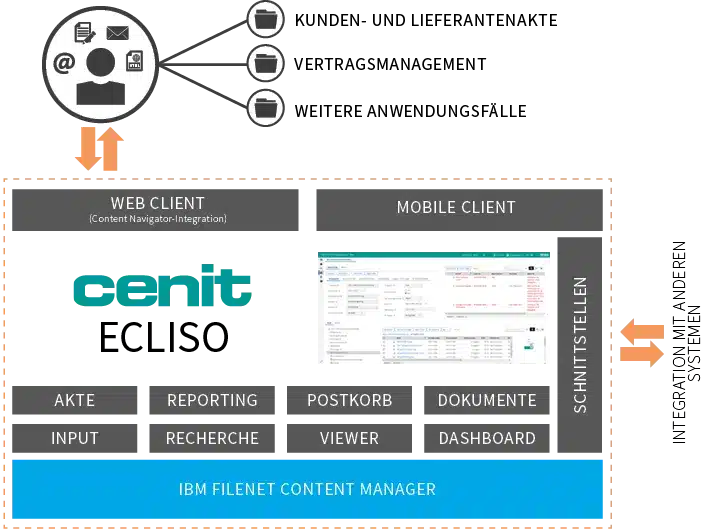
Through the integration of invoice processing, invoices with information such as status, invoice number, supplier name, etc. from purchase orders (FI) and cost accounting (MM) are reliably synchronized as document properties from Accounts Payable Flow into the P8 backend of EclisoECLISO. In ECLISO, the invoices with the properties can be combined with other supplier data in the associated electronic supplier file in a larger context, enabling a holistic view of the supplier in one system.
You can navigate from ECLISO invoices to invoices in Accounts Payable Flow at any time. This is done using the “ShortLink” feature, which allows you to open the invoice directly.
The integration of ECLISO and Accounts Payable Flow provides companies with a smooth and efficient solution for document management and invoice processing. Particularly noteworthy is the fast search function in ECLISO for information on suppliers, including the option to retrieve the corresponding invoices from Accounts Payable Flow. This seamless integration makes it possible to have all relevant information centrally available in ECLISO, which significantly shortens the search process.
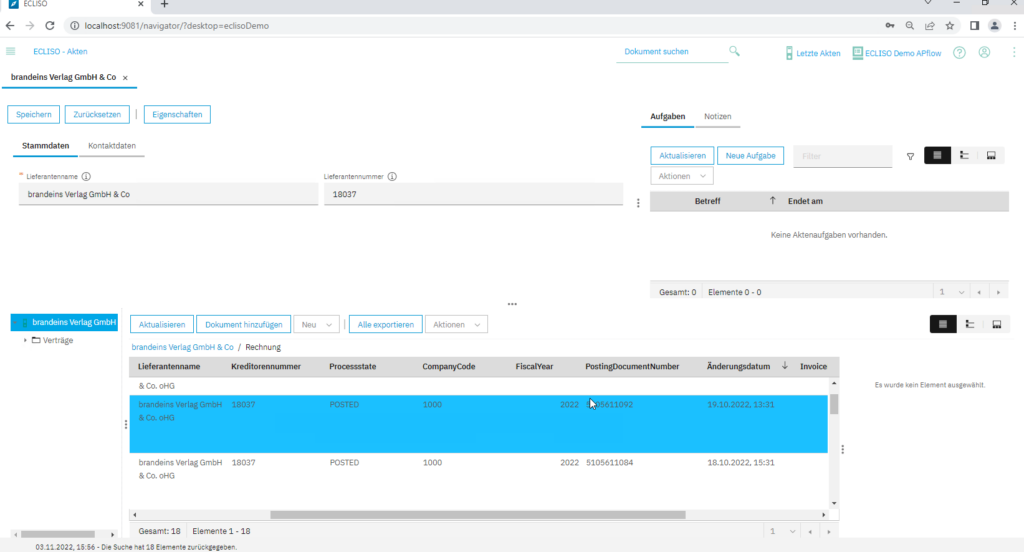
In addition, open and paid invoices can be clearly displayed in ECLISO, enabling transparent presentation of invoice status. This is made possible by the integration of accounts payable flow data, which is updated in real time to give users a clear overview of their financial obligations at all times.
Another major advantage of this integration is that invoices in ECLISO can be easily navigated to the corresponding information in Accounts Payable Flow. What makes this integration special is that ECLISO users do not have direct access to Accounts Payable Flow, but can still access the relevant invoices. User management controls access to the integrated data. This promotes collaboration and information exchange within the company, as relevant information is easily accessible to all parties.
The integration of ECLISO and Accounts Payable Flow improves efficiency and avoids errors caused by redundant data entry in both systems. Real-time synchronization means that all important data is stored centrally in ECLISO, significantly reducing the risk of human error. Overall, this example clearly shows that the integration of both systems optimizes business processes and takes collaboration within the company to a new level.
Have we piqued your interest?
Are you already using ECLISO and want to learn more about integrating Accounts Payable Flow? Or are you looking for an efficient solution that combines a document management system with digital invoice processing and contract management? Then feel free to find out more here on our ISR Software page or contact us directly.

Andreas Carlsen
Senior Manager
Application Management
andreas.carlsen@isr.de
+49(0)15152745125