
IBM is shaking up the FileNet world with Content Cortex. Find out how IBM Content Cortex impacts existing FileNet environments and what companies should be aware of now.
IBM Content Cortex is IBM's next-generation content services platform: The company is integrating IBM FileNet Content Manager, IBM Content Manager on Demand, IBM Content Manager (CM8), and IBM FileNet Image Services into a single technology platform and enhancing them with new capabilities for AI-powered information processing and intelligent automation.
Anyone reading this announcement for the first time will likely ask themselves: What does this mean for me? Do I need to migrate? What will happen to my license? Is there any need to take action right away?
1. What is IBM Content Cortex, and how is it related to FileNet?
2. Evolution Rather Than Replacement: What Will Change, and What Will Stay the Same?
3. What does this mean for your licenses and usage rights?
4. What are the benefits of IBM Content Cortex?
5. What specific steps should you, as an existing customer, take now?
Key Points
IBM Content Cortex combines FileNet Content Manager, Content Manager on Demand, IBM Content Manager (CM8), and FileNet Image Services into a single platform. For long-time FileNet Content Manager customers, the change is essentially a release and name change: the backend, data model, database, and existing user interfaces remain the same, and migration is not required. For customers of CM8, Content Manager on Demand, or FileNet Image Services, the transition is more significant and will ultimately result in a migration with transition periods in the medium term.
What is IBM Content Cortex, and how is it related to FileNet?
IBM Content Cortex is not an entirely new platform. Rather, IBM is bringing together several established content management solutions under one umbrella and developing them further in a targeted manner.
The goal is to enable companies to use AI, semantic search, and intelligent automation securely without fundamentally changing their existing content management structures.
A key component of this is the new AI layer. It ensures that AI agents are integrated into existing authorization and security frameworks. This enables companies to leverage new AI use cases without losing control over sensitive documents and information. At the same time, IBM is consolidating several previously separate content products onto a single platform and continuing to develop them further.
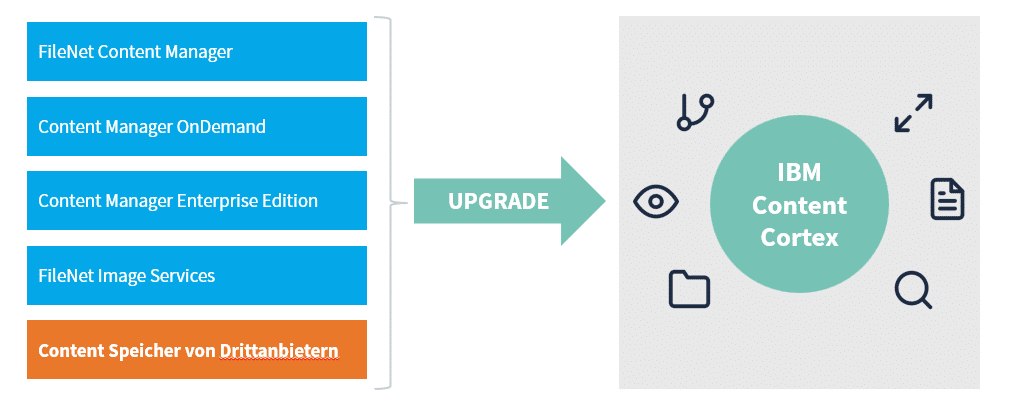
Each of the following platforms has its own strengths and specific use cases for which it is optimized.
A unified content services platform combines the strengths of existing solutions into a single, centralized platform.
Evolution Rather Than Replacement: What Will Change, and What Will Stay the Same?
For existing customers, Content Cortex is primarily an evolutionary step. Existing documents, metadata, authorization models, and applications can generally continue to be used. The extent of the changes will depend primarily on which IBM product is currently in use.
| Product Used | What's Changing | Need for Action |
|---|---|---|
| IBM FileNet Content Manager | Essentially, this is a release and a name change. The backend, data model, database, and user interfaces will remain functional. | Low. – License is automatically switched to Content Cortex Essentials |
| IBM Content Manager (CM8) / Content Manager on Demand / FileNet Image Services | This is a major step, as the backend is being replaced. A compatibility layer will initially ensure that our own applications continue to run. | Plan for a migration strategy early on, including transition and compatibility periods |
| Other Third-Party Content Storage Solutions | Also intended as an upgrade path to Content Cortex. | To be evaluated on a case-by-case basis |
| IBM Business Automation Workflow, Case Manager, Datacap, ODM, RPA | Remains unchanged and is not affected by Content Cortex | No action required |
For traditional FileNet customers, this means, above all, planning certainty. Existing investments are preserved, while new features can be added gradually. This allows companies to plan their next steps at their own pace, rather than having to react on short notice.
Important to know: IBM is not discontinuing anything with Content Cortex. Users who remain on the existing FileNet platform will not lose any functionality. However, new AI-powered features will first be available in containerized environments—so anyone who wants to take advantage of them should plan to transition to container deployments in the medium term.
What does this mean for your licenses and usage rights?
There is also good news for existing FileNet customers regarding licensing: Anyone who currently holds a FileNet Content Manager license can obtain usage rights for the Content Cortex Essentials Edition, depending on their existing licensing model. For customers with Cloud Pak for Business Automation, these usage rights are already included in the license terms. You should review your existing license agreement to determine which provisions apply in your specific case.
It’s worth taking a closer look at your existing contract model: Customers with IBM Cloud Pak for Business Automation already have the necessary usage rights for Content Cortex. For dedicated IBM FileNet Content Manager licenses, the transition may occur automatically depending on your license or subscription agreement, or it may require a contractual adjustment. Reviewing your existing license agreement will clarify this; we’d be happy to work with you to determine which terms apply to your environment.
The Essentials Edition provides the foundation for using new AI features. These include, among other things, improved text recognition, intelligent archiving features, and technical components for the secure integration of AI applications.
The Premium Edition (available since September 2026) comes with a fee: It includes dedicated agents for legal hold, redaction, and document insights; AI agents directly within the user interface; and optional modules such as Enterprise Records or the Salesforce Connector.
Starting in December 2026, additional features are expected to be released to enhance team collaboration and enable the editing of PDF, DOCX, and XLSX files, as well as a no-code agent builder.
For many companies, therefore, the initial focus is not on licensing, but rather on the question of what new possibilities Content Cortex opens up for their existing environment. The good news is that, in many cases, they can get started without incurring additional licensing costs.
Ultimately, it is not the platform alone that determines success, but rather how it is integrated into existing processes and operating models.
"For existing FileNet customers, the focus is not on switching platforms, but on how they can effectively evolve their existing environment. This is precisely where IBM Content Cortex offers new possibilities."
Christoph Sünderkamp | Business Team Lead | Document Logistics
ISR Information Products AG
What are the benefits of IBM Content Cortex?
For existing FileNet customers, the greatest benefit lies not in a short-term platform switch, but in the targeted enhancement of their existing environment. Companies can continue to use proven document management and archiving functions and expand them in a targeted manner to include AI-powered search, intelligent information retrieval, and automated processes. Existing documents, permissions, and integrations are generally preserved.
As an existing customer, what specific steps should you take now?
The general direction is clear, but the specific next steps will depend on your individual situation. The IBM products you use, the structure of your FileNet environment, the integrations you have in place, and your modernization and AI goals will significantly influence the most appropriate path forward.
This is exactly where we’re already helping many companies today. Together, we assess existing FileNet environments, evaluate the impact of IBM Content Cortex, and develop a roadmap tailored to each company’s current level of modernization and business objectives.
Is there an urgent need for action?
As reassuring as the short-term situation may be for most existing customers, Content Cortex marks the beginning of an ongoing evolution that IBM will consistently drive forward in the coming years. While those who remain on the traditional, non-containerized platform will continue to receive support, they will not automatically receive new features—these will first be released in container mode. The right time to take the next step is therefore less a question of “if” and more a question of “when.”
A typical example: A company currently uses IBM FileNet Content Manager to manage its contract files. With Content Cortex, this environment remains essentially unchanged. New features—such as intelligent search or AI-powered document analysis—can be added incrementally as needed. This allows companies to test initial AI use cases without having to fundamentally overhaul their existing platform.
In practical terms, this means for you:
- There is no immediate need to take action; your environment continues to run smoothly.
- In the medium term, it is worth evaluating your own target architecture, especially if you plan to use AI features and container-based deployments in the future.
- Anyone using FileNet Image Services, Content Manager on Demand, or IBM Content Manager should develop a migration strategy early on, rather than having to react at the last minute.
- While mixed environments consisting of the old FileNet front end and the new Cortex back end are technically possible, our experience has shown that they introduce additional complexity and should therefore be carefully evaluated.
Operations for Your Content Cortex Environment
Introducing new technologies is only part of the challenge. It is equally important to further develop existing platforms in a meaningful way and ensure their long-term operational stability. This is exactly where we support our customers—from strategic assessment through architecture and technical implementation to operations and application management.
Upon request, we can also take over the complete operation of your FileNet or future Content Cortex infrastructure—from monitoring to change and patch management to rapid troubleshooting—with a dedicated service manager serving as your central point of contact. This way, you not only retain control over your existing environment but are also well-prepared when the time comes to take the next steps in modernization.
Frequently Asked Questions
IBM Content Cortex is the next generation of IBM Content Services and builds on the existing platform for FileNet Content Manager customers. Rather than providing a complete replacement, IBM is further developing FileNet technologically and enhancing the platform with new capabilities for AI, intelligent automation, and modern user interfaces.
Not necessarily. For companies using IBM FileNet Content Manager, Content Cortex is essentially just a release and name change—existing repositories, data models, and applications can generally continue to be used. A more significant need for migration exists primarily for users of IBM Content Manager (CM8), Content Manager OnDemand, or FileNet Image Services.
For existing FileNet Content Manager customers, licenses will be automatically converted to the Content Cortex Essentials Edition at the same price point. Customers with Cloud Pak for Business Automation also already have the necessary usage rights. Additional licensing costs will only apply if you wish to use the advanced features of the Premium Edition.
Most FileNet customers are not under immediate pressure to take action. However, those who wish to use new AI features, agents, or container-based deployments should review their existing ECM landscape and their own modernization strategy early on. This will allow them to plan for future developments in a targeted manner and implement them step by step.
Yes. For FileNet Content Manager customers, existing documents, file structures, metadata, and permission schemes are generally retained. Content Cortex builds on these existing structures and enhances them with new features rather than replacing them.
Next Step: Assess Your Current Situation
Would you like to know exactly what IBM Content Cortex means for your FileNet environment, your licenses, and your roadmap? Talk to us. Together, we’ll assess your current situation during a FileNet Roadmap Check, review dependencies, and develop a strategy that fits your pace—without rushing into anything.

Jens Brettschneider
Head of Business Unit
Application Management
jens.brettschneider@isr.de
+49(0)151 422 05 425