
Digital Transformation
Digital Transformation
Rewriting your company's DNA
Digital transformation gives companies the opportunity to fundamentally reposition themselves. Through the use of advanced technologies and data-driven approaches, processes, business models, and corporate culture can be comprehensively optimized. This transformation makes it possible to tap into hidden potential and prepare for future challenges in an agile manner. It is like a profound restructuring in which the DNA of your company is redesigned to be successful in the digital era.
Table of Contents
- What is digital transformation? A definition
- What are the key elements of digital transformation?
- Digital transformation vs. digitization
- Why is digital transformation so important for companies?
- An example – Digital transformation in the logistics industry
- Challenges of digital transformation
- 10 success factors and strategies for digital transformation
- How do we provide concrete support to enterprises?
- Your Point of Contact
What is digital transformation? A definition
Digital transformation describes the constant change in the age of digitalization. Digital technologies are constantly evolving in society and the business world, leading to fundamental changes in traditional business models, customer experiences, and operational processes. The process began when numerous new technologies made new types of information and functions accessible in innovative ways (such as mobile devices, social media, cloud computing, and IoT).
At its core, digital transformation is about adapting and advancing internal company processes. The goal is to create a robust technical foundation that improves efficiency and agility. This transformation requires the seamless integration of new technologies into existing systems and ways of working through the development of effective strategies.
Overall, digital transformation aims to make companies competitive in the long term by enabling them to adapt flexibly and quickly to changing market conditions and customer expectations. For this to succeed, not only must a fundamental change take place within the corporate culture, but a clear vision and strategy must also be supported and communicated by management.
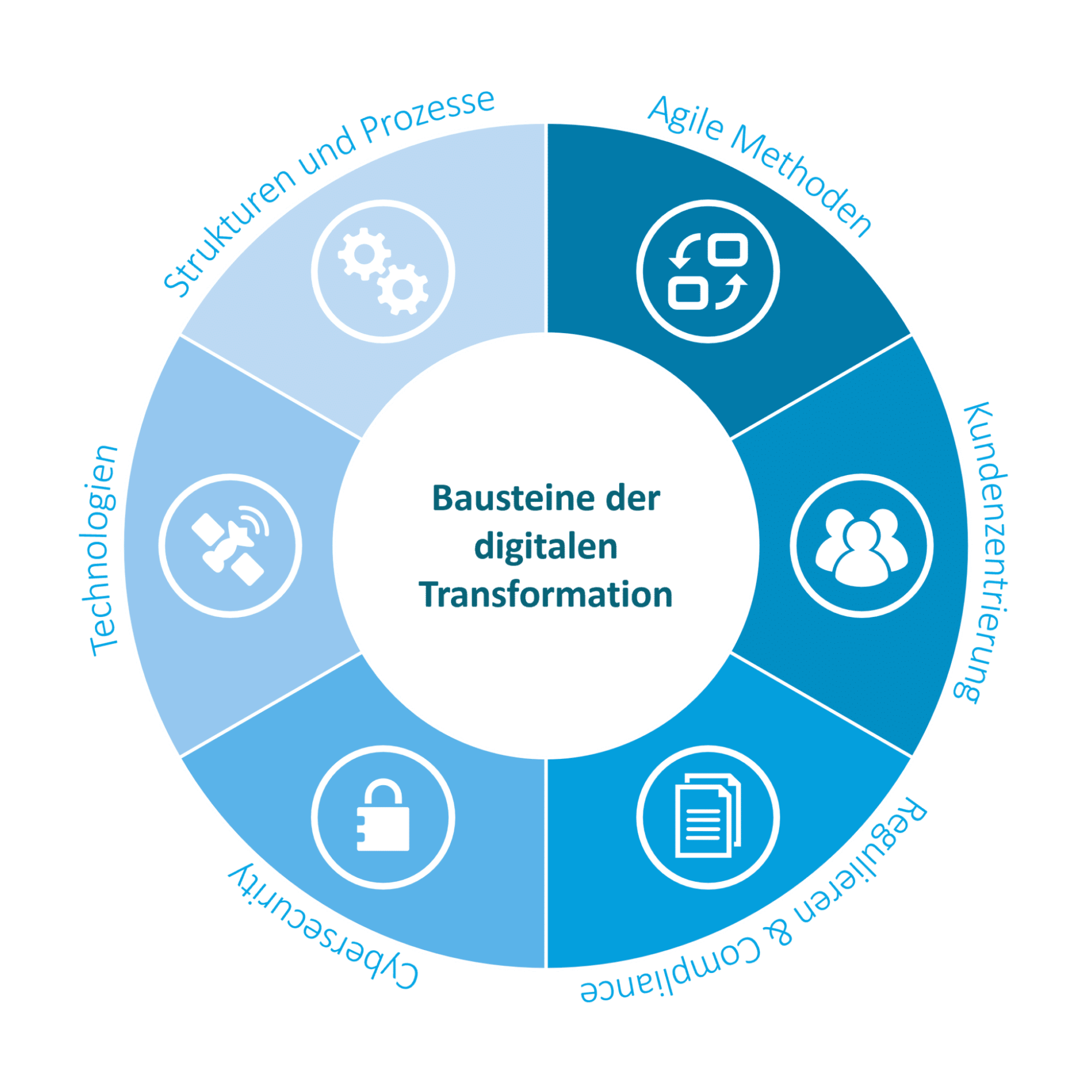
What are the key elements of digital transformation?
Several key elements are required for a successful digital transformation are required.
- Technologies: Technologies are crucial for digital transformation because they automate processes, provide real-time data, and improve collaboration. Examples include cloud computing, artificial intelligence, and big data.
- Structures and processes: Digital transformation creates efficient structures, simplifies workflows, and opens up new opportunities through more precise and faster digital processes.
- Agile methods: Agile methods promote flexibility, innovation, and continuous improvement, which are crucial for the success of digital projects.
- Customer centricity: Digital transformation strengthens customer relationships, increases customer satisfaction, and gives companies a competitive advantage.
- Regulation & compliance: It ensures that technological developments are legally compliant, protects against legal risks, and strengthens trust in digital solutions.
- Cybersecurity: Cybersecurity ensures the security of data and systems, promotes trust, and minimizes the risks of digitalization.
Digital transformation vs. digitization
Both in digital transformation and digitization , digital technologies are used. The two terms are often closely related and used synonymously.Nevertheless , a difference between these two terms.
Digital Transformation
Digital transformation relies on a holistic change in working methods and corporate culture through the introduction of new technologies. New business models and new working methods (such as agile methods)are emerging, influencing all areas of a company. Digital transformation pursues the goalto solve with technical means and thus simplify or speeding up.
Digitalization
Digitalization describes the process of converting analog aspects to digital ones or process.. For companies, this means specifically promoting the automation of workflows ,so that time and costs can be saved. Digitization within a company simplifies the way we work by increasing efficiency the way we work by increasing efficiency and simplified, digital processes. A simpleexample example isthat that the bill is notin sent in paper form sent ,, but as PDF document or (even better) as einvoice .
Digital transformation is like the transition from a traditional village to a connected metropolis. Old paths are replaced by smart roads, and houses are connected by invisible threads that exchange information at lightning speed.
People use flying cars and high-speed trains instead of carriages. Mail is replaced by digital messages that arrive in seconds. Businesses are connected by transparent domes where ideas flow freely. Smart machines solve problems and are constantly learning.
Digital transformation is like switching from a hand-drawn map to an interactive 3D navigation system: clearer, faster, and easier. A dusty attic becomes a modern loft full of possibilities. This is how digital transformation makes companies future-proof and more efficient.
Imagine an old steam locomotive slowly and laboriously chugging through the countryside—it symbolizes traditional, analog processes. The engineer has to regularly add coal and operate the technology manually, which makes operation sluggish and inefficient.
Now visualize a modern high-speed train traveling elegantly and quickly on a perfectly constructed track. This train represents digitalization: it uses automated systems and modern technology to travel efficiently and precisely, with optimized processes and real-time data processing.
The steam locomotive represents the analog world, while the high-speed train represents the digital world, in which technological advances and automation simplify and accelerate processes.
Can digital transformation work without digitization? Short answer: No. Digital transformation requires digitization as its foundation. Without the fundamental digital technologies and processes provided by digitization, it is not possible to achieve the profound changes and innovations that accompany digital transformation.
Why is digital transformation so important for companies?
Digital transformation provides companies with a host of advantages that enable them to remain successful in an increasingly digitized world. Here are a few reasons why change is essential:
- Cultural challenges and change management: Change is fundamentally difficult for people who cling to their habits. Digital transformation is significantly changing corporate culture, creating new circumstances that can influence corporate values. This can result in a lack of willingness or acceptance of change brought about by new technologies. Strategies need to be developed to make the transition supportive and pleasant.
- Data protection and data security: The increased use of new technologies enables greater data collection of both company-related and personal information. For this reason, companies are obliged to take data protection measures to ensure that data is protected. Various data protection laws provide an important basis for this. Failure to comply can result in legal consequences.
- Skills shortage and skills development: Digital transformation requires skilled workers, who are in short supply in most companies. The majority of skilled workers do not have the technical skills required for digitalization. It is therefore essential that skilled workers receive targeted training and further education in their technical skills so that sufficient resources are available.
- Integration of existing systems: Integrating new systems with existing ones can be complex. To ensure that processes and procedures within the systems can cooperate smoothly, detailed planning and coordination of the changeover is required in advance. IT service providers such as ISR can assist with this process to ensure a smooth transition.
- Regulatory requirements: Digital transformation also involves a series of laws and guidelines that companies must comply with when integrating digital technologies. In addition to data security, fair competition requirements and ethical standards are also clearly defined in legislation such as the GDPR.
Blog Article
IT transformation with external support
Those who view IT transformation merely as the acquisition of new computers and infrastructure are taking a short-sighted approach. IT transformation extends far beyond merely modernizing technical equipment; rather, it involves adapting the entire organizational structure and corporate culture to digital requirements – encompassing business models, processes, and personnel.
Example
Digital transformation in the logistics industry
In the context of B2B business, the logistics industry is undergoing a profound digital transformation that goes far beyond traditional transportation. Thanks to mobile devices, business process management (BPM), and advanced technologies, companies are optimizing their processes, offering customers added value, and promoting employee collaboration.
The logistics industry demonstrates how these technologies are profoundly changing business. Mobile devices and GPS tracking allow drivers to be monitored in real time. An app enables drivers to report the location of their cargo and adjust routes, while customers can view delivery status at any time via a web portal.
A comprehensive BPM system automates all logistics processes, from order acceptance to invoicing. This reduces processing times, minimizes errors, and increases customer satisfaction. Cloud technologies and collaborative platforms improve cooperation between warehouse staff, drivers, and management. Information is shared in real time and solutions are developed jointly. AI and big data analytics help to anticipate potential problems and take proactive measures. Traffic data is analyzed and alternative routes are suggested before delays occur.
Digital transformation brings numerous advantages: real-time shipment tracking, rapid response to unforeseen events, reduced operating costs through automated processes, and data-driven decisions. Logistics companies that adapt to these developments secure a competitive advantage and offer their customers real added value.

There is no alternative to digital transformation, just as there was no stopping the development from horse-drawn carriages to automobiles. New digital business models, the further and continuous automation of processes, and the advent of AI will continue to advance. There are companies that are taking this path and surviving, and there are companies that are not adapting quickly enough and will go under!
Mark Hommola
Division Head | Business Process Automation
Challenges of digital transformation
Digitalization is digitization is new new advances and developments and thus presents companies with the task of keeping pace with this change in the form of digital transformation continuously activelyactively shaping. This restructuring also also presents challenges. These include:
Change is fundamentally difficult for people who cling to their habits. Digital transformation is significantly changing corporate culture, creating new circumstances that can influence a company's values. This can result in a lack of willingness or acceptance of change brought about by new technologies. It is important to develop strategies that support the transition and make it as smooth as possible.
The increased use of new technologies enables increased data collection company-related, but also personalinformation. For this reason , companies areto to implement data protection measuresto ensure the protection of data is ensured. There are various data protection laws that form an important foundation . In the event of non-compliancemay result in legal consequences.
The digital transformation requires qualified specialists, who are only available in limited numbers in mostcompanies. The majority of specialists do not have the required technical skills result from digitization .. Therefore, it is essentialthat specialists receive training and further education in their technical skills through training and continuing education so that sufficient resources are available.
The integration of new systems into existing systems can be complex. To ensure that processes and workflows within the systems can ,, it is necessary to carry out detailed planning and coordination of the transition. IT servicecompanies, such as ISR, can provide support during this processto ensure a smooth transition.
Digital transformation also involves a series of laws and guidelines that companies must comply with when integrating digital technologies . In addition todata security, fair competition and ethical standardsstandards in the legislation, as the GDPR, defined defined.
10 success factors and strategies for digital transformation
1: Think big – start small:
Digital transformation is leading to major changes that cannot be implemented overnight in a "big bang." It is a long-term process of change that is most successful when you set ambitious goals but achieve them in small, prioritized steps.
2: Create a culture of change and allow mistakes:
For the success, it is particularly important to create a culture of change and break down old structures. The goals, strategies, measures, and especially their benefits must be communicated to employees in a comprehensible manner.. . Remember: far-reaching changes are never easy! Therefore ,address your employees'fears constructively and allow mistakes, because mistakes are a learning opportunity.
3: Create a culture of innovation instead of a culture of optimization:
Digital transformation thrives on innovative ideas. So don't shy away toquestion the status quo and look at your business from different angles. You should therefore promote a culture of innovation in your company and give all employees the necessary skills.
4: Methodology in the project is more important than ever before:
Digital transformation is leading to an increasingly interconnected world that is becoming more dynamic, complex, and unpredictable. In order to optimize the potential of project teams, agile project management is becoming increasingly relevant, and methods are being modified or newly created.
5: Digitalization requires absolute management commitment:
For the successful implementation of digitization strategies, management must involve all employeessupport in achieving their goals and create the necessary freedom. Digital transformation can only succeed if all stakeholders (management, employees,, customers, partners, and suppliers) recognize the benefits of digital transformation and are convinced thatthat the path taken is the right one.
6: Organization is key:
Digitalization means change. The challenge here is not necessarily technical, but rather organizational in nature. The important thing is to have the right organization and strategy: the way in which technology is integrated into business processes and introduced into your company. To make digitization projects effective, you need employeeswhowho think "think digitally" and are prepared to question processes holistically.
7: Digitalization means radical alignment with customer needs:
Customers today expect a high degree of digitalization. They choose the company that meets their needs meets. Focusing on customer needs is therefore essential in the context of digitalization. Continuous observation and analysis of customers, competitors, and markets is a mandatory requirement. This enables a quick response and adaptation to upcoming changes and trends, as well as successful exploitation of digitalization potential.
8: Simplify, digitize, and automate internal processes:
Internal processes play a fundamental role in digital transformation. These must be optimized, digitized, and automated. This not only increases efficiency and flexibility, but also reduce costs and save time.
9: Act instead of react:
Companies should not "wait" for an event that then forces them to react, but should take action beforehand. This way, they can ideally help shape or even create the event. With potential that digital technologies offeroffered by digital technologies, action must be taken at an early stage. In today's fast-paced world, simply focusing on competitors or market leaders is no longer sufficient.
10: Service orientation is a paradigm shift:
The strict implementation of a service-oriented principle makes it possible to incorporate and fulfill customer requests in the form of compact services . For the organization, this means that they can bring services to market much faster, test them, and continuously adapt them to user requirements. The idea can be constantly questioned and further developed, enabling much faster adaptation to external influences or new technologies.
We offer the following consulting services
Digital transformation




How do we provide concrete support to enterprises?
With more than 30 years of processexpertise,business are the business process management and the development and implementation of manufacturer-independent EIMsolutions related to documentlogisticslogistics (including input, workflow and document management systems) are integral parts of our comprehensive range of services. This means we are ideally positioned to cover all aspects of business process management endtoto–end . With the help of oursolutions, we support you in designing, optimizing, and implementing your processes efficiently and solutions, we support you in designing, optimizing, and implementing your processes efficiently and effectively. Not all business processes can be easily modeled with rigid workflows. Our approach here is to integrate your individual processes into your applications.
Get in touch with us now
We would be pleased to advise you.

Cihan Klingsporn
Senior Account & Marketing Manager
Document Logistics
cihan.klingsporn@isr.de
+49(0)151 422 05 471