Document Management
document management Precision on cue: your clockwork for document management!
Imagine your office running like a well-oiled machine, where all information flows smoothly. Document management is the key to this efficient process. It ensures that all electronic documents—whether PDF, image, or text—are systematically organized, easy to find, and efficient to use.
With a modern document management system, you can transform the jungle of paper and digital records into a clearly structured landscape. Your documents are not only stored, but also intelligently managed so that you can access them anytime, anywhere. Say goodbye to chaotic filing systems and long searches! Effective document management can facilitate access to information, support collaboration, and ensure high security standards. Discover the benefits it offers for your daily work and long-term organization.
Table of Contents
- What is digital document management? A definition
- Why is document management important for companies?
- Benefits that count: Why efficient document management is essential
- Frequently asked questions about document management
- In which areas of a company can document management be applied?
- Digitization in document management: A practical example from the real estate industry
- How do we provide concrete support to enterprises?
- Your Point of Contact
What is digital document management? A definition
Document management encompasses the systematic organization, management, and storage of electronic documents using database-supported software systems. These systems enable documents to be organized efficiently regardless of their format or content. This includes functions such as storing, searching, editing, sharing, and deleting documents.
An essential component of document management is the addition of an archiving function. This not only manages documents, but also stores them in a long-term and audit-proof manner, so that they can be found at any time and deleted in a legally compliant manner.
The aim of digital document management is to optimize work processes, create transparency, and ensure the availability of information—both during ongoing operations and for historical or legal purposes.
Why is document management important for companies?
Document management is essential for businesses as it significantly improves efficiency, cost structure, and security. A digital system enables quick organization and access to documents, saves time, and automates recurring tasks. This reduces costs for paper, storage, and inefficient work processes, while increasing productivity. At the same time, it promotes collaboration as teams can access documents in real time and track changes transparently.
Compliance with legal requirements is also facilitated by a document management system, as it ensures audit-proof storage and protection of sensitive data in accordance with data protection guidelines. It also protects digital documents from loss and physical damage and enables easy backups, which strengthens business continuity. Finally, the system contributes to sustainability by reducing paper consumption and lowering the ecological footprint.
Efficient document management is therefore a strategic necessity in order to optimize workflows, minimize risks, and meet modern requirements for flexibility, security, and sustainability.
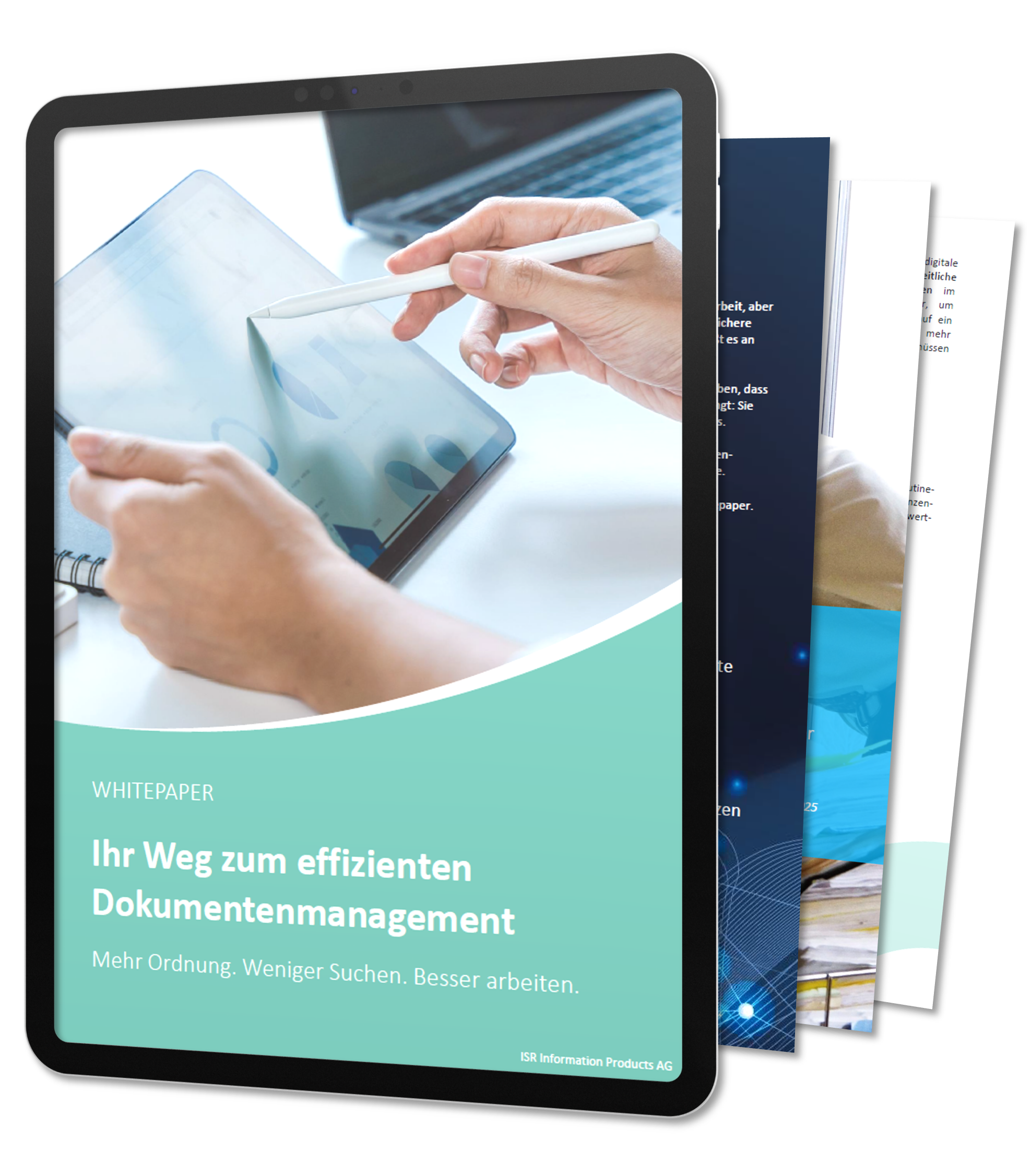
Whitepaper
Your Path to Efficient Document Management
Advantages that count:
Why efficient document management is essential
A digital document management facilitates the handling of information in everyday work, increases efficiency, and promotes collaboration. It ensures transparency, security, and flexibility—crucial advantages for companies in the digital age.
Location- and time-independent working
Document management enables the use of cross-location teams, thereby promoting flexibility in everyday work. All relevant information and applications are available at all times via a digital workplace. This not only facilitates the exchange of knowledge and documents, but also enables efficient collaboration on projects and the holding of online meetings.
Greater transparency and process efficiency
Structured storage of all information and documents ensures greater transparency in work processes. Centralized data storage makes it easy to find documents, forward them quickly, and share them. This leads to a significant increase in process efficiency and minimizes delays in the provision of information.
Better collaboration and high traceability
The central data storage of a digital document managementfacilitates makes it easier to share documents and promotes collaboration. Functions such as versioning and logging ensure that changes are traceable and that previous versions can be accessed at any time. This ensures consistent and transparent document management.
Ensure compliance with SLAs and deadlines
Integrated deadline management with escalation levels supports document management.document management supports compliance with service level agreements (SLAs) and other legal or organizational requirements. Deadlines and appointments are always kept in view, ensuring timely action.
Quick familiarization and flexibility
Thanks to an intuitive user interface and simple handling, new employees can work efficiently with document management after just a short introduction.document management . At the same time, the system offers a high degree of flexibility, as all information is available around the clock and from any location.
Low maintenance and high security
The central administration of digital document management system ensures minimal maintenance effort. A finely graded rights concept and detailed logging functions also guarantee the security of stored documents and protect sensitive data from unauthorized access.
Frequently asked questions about document management
A document is a written, digital, or physical record of information that serves as evidence, reference, or means of communication. It can consist of text, images, diagrams, tables, or other content, and is often created to record knowledge, meet legal or organizational requirements, or share information.
Documents can come in various forms, including physical papers such as letters, contracts, or reports, as well as digital records such as PDFs, Word documents, or emails. They are important in various contexts, such as legal, business, scientific, or personal contexts, and are often used to structure, archive, or verify content.
Document digitization converts paper-based documents into digital formats and begins with preparation, such as sorting and removing obstacles. Using scanners and software, often with optical character recognition (OCR), the documents are scanned, made searchable, and saved in formats such as PDF. They are then organized, named appropriately, and stored in secure systems such as a document management system (DMS), often supplemented with metadata for better searchability.
Regular backups and access rights protect data, while legal retention requirements are checked before physical documents are securely destroyed. Training employees and adapting work processes ensures that digitization is used to its full potential. It increases efficiency, saves costs, and supports sustainable business processes.
A document management system (DMS) must meet various legal requirements in order to be legally compliant. The General Data Protection Regulation (GDPR) requires that personal data be stored securely, accessible only to authorized persons, and deletable upon request. The DMS should also log changes to data in a traceable manner. The principles for the proper management and storage of books, records, and documents in electronic form (GoBD) require that tax-relevant documents are audit-proof, remain unchanged, and are stored for up to ten years. The accounting requirements in the German Commercial Code (HGB) and the German Fiscal Code (AO) also require transparent documentation and traceability.
In recent years, various technologies have had a significant impact on document management.
Artificial intelligence (AI) has improved through machine learning and automatic data extraction, which facilitates the recognition and categorization of document content. Optical character recognition (OCR) has advanced, allowing scanned documents to be converted more accurately into searchable and editable formats. Cloud technologies are revolutionizing document storage and access, enabling flexible, location-independent access and promoting collaboration. Automation tools and workflow management systems optimize processes by automating routine tasks and increasing efficiency. Mobile applications make it easier to use document management systems on the go, which is particularly important in today's flexible working world. Finally, security solutions such as encryption and blockchain technology have made document management more secure by ensuring the integrity and confidentiality of data.
Together, these technologies contribute to more effective, flexible, and secure document management in companies.
Document management
as a source of knowledge and information within the company

In which areas of a company can document management be applied?
- Administration and organization: Document management systems support the efficient management of employee files, contracts, and guidelines. They enable the automation of processes such as onboarding in HR and the audit-proof archiving of documents in the legal department.
- Finance and accounting: Invoices, tax documents, and reports can be processed and archived digitally. This facilitates compliance with legal requirements and simplifies audits by providing quick access to relevant documents.
- Sales and customer service: Customer files, contracts, and quotes are managed centrally, which improves customer communication. Integration with CRM systems provides a comprehensive overview of customer information.
- Purchasing and logistics: Supplier contracts, orders, and shipping documents are managed centrally. This optimizes the procurement process and ensures traceable documentation of supply chains.
- Production and quality management: Technical documentation, manuals, and drawings are securely stored and versioned. In addition, compliance with quality standards is supported by complete documentation.
- Research and development: Research results, patent applications, and development documents are protected and versioned. This facilitates collaboration and the protection of sensitive information.
- Marketing: Campaign documents, media files, and content assets are organized to ensure consistent brand communication. Linking to project management tools creates additional clarity.
- IT department: IT processes, system architectures, and service contracts are documented. This supports compliance with security guidelines and facilitates the management of license agreements.
- Project management: Project plans, reports, and changes are stored and versioned centrally. This promotes collaboration and ensures structured filing.
- Management level and strategy: Strategic documents and reports are managed efficiently, with confidentiality maintained through controlled access rights.
Overall, a document management system offers advantages such as efficiency, transparency, and security in every area, while also facilitating compliance with legal requirements and optimizing work processes.
Digitization in document management
A practical example in the real estate industry
In private real estate financing, companies face the challenge of designing their processes efficiently while also meeting the requirements for digital solutions. A key problem is often the overload of paper files, which not only take up valuable space but also significantly increase processing times. Against this backdrop, companies are increasingly opting for modern document managementsystemsystem to overcome these challenges and sustainably increase the efficiency of their business processes.
The first goal of the transformation is to eliminate all paper files in order to reduce space requirements and create a modern working environment. In this context, the digitization of all existing and new documents is of central importance in order to ensure audit-proof storage and compliance with legal requirements. Another crucial aspect is reducing delays in document management. Employees should be able to access information and make decisions more quickly, which ultimately increases the efficiency of the entire organization.
Measures: To achieve these goals, a comprehensive project to introduce the DMS must be initiated. This requires a thorough analysis of existing business processes in order to identify inefficient procedures and replace them with optimized processes. On this basis, an electronic financial project file will be developed that will enable all relevant documents and information to be managed centrally and digitally.
A crucial step involves integrating an electronic file into the existing business process management (BPM) software. This seamless connection providesensures that all process participants have access to the necessary information at all times, significantly increasing processing speed. Digital storage of all incoming and outgoing documents not only reduces space requirements, but also ensures structured and efficient data organization. The processing speed of transactions has been reduced from several days to a few minutes. The elimination of paper-based processing has noticeably reduced the workload for employees, who now have more time for other activities. Further advantagesinclude include the creation of new solutions for technical requirements and mobile working. Employees can now work flexibly and access all relevant data from external locations.
The technologies used to implement the project played a decisive role. Powerful document management software enabled efficient management and organization of electronic documents, while modern BPM tools were used to model and automate business processes. These innovative solutions contributed significantly to increasing efficiency and optimizing workflows within the company.
In summary, it can be said that the successful introduction of a document management system in private real estate financing has not only significantly increased the efficiency of business processes, but also created a modern and flexible working environment that meets today's requirements. This practical example impressively demonstrates how the digitization and automation of business processes can bring about a sustainable change in working methods.
In the field of Document Management, we rely on these
TECHNOLOGIES



We offer the following consulting services
Document management




How do we provide concrete support to enterprises?
We support our customers in the area of document management by contributing our expertise and many years of experience—with the aim of offering tailor-made solutions. By optimizing work processes, we help to replace manual, time-consuming procedures with digital workflows and increase efficiency.
We ensure compliance with legal requirements, such as audit-proof archiving and data protection, and offer modern, scalable technologies that can accommodate growingn business needsn . Our solutions also help reduce costs by cutting paper consumption and storage costs.
Our team offers comprehensive support to ensure a smooth transition. We develop customized solutions that are specifically tailored to the needs of our customers. This means that we are not only a technology provider, but also a long-term partner for digital transformation and process optimization.
Consulting in the field of
Document management
Are you looking for an optimized method to manage your documents and simplify your work processes? We offer customized consulting and suitable solutions in the field of document management.
Get in touch with us now
We would be pleased to advise you.

Mark Hommola
Head of
Document Logistics
mark.hommola@isr.de
+49(0)151 422 05 426