Enterprise Information Management (EIM)
More than content management
Holistic integration of information using EIM
How can companies manage information in a way that not only creates order but also generates real added value? Enterprise Information Management (EIM) provides the answers. The approach goes far beyond conventional data management methods and combines structured and unstructured data, automates processes, integrates artificial intelligence, and ensures compliance in an increasingly complex environment.
Whether you want to optimize your business processes, use data analysis strategically, or deploy innovative technologies such as intelligent document processing, EIM opens up many possibilities. Here, we would like to show you how holistic EIM solutions can help you achieve sustainable competitive advantages.
explained simply What does EIM mean?
Enterprise Information Management (EIM) helps companies systematically structure, manage, and use information. The holistic approach ensures that data is available across departmental and system boundaries and can be used optimally.
EIM not only takes into account unstructured or semi-structured documents such as contracts, reports, presentations, emails, website content, multimedia files, forms, etc. Structured information, such as that typically stored in databases, tables, and specialized applications, is also considered in this comprehensive strategic concept. The aim of this approach is therefore to optimize data in a format-independent manner and to ensure its uniform use and management through central control of components and configurations. Information from multiple systems and departments can then be used to increase efficiency and create transparency through precise data analysis.
Enterprise information management enables business insights. It helps manage the complex flood of information within the company, improve ongoing business processes, and at the same time ensure compliance with legal requirements for information systems.
at a glance What sets EIM systems apart
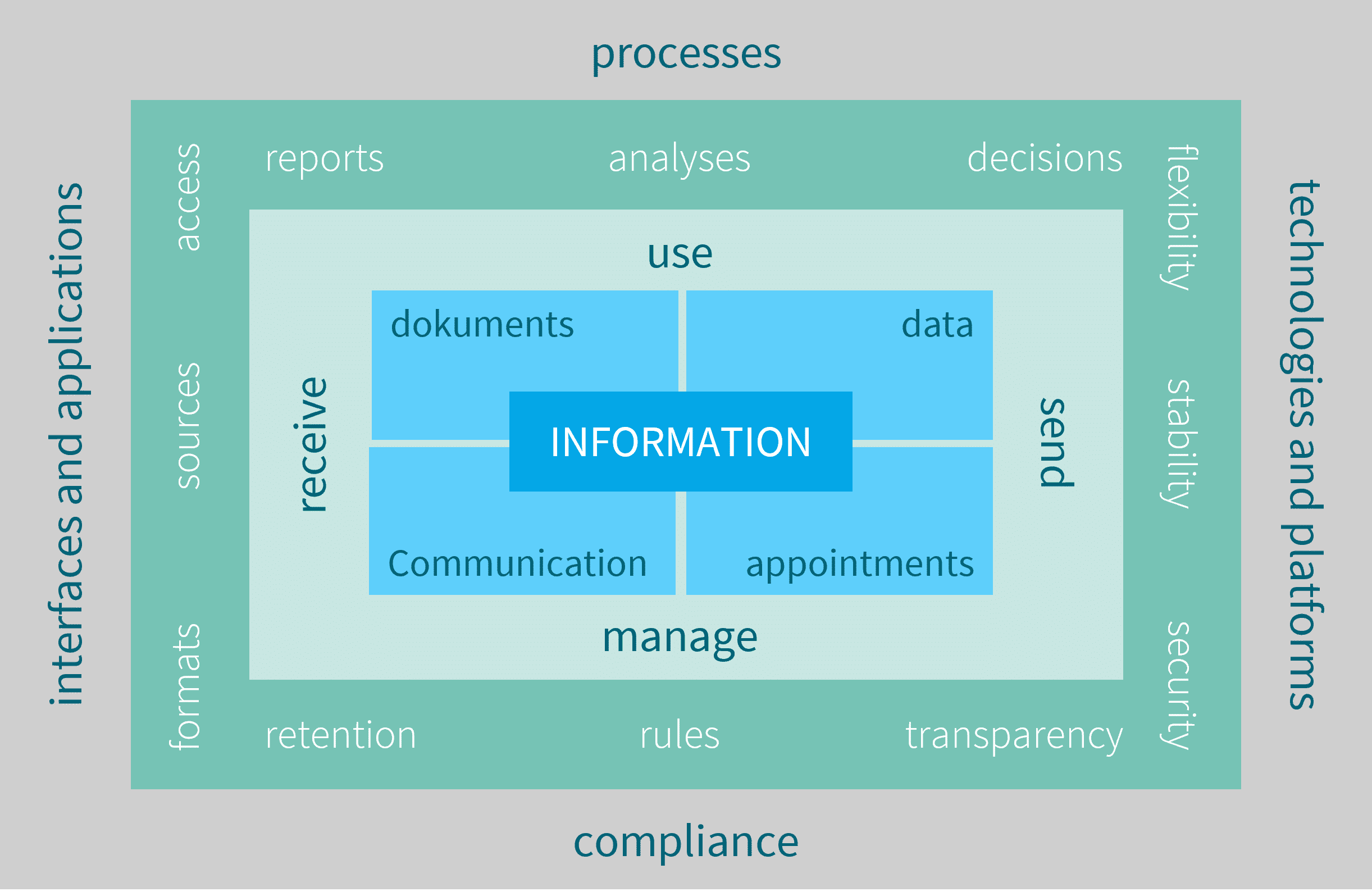
Our graphic clearly shows that information plays a central role in companies. New value can be created through the harmonious integration of effective interfaces, structured processes, modern technologies, and clear compliance rules. In the EIM approach, information is not only managed, but also actively used to achieve business goals.
Today, companies receive data in various formats, from a multitude of sources, and with specific access permissions via various applications or interfaces. This diversity requires systematic and efficient handling in order to organize information effectively and make it accessible.
In order to use it for decision-making and process improvementswithin the company, the collected information is processed into reports, analyses, and dashboards based on consolidated and transparent data sources.
At the same time, you must ensure that compliance requirements are met. This requires the definition of retention periods in archives and communication rules for data security. Transparency is crucial here: all relevant information must be available exactly where it is needed – at any time.
But EIM does not end with internal management. Companies must also be able to communicate information securely and reliably to external parties, such as customers, partners, and other stakeholders, via connected technologies and platforms. A flexible system is essential in order to be able to respond quickly to new requirements or regulatory changes.
: EIM in practice
EIM solutions enable structured and unstructured information from different systems to be consolidated in order to create a uniform and accessible information base for all areas of the company. This promotes better collaboration and supports decision-making based on comprehensive and up-to-date data.
The integration and centralization of data from various business processes, automated document processing, records management, and the implementation of complex analyses—all of this is part of enterprise information management.
Routine tasks are automated and manual intervention is minimized.
EIM is used in various industries, e.g.

in the financial sector
to improve compliance and risk management,

in healthcare
for managing patient data,

in manufacturing
for optimizing supply chains.
Other applications
In invoice processing, contract management, and customer file management, companies can achieve significant cost savings and efficiency gains through EIM.
The automation of document management processes, in which AI tools are used for classification and metadata extraction, is also part of EIM's scope of application. These technologies enable companies to organize information more efficiently and find relevant data more quickly.
Further applications can be found in the area of compliance: EIM solutions help companies meet regulatory requirements such as the GDPR by automatically identifying and protecting personal data. The implementation of information governance strategies ensures compliance with regulatory requirements and security standards, which is particularly important in highly regulated industries.
From an EIM perspective, the challenge for companies lies in
The challenge lies primarily in the different perspectives that stakeholders within a company have on the topic of EIM.
- Both internal departments and external end users want "information at the touch of a button" and simple, quick solutions for complex requirements. With rapidly changing markets and technologies, user interests are also changing—so IT must either be designed to be flexible or, alternatively, offer a ready-to-use business/problem/industry solution. The technical basis plays a secondary role for this interest group.
- A strategically minded IT department, on the other hand, must now consider automation and AI, as well as consumer-oriented apps, mobile devices, and wearables. Even regulated and confidential content will migrate to the cloud in the future. Their interest lies in integrating these aspects as well as document technologies such as ECM with business process automation (BPA) and customer relationship management (CRM) in business applications. And that makes a lot of sense in terms of EIM in the long term, but it's difficult internally and represents a cost factor in the short term.
- Data protection officers, compliance officers, and legal departments, on the other hand, primarily see specific legal requirements in the EU, and especially in Germany, which often result in the migration of older archives to electronic archives.
EIM is evolving
Enterprise information management does not differentiate between unstructured content (such as in documents or emails) and structured data (such as in databases). It brings both together.
In an interview Dr. Ulrich Kampffmeyer, a pioneer in this field, stated that it is particularly important to provide users with information in context, but independently of time, original source, device, format, and location.
In line with this fundamental idea, we focus on information and work every day to ensure that document-based processes and data grow together.
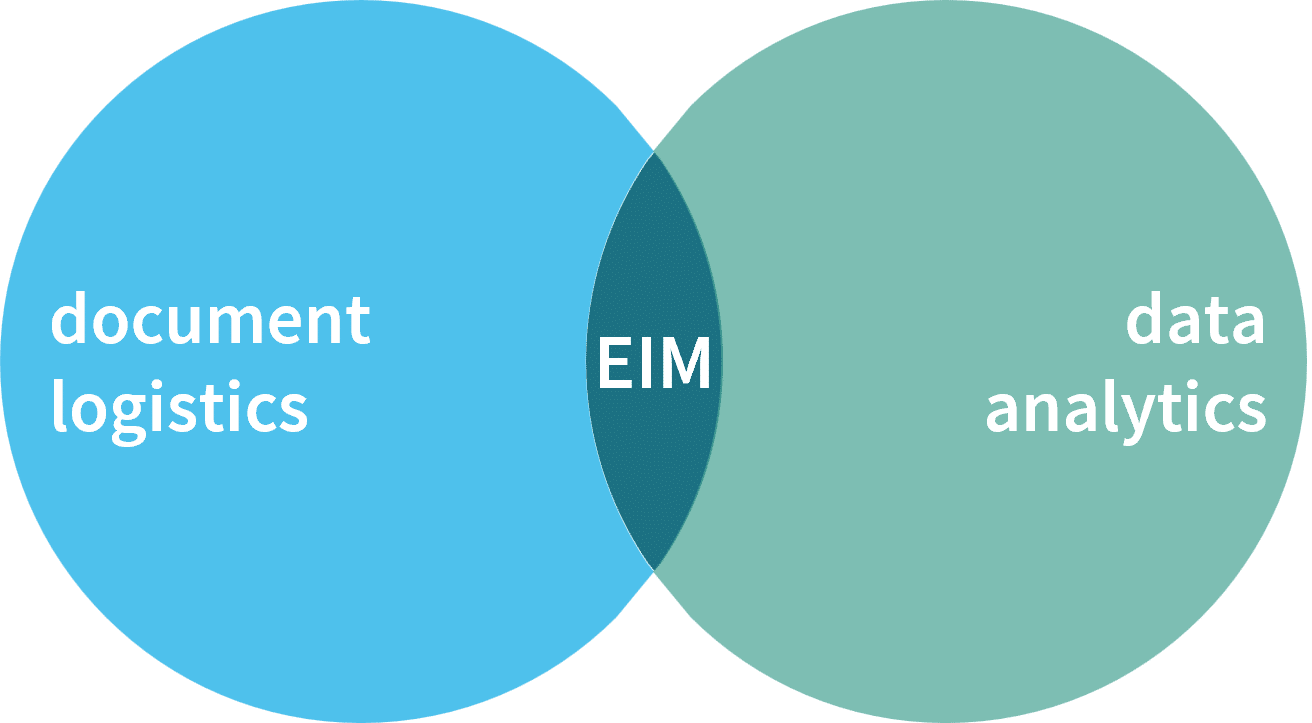
The EIM approach focuses on two strategic areas: document logistics and data analytics – and both are growing together.
Just like the systems we advise on.
EIM is constantly evolving. The perspective is broadening. Instead of looking only internally at the "enterprise" – i.e., the company itself – the technological, industry-specific, and media environment outside the company's boundaries is also becoming more important. For example, social networks can be used to understand customer opinions and obtain feedback. At the same time, the number of mobile devices and platforms is increasing massively, which means more data traffic. And: this data is increasingly being stored, processed, and shared in the cloud. (Keyword: SMAC)
In recent years, in addition to automation approaches, the integration of artificial intelligence (AI), machine learning (ML), and robotic process automation (RPA) has been promoted. This reduces manual work and enables the systems themselves to optimize processes. Interfaces can be optimized through adaptable user interfaces and intelligent analyses. Automated monitoring and governance also strengthen information security. Thanks to AI, processes can also be scaled much more quickly.

EIM in practice
A next-generation customer portal
EIM vs. ECM
Enterprise Information Management
EIM refers to the comprehensive management of ALL information within a company. This also includes, for example, metadata, logical links, or BI data that are not defined as classic "content."
EIM therefore concerns integrated data and content from multiple systems and departments that need to be managed, used, and optimized throughout the entire information lifecycle, regardless of the format in which they are available. In addition to ECM technologies, databases, analysis tools, and data governance systems are also used to integrate information from different sources and systems across the board.
Enterprise Content Management
ECM is a sub-area of EIM. It focuses on content management—i.e., CONTENT in the form of documents and files. Enterprise content management involves structuring, storing, distributing, and archiving this digital content and these documents.
ECM tools such as document management systems and digital archiving platforms are used here. Workflow management and web content management are also used. With regard to governance and compliance, the emphasis is on compliance with regulations and document retention requirements.

My vision is that we no longer distinguish between structured and unstructured information. Information management must handle all types of data and documents. Focus on the business process. This is how I built up the CENIT EIM Group with ISR as its central brand.
André Vogt
Spokesperson for the Executive Board | ISR
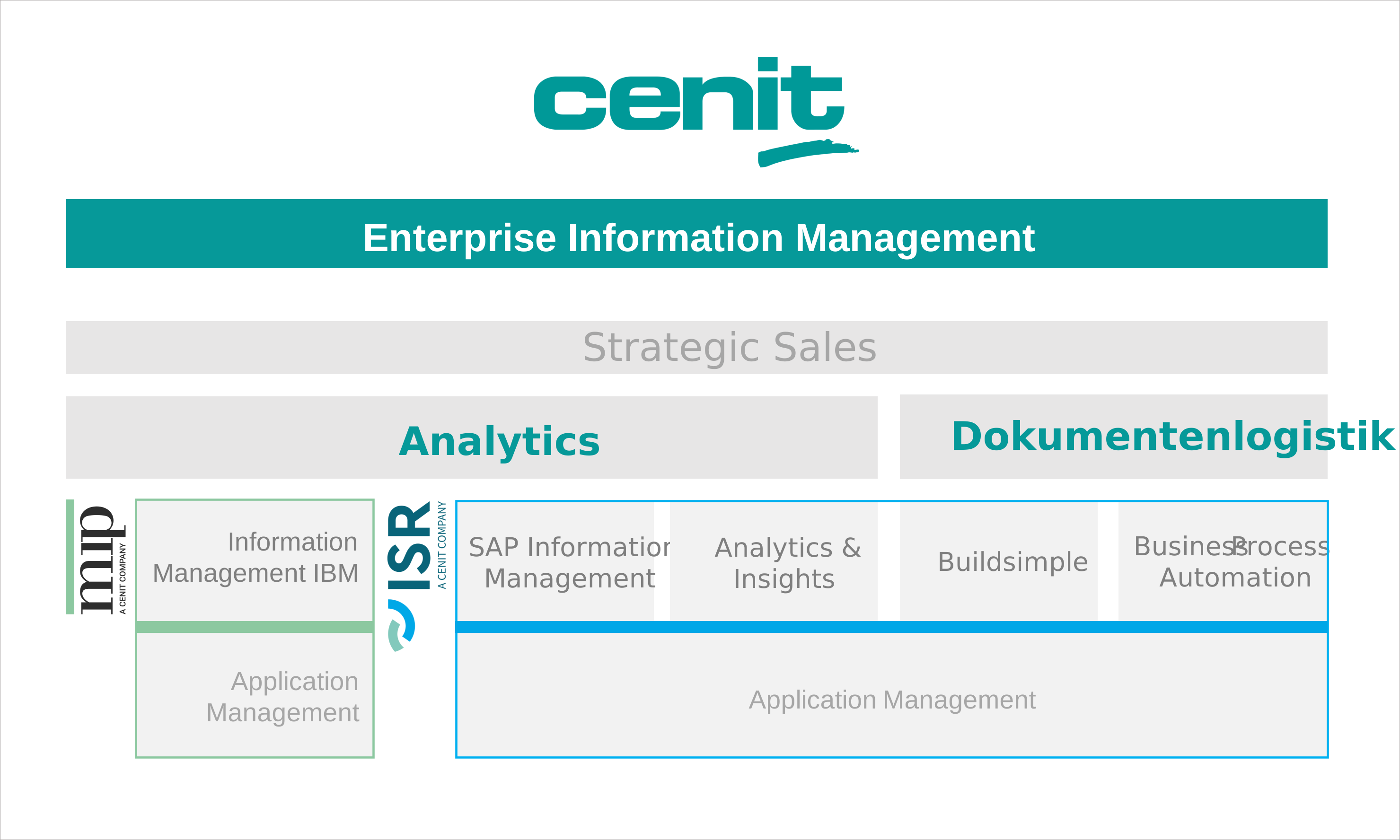
Our focus on enterprise information management is reflected in the structure of the CENIT EIM Group. Our ISR team of specialists in ECM, BPA, input management, and data analytics is joined by the AI experts from the ISR brand Buildsimplewith their solution for intelligent document processing.
Management information systems based on IBM technologies are the specialty ofmip GmbH. As a specialist, the company rounds off the focus and provides you with expert support in all EIM issues.
Concrete and practical
Our support for companies
We specialize in IT-supported management of business-relevant documents and information in our customers' core processes. As a full-service EIM provider, we offer a range of integrated services, consulting, and software solutions that you can use for comprehensive and automated information management.
These include:
- Creation of specialized and technical concepts
- Distribution and provision of software from our partners
- The development and adaptation of individual software extensions
- Implementation and configuration of solutions
- Maintenance, application management, and operation of the solutions
This is how we understand EIM:
Our Focus


Would you like to learn more?
Get in touch

Michael Frihs
Senior Executive Manager
Key Account Sales
michael.frihs@isr.de
+49(0)151 527 45 346