What does change management mean?
Change management encompasses all planned measures, tasks, and activities that lead to comprehensive, sustainable change processes in organizations. These can include, for example, changes to cross-departmental processes, systems, structures, and strategies, or new requirements and goals.
In the field of ITIL, the term change management is also used to describe a process that controls all adjustments to the IT infrastructure and executes business services while minimizing operational risk.
Phases of change management
According to Kurt Lewin, change management can be divided into three phases:
- Thawing phase: In this phase, an organization realizes that change is necessary because expectations no longer match reality. It is about "thawing" the previous state and creating motivation.
- Action phase: In this phase, the problem is actively addressed. Solutions are defined and implemented in sub-projects in order to bring about a change towards a balance between expectations and reality.
- Freeze phase: In this phase, the solutions are integrated. The changes that have been completed are stabilized and frozen for permanent integration into the organization, so that a relapse into the previous imbalance triggered by habit is avoided.
The phases are also illustrated in the following figure:
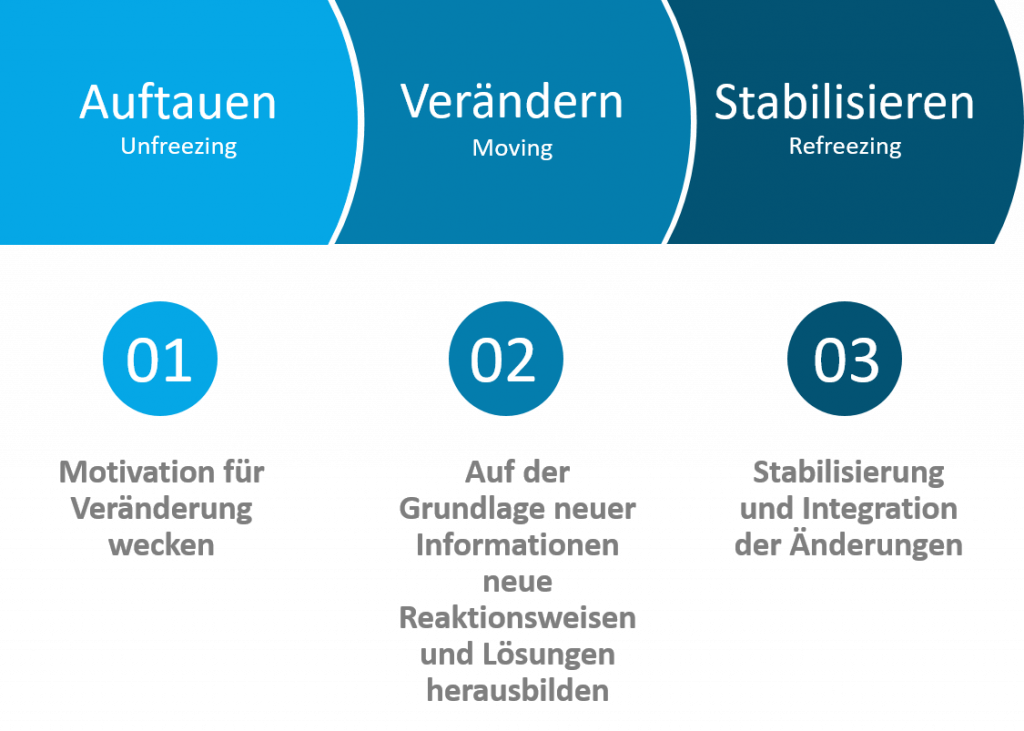
Figure 1:Phases of change management
Success factors in change management
Based on Lewin's field theory, which can be described as a classic in change management, a model with six success factors has been developed that should generally be taken into account in change processes. It is assumed that the people involved in the change always need guidance on the goals and progress of the changes. Furthermore, it is not only important to ensure sufficient motivation to tackle change processes in the first place, but also to maintain motivation throughout the course of the change in order to achieve sustainable success.
The six success factors of change management are shown in the following figure:
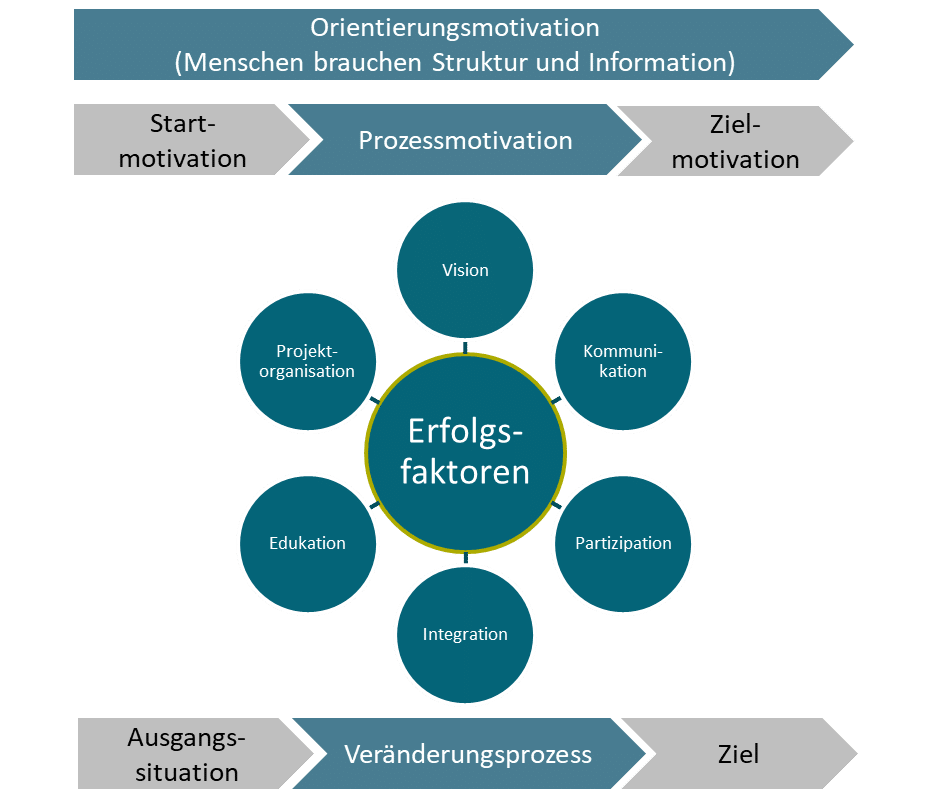
Figure 2:Success factors of change management
Success Factor: Vision: The “Vision” success factor is about setting motivating goals. There must be a goal that the vast majority of those involved find worthwhile.
Communication as a success factor: Communication is one of the key success factors in change management, and is included in almost all other success factors because leadership itself is primarily applied communication. The aim is to avoid and overcome resistance.
Participation as a success factor: Participation is about involving those affected. Involving as many employees as possible in the change process generally increases their motivation and reduces resistance.
Integration as a success factor: Integration is about overcoming differences. The goal of integration is always to ensure harmonious and cooperative coexistence, which accelerates change and increases productivity.
Education as a success factor: Education is about developing personnel in a targeted manner. Personnel development should be carried out as proactively as possible within the framework of the planned change. The aim of education is to achieve better preparation for the additional requirements arising from change. A side effect of education is the temporary motivation of employees due to their further training.
Project organization as a success factor: Project organization helps to reduce complexity and clearly assign responsibility. It also serves to provide resources and ensure that goals are achieved and deadlines are met.
At ISR, we frequently use change management as part of our process management. In doing so, we pursue the following goals:
- Empowering those affected to bring about change
- Develop project-promoting attitudes and behaviors
- Promote a targeted and open information policy
- Identify problem stakeholders early on
- Intervene preventively through measures
- Minimizing potential conflicts and resistance
- Promoting communication
Benefits of change management
Change management brings numerous benefits. We have listed some of them below:
- Ensuring project success
- Improving the quality of results
- Employee motivation
- Reduction in postponements
- Elimination of unnecessary costs
- Reduction of conflicts and resistance
- Establishment of broad support beyond the end of the project
What does change management have to do with IT?
In order to master increasing digitalization and the rapid development of IT infrastructure and to adapt to changes in markets, the IT strategy should be further developed within the framework of change management. Change management helps to plan changes in IT infrastructure proactively, carefully, and with a long-term perspective. It ensures that standardized methods for implementing changes are used efficiently. The planned adjustments to the IT infrastructure are carried out in cooperation with the relevant departments, management, etc. With the help of efficient project management, all those affected should be informed at an early stage, comprehensively and with an emphasis on the advantages. As mentioned under the success factors, communication is a very important component in creating willingness to change. It is also helpful to bring in external, objective consultants, as they can help minimize risks by assisting in the selection of the appropriate solution. Overall, change management helps to optimize the IT landscape and generate a willingness to change among all those affected, while minimizing the risk of failure and involving everyone in the company.
Do you have questions or want to successfully establish change management in your company?
Our Digital Operations Team will be happy to help you. Just get in touch!