
DOCUMENTS, FILES, AND CONTRACTS ONLY PROVIDE RELIABLE INFORMATION WHEN THEY ARE PROVIDED WITH CONTEXT. THE BLOG ARTICLE EXPLAINS HOW CONTEXT ENGINEERING MAKES AI PRODUCTIVE IN DOCUMENT MANAGEMENT.
Table of Contents
Context Engineering: Why AI cannot know the truth without context
When ChatGPT was released at the end of 2022, it caused quite a stir. Suddenly, it was possible to ask an AI questions in natural language—and get surprisingly good answers. Prompt engineering, the art of formulating the right questions, became a new discipline overnight. Those who found the right words achieved impressive results.
But anyone who works with AI on a regular basis also knows that it's not that simple. A small difference in wording can completely change the result. And although AI produces text in seconds, it often remains unclear whether the result is actually correct.
This discrepancy highlights a fundamental problem: AI can understand language, but it understands not. At least not without help.
Here comes context engineering . It's not just about unleashing artificial intelligence on data, but embedding it in a structured, meaningful environment. This way, AI knows what it's talking about and where the information comes from, and how to interpret it in the business context.
1. Why prompt engineering is not enough
Prompt engineering has enabled the first major "aha" moments with AI. And even today, companies are experimenting with new prompts on a daily basis to achieve better responses.
But this is precisely where the limitation lies: there are already better solutions for standardized tasks, such as workflows or program code.
AI can help here by selecting tools or feeding parameters. But the real added value comes where tasks are not standardized, where experience, knowledge, and interpretation are required.
Companies benefit from AI primarily in two areas:
- In the application, when skilled workers are working on complex, non-standardized tasks. Here, it is crucial that they can operate in free language and that the AI reliably classifies these inputs into existing processes.
- In orchestration, when agentic systems connect different tools and applications. AI thus becomes the link between previously isolated systems and creates process chains that were previously hardly possible.
In such scenarios, it is not enough to ask good questions. Context is what matters here—or, more precisely, context engineering.
After all, if AI is to understand how a process, contract, or document should be classified, it must have access to data, metadata, and semantic relationships. Only then can it bridge the gap between language comprehension and business logic, providing guidance, building trust, and making AI an integral part of corporate IT.
2. What is context engineering? Definition and differentiation
Context engineering means not only providing AI with a prompt, but also embedding it in a structured information environment. While prompt engineering optimizes the input, context engineering ensures that the AI is aware of the relevant framework conditions:
- What data is relevant?
- Which metadata provides guidance?
- What semantic relationships exist between objects and processes?
The term originated in the context of large language models (LLMs), which are impressive at formulating sentences but, without context, can easily miss the mark.
A simple example illustrates this clearly:
Prompt: "Summarize contract XY."
Without context, AI does not know which version is meant, how valid the contract is, or whether it is a draft.
The result: a linguistically correct but factually incorrect answer.
With context engineering, however, AI knows which contract comes from which system, who created it, when it was last modified—and provides a correct, comprehensible summary.
Context engineering ensures that AI does not "guess" but understands – and thus delivers results that are viable, verifiable, and technically relevant .
3. Context as the key: Why Context Engineering Makes AI Relevant
Large language models are powerful text generators. However, without context, they lack anchoring in real business data. They provide plausible answers, but not reliable ones.
A practical example:
Question for the AI: "Has contract XY already been approved by the legal department?"
Without context, the model may respond may respond as follows:
"In most cases, approval is granted by the legal department after all technical reviews have been completed."
The wording sounds reasonable, but it doesn't answer the question.
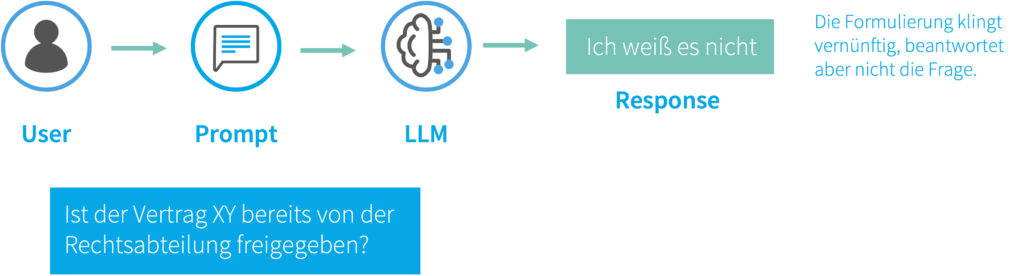
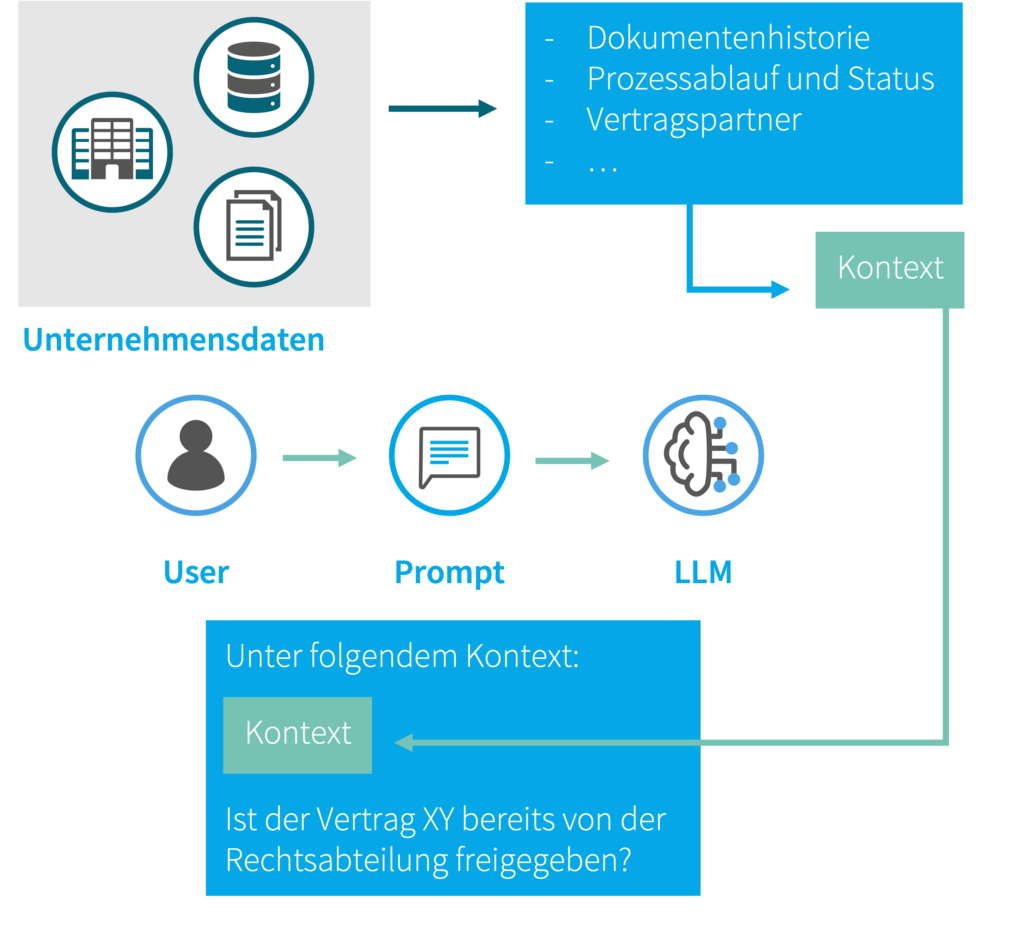
With context engineering, on the other hand, the AI can access the relevant data, knows which version of the contract is meant, knows the approval status in the corresponding system, and provides the information:
"Contract XY, version 2.3, was approved by the legal department on August 12."
This is insufficient, especially for companies. This is about reliable information, compliance and traceability. Context ensures that answers are not only linguistically convincing, but also verifiable, reproducible, and embedded in business logic .
The importance of context engineering is also evident in the development of many information systems—and this is where ISR can draw on its wealth of experience. With the introduction of digital records, we ensured early on that information was not only stored but also used in the right context. The idea was simple but effective:
- structured filing systems,
- Dynamic views by use case,
- Orientation based on roles and processes.
This resulted in a system that combines technical expertise and IT—a form of context engineering before the term even existed.
Today, it is clear that this way of thinking is an ideal basis for AI. Our file solutions already contain what AI needs: structured information, metadata, and process logic. When we pass this context on to AI, it creates a bridge between proven specialist applications and modern AI interaction. The file thus becomes the interface between business logic, IT, and AI. A clear entry point through which AI systems can access corporate knowledge without leaving the existing architecture.
4. Context Engineering in practice: more than RAG
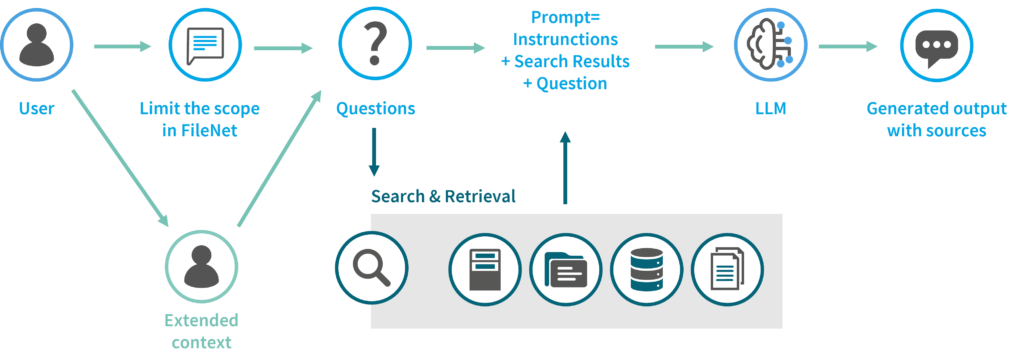
Classic RAG (retrieval-augmented generation) systems generally work with pure document content. This is helpful, but falls short in a business context.
Only when
- metadata,
- User context and
- process logic
When all of these factors are taken into account, a complete picture emerges—and this is where true context engineering begins.
We call this approach Extended Context:
- Metadata and business logic are already taken into account during retrieval.
- The AI therefore does not receive the framework in the prompt, but from the outset.
- This results in answers that are technically sound and can be used in a business context.
Another crucial aspect is the user experience. While traditional applications are often controlled via complex masks or workflows, AI opens up new ways of interacting, primarily through chat. Here, users can formulate their requests in natural language. The AI translates these inputs into structured actions within the company's logic. This makes complex systems accessible via language – intuitively, comprehensibly, and in line with internal processes.
This effect is even stronger when the AI itself suggests meaningful next steps instead of just reacting; it acts proactively. This creates a dialogical form of interaction that focuses on expertise and makes IT almost invisible.
Of course, one old truth remains: context engineering only works as well as the data on which it is based. The issue of data quality has been with companies for decades—and it will not disappear in the AI era. But this is precisely where AI itself can become part of the solution: it can highlight inconsistencies, validate index values, and supplement missing metadata. This creates a cycle in which AI not only benefits from context, but also continuously improves it.
Our advantage: We operate directly within companies' applications, where the context already exists. We make precisely this context usable for AI. The result is systems that not only work experimentally, but are also productive, trustworthy, and connectable.
Workflow Stability, scalability, and enterprise readinessreadiness . IBM provides the engine room, ISR delivert the navigation system. Together, they create an architecture that is both robust and practical.
5. Added valueofcontextengineeringfor companies andusers
The benefits of context engineering can be clearly described:
- Relevance: AI results are based on company data and processes.
- Trust: Responses are based on known business logic, not on 'hallucinations'.
- Integration: Existing systems become entry points for AI and agentics.
- Efficiency: Fewer tool changes, more focus on content-related work.
Possible examples from real office life:
- In public administration, citizens' inquiries are answered in a context-specific manner—in a comprehensible and legally compliant manner based on laws and files.
- In industry, AI knows maintenance histories and machine statuses, for example, and provides recommendations for action in real time.
- In insurance, claims are not processed in isolation, but in the overall context of a case.
These scenarios show how context engineering makes all the difference. Individual AI functions become integrated systems that support people in their work instead of leaving them alone with unconnected data and tools.
6. Conclusion:Whycontextengineering is the new currency of AI
Today, we primarily experience AI as assistance system: it makes suggestions, summarizes, and provides support. This creates added value and lays the foundation for trust. The next step is agentsthat act independently, orchestrate different systems, and prepare decisions.
The path to get there is not a big bang, but a gradual process. Those who model their context cleanly today lay the foundation for scaling, automation, and future viability.
But one thing remains: without a clean database, context engineering remains piecemeal.
Data quality, governance, and structure are not secondary issues, but rather the core of a functioning AI strategy. And AI can help to continuously improve this foundation.
Our conviction: Context is the new currency of AI. Technology alone is not enough. Only when knowledge and logic of a company integrated and made accessible via new interfaces does true relevance – and trust – emerge.
This is precisely where our strength lies: with our file solutions, we have been demonstrating for years how context works for people: structured, comprehensible, and close to the processes. Now we are transferring this principle to the world of AI. This is how experience with structure suddenly becomes context engineering for AI—and technology becomes genuine business intelligence.

Christoph Sünderkamp
Managing Consultant
Business Process Automation
christoph.suenderkamp@isr.de
+49(0)151 422 05 489