
The aspiration of every accounting department: automated, AI-based, and intelligent incoming invoice verification that significantly streamlines the daily operations of their specialists through smart features.
Digitalization has also extended to invoice verification. An increasing number of companies are adopting digital solutions to automate and enhance the efficiency of their invoice processing. While many companies already utilize partially or fully automated solutions for their invoice processing workflows, significant optimization potential still exists in numerous areas. In this blog article, you will learn why invoice verification is generally important; precisely how digital and automated invoice processing functions, and which steps need to be considered.
1. Invoice Verification – Why is it Necessary?
2. How Does Digital Invoice Verification Typically Work?
3. Digital Invoice Verification
4. Digital Invoice Verification Meets Compliance
5. AI-Powered Automated Invoice Processing
6. Invoice Verification, Approval, and Automated Posting – Seamlessly Integrated
Invoice Verification – Why Is It Necessary?
Initially, this may seem like a trivial inquiry, but it is crucial to understand the various aspects that must be considered during digital invoice verification.
This encompasses invoice data such as the invoice number, date, amount, taxes, and currency. Furthermore, services and deliveries are scrutinized to ensure that quantity, price, and quality align with contractual agreements. Payment terms, including discounts and due dates, are also verified to prevent duplicate payments and overpayments.
Moreover, invoice verification consistently serves to identify irregularities and anomalies. These may include, for example, unusually high invoice amounts, missing or illegible invoices, or divergent tax rates. Such discrepancies can indicate fraud or errors and therefore necessitate investigation. Diligent invoice verification contributes to minimizing risks for you and your enterprise, while also ensuring the compliance of your operations and processes.
How Is Digital Invoice Verification Typically Conducted?
Back to Basics: How is the Digital Invoice Verification Process Structured, and Where Can Software Provide Support? While the workflow for digital invoice verification varies depending on the company and the specific software utilized, several common steps are typically involved:
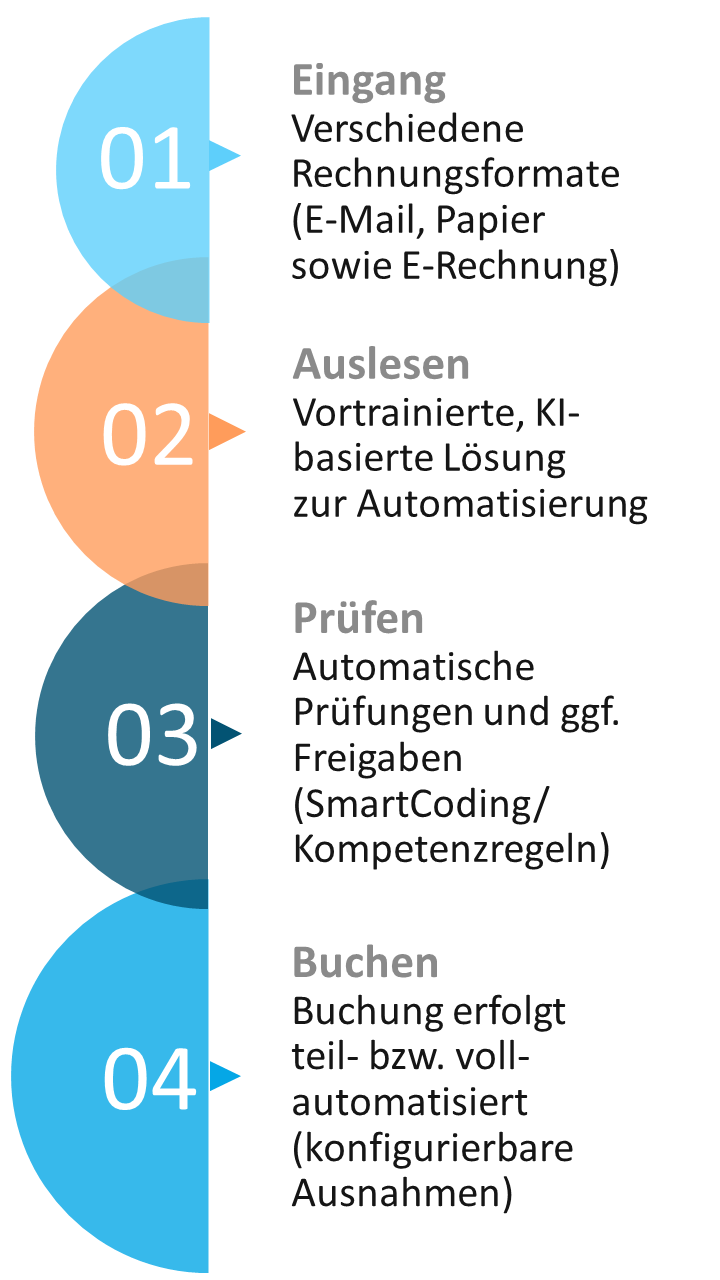
Invoice Receipt: Invoices are typically received in various formats, usually via email. If the invoice is not already in a standardized format (e.g., XRechnung or ZUGFeRD), the relevant invoice information must be extracted automatically using AI. Modern systems also automatically verify the compliance of the e-invoice with EN 16931 and ensure that all legal requirements are met.
Verification of Invoice Data: The subsequent step involves reconciling the extracted invoice data with the supplier's master data and corresponding order information. Concurrently, plausibility checks are conducted to ensure the accuracy and validity of the invoice.
Invoice Approval: Should the invoice successfully pass all verifications, it is digitally routed to the designated employee for approval. At this stage, the invoice undergoes a final review and is approved if all details are found to be correct.
Invoice Posting: Following approval, the invoice is posted. This involves generating the necessary accounting entries and transferring them to the accounting system.
Invoice archiving: The invoice is automatically archived digitally so that it can be retrieved and verified at any time.
Invoice Payment: Subsequent to posting, the invoice is released for payment. The payment is then automatically initiated and remitted to the supplier.
Digital Invoice Verification
Formal and Substantive Verification? What Is Checked?
From a business perspective, transitioning one's accounting processes to digital invoice verification is an imperative.
The benefits are evident: Automating invoice verification reduces error rates, minimizes processing times, and frees employees from routine tasks. Moreover, it facilitates comprehensive traceability and transparency throughout the process, thereby enhancing corporate security and compliance.
By implementing modern IT solutions such as invoice verification software, automated text recognition, and AI algorithms, companies can make their digital invoice verification processes more efficient, secure, and transparent.
Formal Invoice Verification
Formal invoice verification, which ensures that invoices adhere to correct structural formats, can be supported by IT solutions such as automated invoice scanners and data extraction tools. These tools identify and extract pertinent data from invoices, thereby ensuring the inclusion of all critical information.
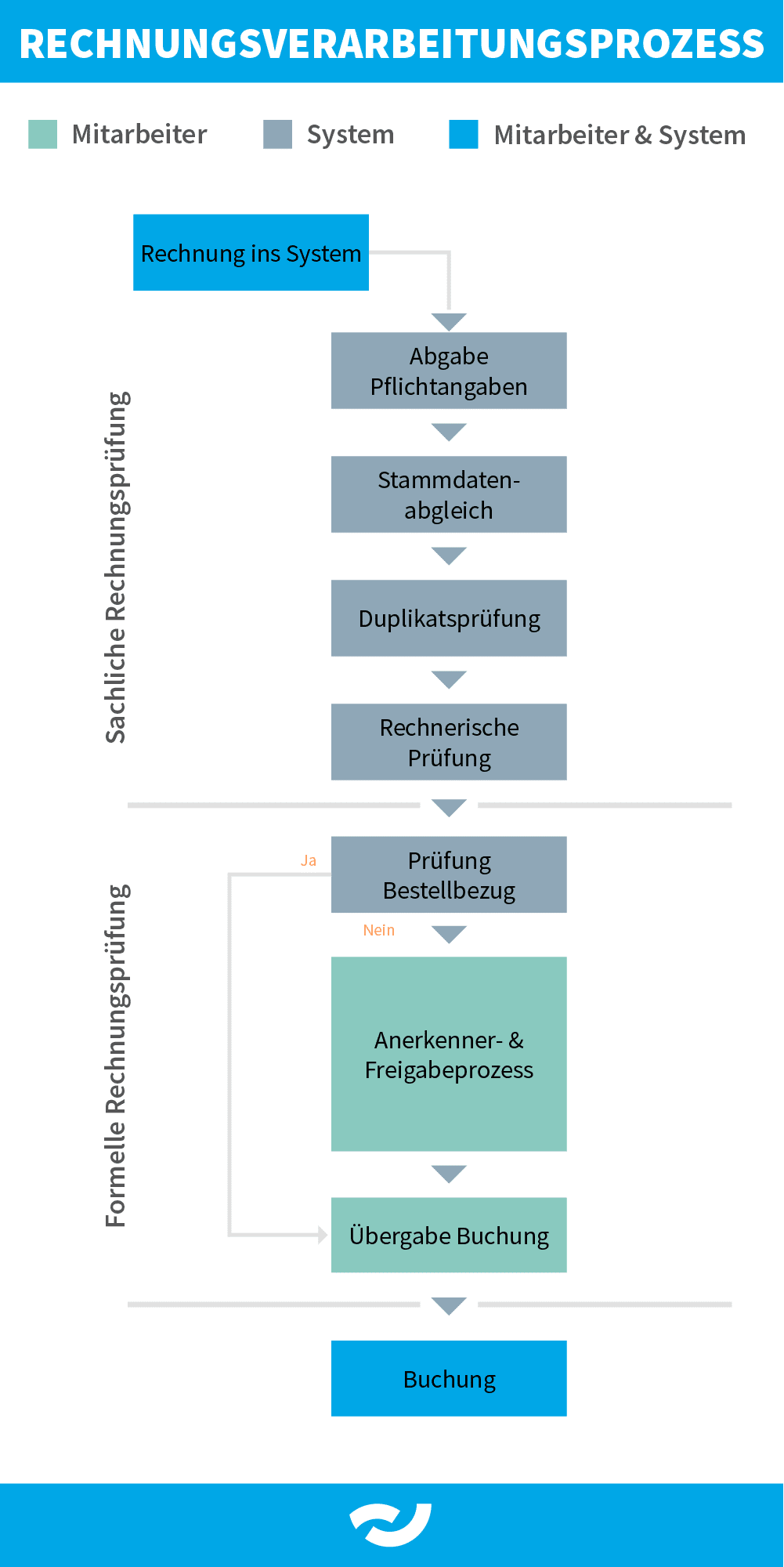
Checklist for Formal Invoice Verification:
- Receipt of invoices into the system via various channels (e.g., e-invoices, email, paper)
- Extraction and validation of required information (e.g., invoice number, tax ID)
- Master Data Reconciliation: Automatic mapping of company codes and vendors using intelligent matching algorithms
- Duplicate check: Verify whether an invoice from the same supplier with the same invoice number already exists
- Calculation check: Validation of amounts, including VAT
Checklist for (substantive) audit:
- Order reconciliation: Checking whether an order exists and whether the invoice amounts fall within defined tolerances
- Approval and Release Process: Rule-Based Control of Approvals and Releases
Substantive Invoice Verification
Substantive invoice verification, which checks whether a delivery or service aligns with the original order, can be supported by IT solutions such as rule databases and automated reconciliation functions. These tools enable the automatic matching of prices and quantities with the details in the contract or order, ensuring complete consistency. By automating invoice verification, companies can optimize their processes, enhance efficiency, and improve security.
This process is accompanied by a corresponding approval and release workflow. Based on the automated assignment of rule-based elements such as a cost center, G/L account, or invoicing/controlling area, one or more approvers can be integrated into this process.
By automating invoice verification, companies can optimize their processes, enhance efficiency, and improve security. It is therefore not surprising that digital invoice verification is increasingly becoming a standard in accounting.
Digital Invoice Verification Aligns with Compliance
The benefits of digital and automated invoice processing have already been briefly mentioned. But what advantages does automated invoice processing offer companies in the area of compliance? In addition to adhering to legal requirements, internal guidelines and control mechanisms must be seamlessly implemented. Digital solutions for invoice verification and processing can play a crucial role in this regard.
Enhanced Transparency and Traceability:
Digital invoice verification ensures complete documentation of all transactions. As a result, digital invoices and an automated verification process make it easier for regulatory authorities or auditors to review and ensure compliance with regulations. All process steps are documented in an audit-proof manner. Every decision, change, or system action is recorded in the audit trail and can be traced at any time. ISR Accounts Payable Flow integrates collaboration directly into the invoicing process: comments, inquiries, and documents are centrally bundled in the invoice file.
Reduction of Errors and Manipulations:
Automated verifications can quickly and precisely check invoices for plausibility, correctness, and adherence to specifications. This minimizes the risk of errors or intentional manipulations that could lead to compliance breaches. Digital invoice verification thus enhances the accuracy and security of accounting processes.
Prompt Identification of Anomalies:
Automated verifications promptly detect irregularities or deviations from policies. This allows compliance issues to be identified and addressed early, before they have significant repercussions. Digital invoice verification enables proactive compliance management.
Improved Control Mechanisms:
Digital invoice verification allows for the implementation of detailed control mechanisms and approval workflows. In addition to merely identifying anomalies, this strengthens internal control systems and supports adherence to compliance requirements. Companies can therefore specifically enhance their compliance security.
Increased Efficiency and Scalability:
Automated verifications can process invoices significantly faster and more cost-effectively than manual processes. This enables companies to efficiently meet compliance requirements even with increasing transaction volumes. Digital invoice verification scales with the company's compliance demands.
Automated digital invoice verification thus offers companies numerous advantages in minimizing compliance risks and enhancing compliance security. The following section details how such a solution can support companies in efficiently and reliably meeting compliance requirements.
AI-Powered Automated Invoice Processing
The manual entry and processing of invoices necessitate continuous, multiple verifications of all invoice data. This process is not only monotonous and time-consuming but also prone to frequent errors. Crucially, all these issues are avoidable!
Automating these routine tasks minimizes the risk of errors, reduces costs, and shortens processing times.
Whether it’s a scan, PDF, XRechnung, or ZUGFeRD —our input management software handles the entire process of capturing incoming invoices. While AI-based data recognition methods are used for traditional documents, structured e-invoices enable the data they contain to be captured directly and with minimal errors.
The captured information is validated immediately and forwarded to the next stage of processing. When used in conjunction with ISR Accounts Payable Flow, all relevant data is centrally available in the digital invoice file and is immediately ready for further processing.
Invoice Verification, Approval, and Automated Posting – Seamlessly Integrated
With the integrated workflow in ISR Accounts Payable Flow, all verification steps are automatically managed, thereby identifying any price or quantity discrepancies that may arise. The workflow not only controls the individual process steps but also ensures a clear distribution of tasks, monitors deadlines, and automatically forwards processes to the appropriate staff members. Configurable escalation mechanisms ensure that invoices do not get left behind: Processors are automatically reminded, and tasks are reassigned as needed. Automatic sales tax verification (UStG § 14) and reconciliation with vendor master data via integration with your systems also significantly accelerate your invoice processing.
Integration with existing systems such as SAP or Datev enables seamless processing of accounting data and prevents data discontinuities. In addition, historical data can be used to automatically identify the appropriate personnel—such as approvers—significantly reducing the need for manual assignments. Intelligent algorithms such as Smart Coding, for example, assist with the correct account assignment of invoices or enable the automatic determination of the appropriate reviewer or approver in your invoice verification processes.
Competency rules and budget approval limits can also be easily managed enterprise-wide through user role clustering. Instead of configuring individual permissions for each employee, user roles are assignable with a single click.
Under certain conditions, the final posting in your financial accounting system can also be fully or partially automated—up to and including so-called dark processing, in which invoices are processed and posted without any manual intervention.
Since every company has exceptions as well as standard procedures, the automation settings can be customized. For example, specific G/L accounts, vendors, or cost centres can be excluded.
A key component of modern invoice processing is automatic matching: systems compare invoice data with existing master data and automatically identify the correct vendor and the associated company code. By comparing multiple attributes such as name, address, or bank details, a high degree of accuracy is achieved in the assignment process—even when spellings differ.
„In my daily processing of incoming invoices, ISR Accounts Payable Flow provides me with an excellent overview of all invoices and their associated information. Information inquiries can be swiftly made with a single click, and the overall processing time has been substantially reduced. I particularly value the data linkage to generated purchase orders and the comprehensive history, which allows for complete traceability of every transaction.
Regina Sanders | Financial Accounting
ISR Information Products AG
Ready to innovate? We are here to support you!
For optimal productivity, it is essential for every enterprise to deploy skilled professionals in critical roles. Every company can therefore benefit from software automating certain routine accounting tasks. By implementing automated and AI-driven invoice verification processes, you empower your financial accounting specialists to focus on core strategic activities.
Leveraging our extensive experience, we are poised to assist you in fully digitizing and automating your invoice receipt process. Are you currently utilizing a solution and satisfied with its performance? Discover the capabilities of our innovative, comprehensive solution featuring ISR Accounts Payable Flow and Buildsimple.


Jens Brettschneider
Head of Business Unit
Application Management
jens.brettschneider@isr.de
+49(0)151 422 05 425