
SKILLS SHORTAGE IN ACCOUNTING: HOW PROCESS AUTOMATION CAN HELP
What to Expect Here – An Overview
1. 7 advantages of digital invoice verification
2. Challenges posed by the shortage of skilled workers in accounting
3. Transactional example: The posting process in accounting is changing
4. Future prospects and conclusion – the role of process automation in accounting
The shortage of skilled workers is a hot topic and is also being discussed in the traditional media. While political discussions are often at the forefront, the question arises as to possible solutions through digitalization and the associated increase in process automation. Recent surveys show that the shortage of skilled workers is noticeable in almost every industry and organization. While the "highlight processes" of a company, such as the smart factory, are often the focus of attention, traditional, supporting processes such as administration and, in particular, financial accounting and bookkeeping are often overlooked.
Financial accounting is often the starting point for digital transformation and process automation because it involves central and repetitive tasks that benefit greatly from efficiency gains and error reduction through automation. In addition, it is linked to almost all other areas of business, which facilitates the integration and improvement of overall processes. Compliance with regulatory requirements and the need for transparent documentation make financial accounting particularly suitable for digital solutions that save both time and money and support informed decision-making.
In summary, seven advantages can be identified when introducing digital invoice verification:
7 advantages of digital invoice verification
1. Ability to integrate
Financial accounting processes (FiBu) are centralized and linked to other business areas. Digitization increases efficiency throughout the entire company.
2. Transparency & Overview
Digital invoice verification ensures better traceability and a clear overview of all processes.
3. High data volumes and repetitive tasks
Automating these processes increases both efficiency and accuracy.
4. Regulatory requirements
Digital systems facilitate compliance with legal requirements and minimize the risk of errors.
5. Internal control and error prevention
Digital systems offer improved control mechanisms and increase process reliability.
6. Cost and time savings
Automated processes lead to significant savings and a fast return on investment (ROI).
7. Data analysis and decision support
Digitization enables more comprehensive analyses and supports informed decision-making.
Challenges posed by the shortage of skilled workers in accounting
A CFO study shows that, on average, one in ten positions in financial accounting is unfilled. The already growing challenges in financial accounting are being further exacerbated by the shortage of skilled workers:
- Stricter requirements from tax authorities, partly in an international context:
Tax authorities are imposing increasingly strict accounting requirements, particularly in an international context. Companies must therefore regularly adapt to new regulations to ensure compliance.
- Increased external pressure from investors, for example:
Investors demand increasingly detailed and readily available financial reports in order to make informed decisions. This pressure forces companies to make their financial processes more efficient and transparent.
- The amount of financial data is growing inexorably:
The amount of financial data to be processed is constantly increasing, which heightens the need for powerful data management and analysis tools. Companies must manage this data efficiently in order to be able to use relevant information quickly and accurately.
- Processes are becoming increasingly complex:
Financial processes are becoming increasingly complex due to new business models, compliance regulations, and technological developments.
- Process automation as a solution:
Invoice and input management solutions compensate for the shortage of skilled workers
Transactional example: The posting process in accounting is undergoing change
Traditionally, accountants have to manually enter, check, and post every incoming invoice. This process is not only time-consuming but also prone to errors. However, the use of artificial intelligence (AI) and input management solutions can largely automate this process. AI captures the relevant data from the invoices, checks its accuracy, and automatically posts it to the accounting system. By shifting these activities from "human to machine" frees up resources, allowing accountants to focus on more complex and truly important tasks. Thethe role of the accountant is thus changing from mere processing and checking to analyzing and deciding.
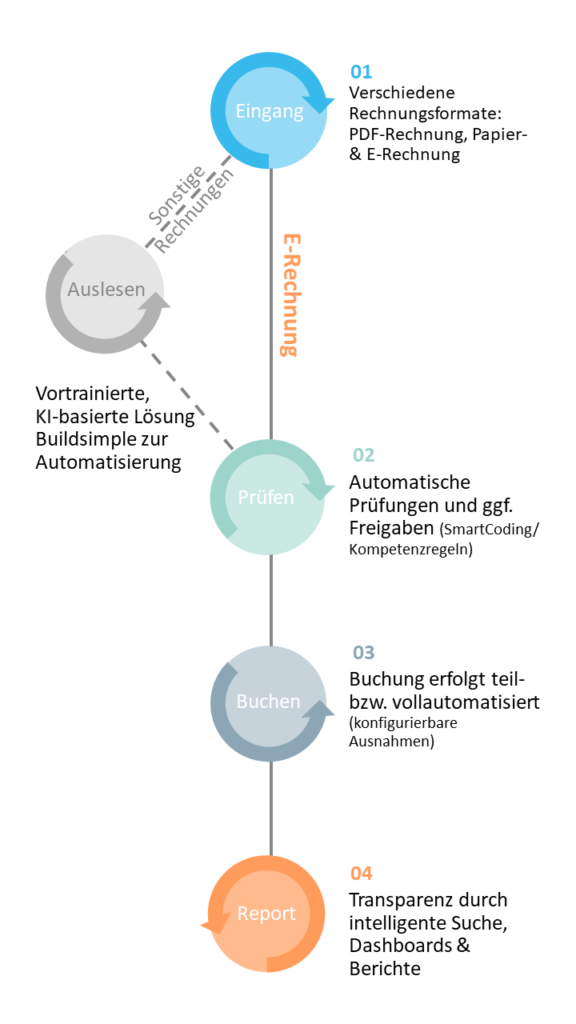
Figure 1: Financial accounting process diagram – Invoice receipt verification | isr.de
The smarter and more digitizedthe invoicing process becomes, the more digital skills and abilities will be required in an accountant's job profile. Accounting is evolving into a strategic field in which technical know-how and analytical skills are crucial. Process automation not only enables companies to reduce costs, but also to increase efficiency and improve the quality of work. Given the shortage of skilled workers and the associated search for "good" personnel , process automation a decisive advantage in remaining competitive and mastering the challenges of the future.
Future prospects and conclusion – the role of process automation in accounting
In recent years, financial accounting in particular has increasingly entered the digital age. Many companies, both large and medium-sized, rely on invoice receipt solutions combined with smart input management to organize their incoming channels. These technologies greatly simplify the management of invoice documents.
The digitization of accounting will continue to advance, and AI and input management solutions will play a central role in this process. In the long term, companies can use these technologies not only to address the shortage of skilled workers, but also to transform their entire finance department and make it future-proof. The shortage of skilled workers in accounting poses a serious challenge, but AI-based accounting solutions and input management systems offer an effective response. By automating document-driven processes, companies can increase their efficiency, reduce errors, and relieve their employees, which increases their satisfaction.
It is time for companies to leverage these technologies to remain competitive and prepare for the future. To successfully address the challenges of the shortage of skilled workers in accounting, companies should act now and take advantage of the benefits of process automation, especially in accounting. Act now to future-proof your business and stay ahead of the competition.
Want to learn more?

Angelina Jordan
Account & Marketing Manager
Business Process Automation
angelina.jordan@isr.de
+49(0)151 422 06 942