
How are predictive and prescriptive analytics related to each other? Is one part better or more important than the other?
In the best case scenario, predictive and prescriptive analytics complement each other perfectly, thereby further increasing the added value for your company. In this article, we explain how this can be achieved, first in theory and then using a practical example.
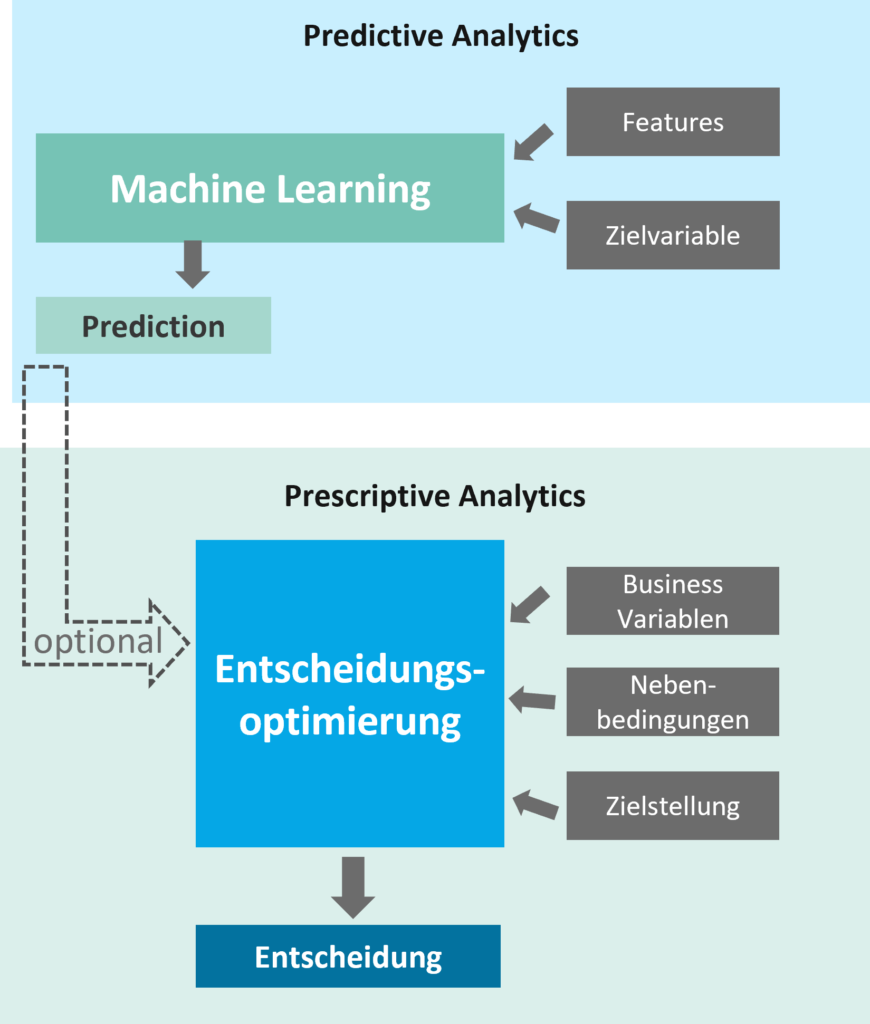
As shown in the figure, the predictions of a machine learning model can be used as additional input variables in a decision optimization process.
In addition to answering the question
the company can still find an optimal solution to the question
find.
How predictive and prescriptive analytics relate to decision optimization
Training a machine learning model to predict future events is a complex and sometimes lengthy process. This part, known as "predictive analytics," is a key component of most data science projects. However, an equally important complex is often overlooked: "prescriptive analytics."
Prescriptive analytics examines the effects of different implementation options on a result.
The goal here is to find the best possible solutions for the company. Decision optimization is a data science technique that can be used for this purpose.
Decision optimization is particularly useful when there are many different options and constraints that all lead to a result but do not necessarily have to be implemented in the same way. Decision optimization analyzes all potential options and selects the one that best meets a defined objective.
- Supply chain optimization
- Predictive maintenance and
- Production & scheduling
Use case: Creating an optimal schedule
Let's now turn to a real-world optimization problem that we dealt with in a customer project. The objective of the predictive analytics project was to create an operating room schedule that maximized the utilization of all operating rooms.
At the same time, certain variablesshould be taken into account during planning. These were recorded in a table.
| OP | Possible rooms | duration | priority |
|---|---|---|---|
| OP 10 | 1,3 | 45 min | 3 (!!!) |
| OP 6 | 2, 3 | 25 min | 1 |
| ... | ... | ... | ... |
In addition, further constraints were mentioned that should be observed:
- The time slots for an operating room must not overlap.
- There must be a 10-minute break between each time interval.
- For the sake of simplicity, operations may only be performed between 7:00 a.m. and 10:00 a.m.
- High-priority operations should take place as early in the day as possible.
- Repairs will be carried out in operating room 1 from 7:00 to 7:30 a.m.
- Repairs will be carried out in operating room 3 from 7:00 a.m. to 8:00 a.m.
By implementing a decision optimization model that takes these conditions into account, time can be saved in planning during productive use, while at the same time significantlyincreasing resource utilization. Ultimately, the decision for optimal planningof operating rooms waslargely automated.
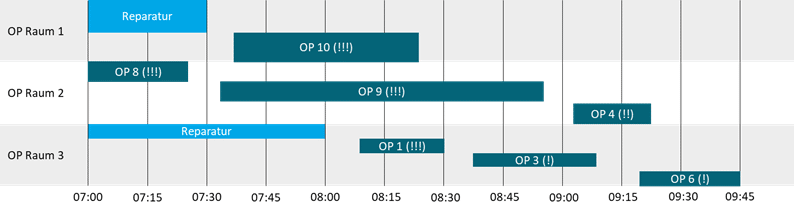
with input from a machine learning model (predictive analytics)
We provide expert support for the implementation of your prescriptive analytics project.
We rely on IBM Decision Optimization or a solution developed specifically for you using open-source tools.
Do not hesitate to contact us!


Silvio Bergmann
Senior Manager
Analytics & Insights
silvio.bergmann@isr.de
+49(0)151 422 05 418