
SAP BW/4HANA – We provide an overview
With SAP BW/4 HANA, SAP has not simply released an update to SAP BW 7.5. Instead, it has seized the opportunity to break with many old traditions.
Table of Contents
1.1 High Performance
1.2 Openness
1.3 Simplicity
1.4 Modern Interface
1.5 Conversion
Objects that are not HANA-optimized simply no longer exist (e.g., virtual providers). We provide an overview of the advantages that BW/4 HANA offers in our opinion.
Functional advantages
SAP BW/4 HANA follows five design principles that clearly illustrate its added value.
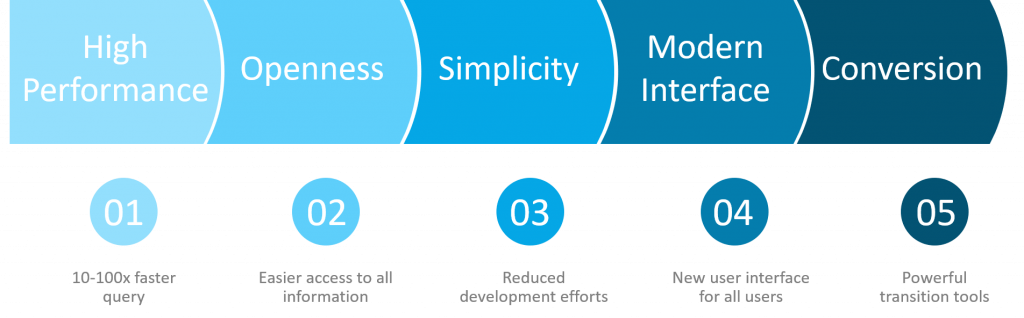
1) High Performance
With SAP BW/4 HANA, more and more functions are being transferred from the ABAP server to the HANA database. This has significantly improved query performance, for example. SAP will continue to push ahead with this in the future. It is expected that this will make both staging processes and reporting queries even faster. Data warehouse modeling will remain in the ABAP part, while "execution" will increasingly take place in HANA.
2) Openness
SAP BW systems do not have a reputation for being particularly open to sources, but also with regard to exporting data from SAP BW (unless an OpenHub license was available). SAP BW/4 HANA has set itself precisely this goal.
When it comes to data integration, BW/4 HANA relies entirely on the capabilities of SAP HANA in addition to ODP. Smart Data Access (SDA) is already available in the standard version for database connections, which can also be virtual. A consolidation of source system types has been carried out. At first glance, this also appears to be a simplification, but in our opinion, it does not significantly reduce the complexity of a source system connection. This is also in the nature of things, because the environment of data warehouse systems is becoming more complex. In this respect, it is more important that a BW/4 HANA system has more capabilities to integrate different systems. Close integration with Smart Data Integration (SDI) enables completely new scenarios to be realized. This is all the more true when you consider that data integration is also possible via the SAP Cloud Platform (Integrator), Data Hub, and Data Services. If the licenses allow it, there are many ways to get data into SAP BW. In the future, separate source system types for SAP Cloud Solutions will also be added.
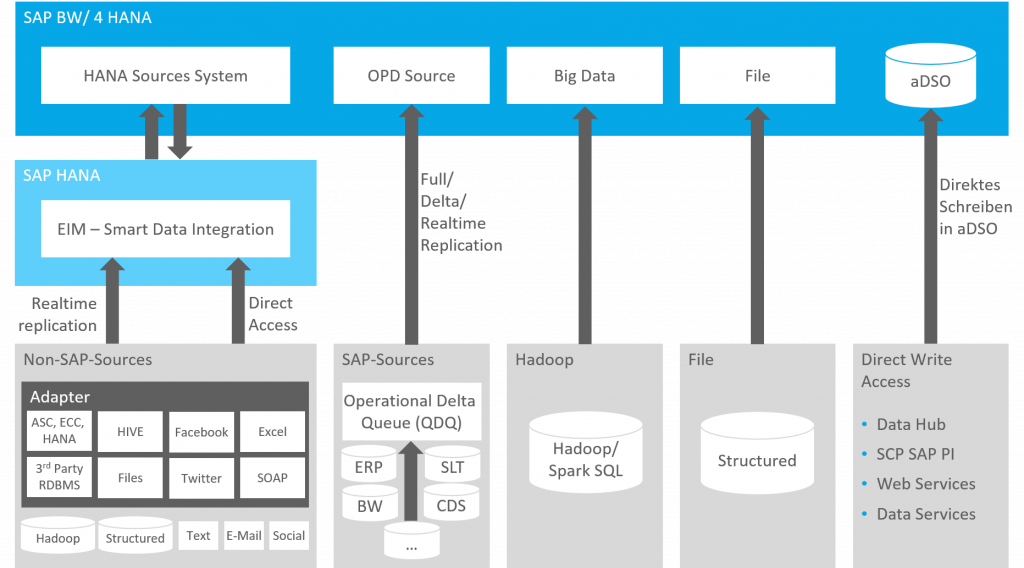
An additional OpenHub license is no longer required to provide data to other applications. This makes it easier to export data from BW. In the past, BW customers were often tied to SAP BI tools. Integration with non-SAP tools was not good and came with many restrictions (keyword: MDX). With a BW system on HANA, data can alternatively be provided as SQL access via a HANA Calculation View. Technically, this allows most BI tools to work, especially since access via HANA is very fast. Other HANA systems can also access SAP BW data very well in the same way.
Overall, BW/4 HANA is now much more integrative than before.
3) Simplicity: Modeling
As already reported in many places, modeling with BW/4 HANA has been simplified. The number of development objects has been reduced from ten to just four. However, it should be noted that an advanced DataStoreObject (aDSO) has many settings (e.g., standard DSO, cube, etc.). This somewhat relativizes the reduction in objects, even though modeling has actually become easier regardless.
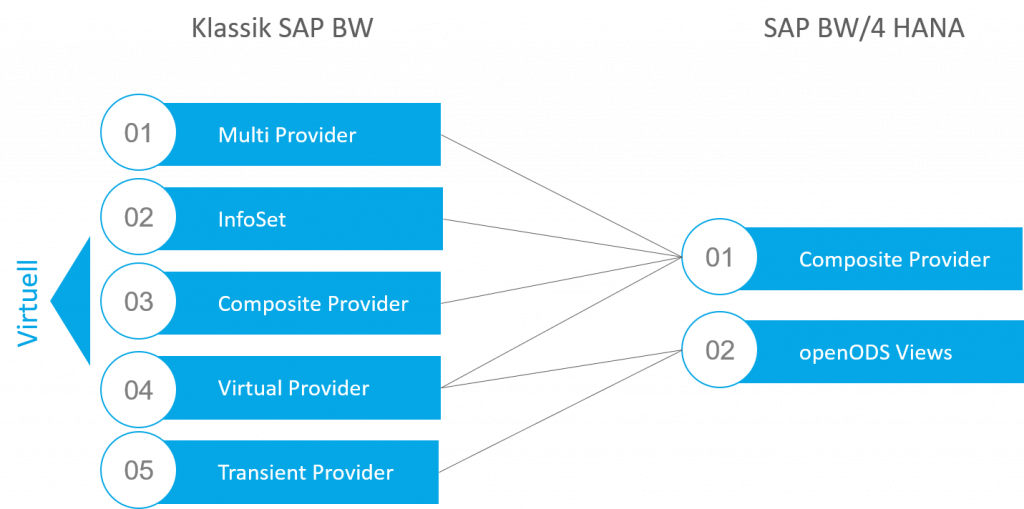
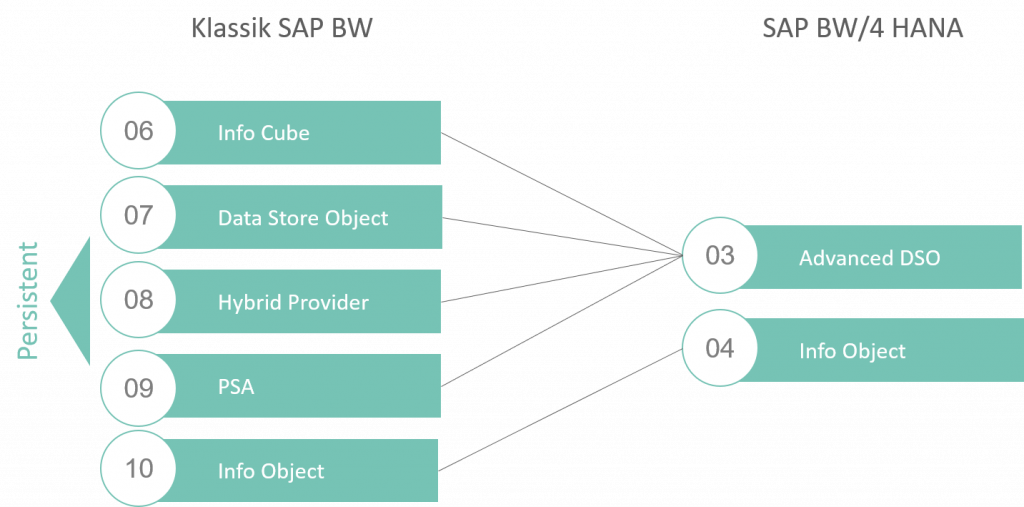
We consider two other aspects to be much greater advantages:
Optional field-based modeling finally (!) enables faster and more needs-based development, because semantics (InfoObjects) no longer need to be defined top-down in advance. The input aDSOs can be generated, enabling initial reporting in just a few minutes or hours. Whereas previously hundreds or thousands of InfoObjects had to be created, even for simple information fields, this can now be limited to cases where it makes sense. This significantly speeds up development processes.
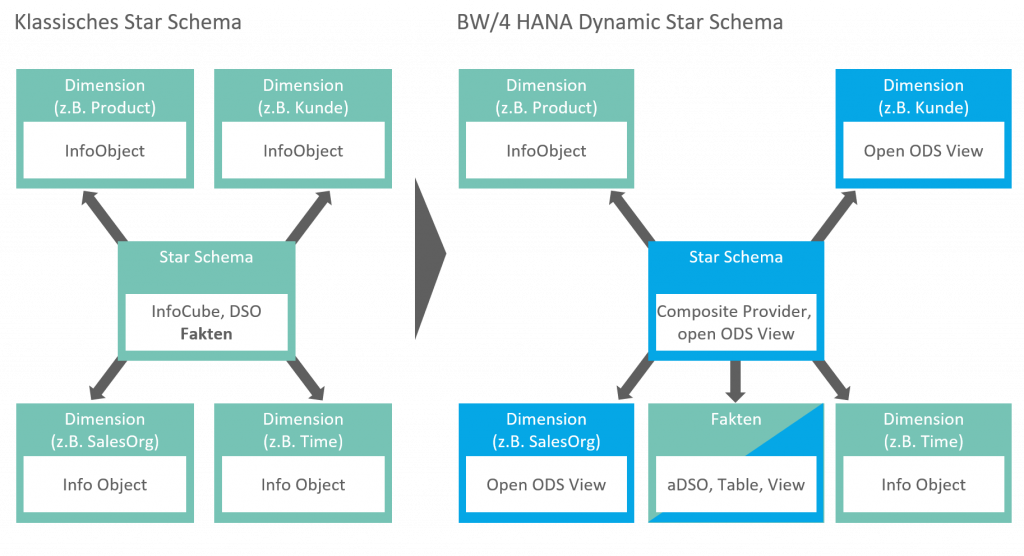
Another major change compared to classic BW systems is the dynamic star schema. Previously, InfoObjects had to be physically stored in the InfoProviderInfoProviders are objects on which reporting (e.g., queries) can be executed.... More in order to be able to use navigation attributes, etc. The semantics have now been separated from persistence. The composite provider associates fields or InfoObjects in InfoProviders with persistent (InfoObject) or virtually modeled (openODS View) master data. Because a field can be associated with more than one master data object, this significantly increases flexibility in the development of data models.
4) Modern interface
With BW/4 HANA, development continues under BW 7.5. Data warehouse modeling is increasingly taking place in Eclipse. Whether this is seen as an advantage depends largely on personal preference. For experienced SAP BW developers, it is definitely a change at first. In our opinion, the BW/4 HANA Cockpit offers a greater advantage because it bundles all functions for the administration and monitoring of the BW system in an easy-to-understand web-based interface. The development environment only needs to be opened when required.
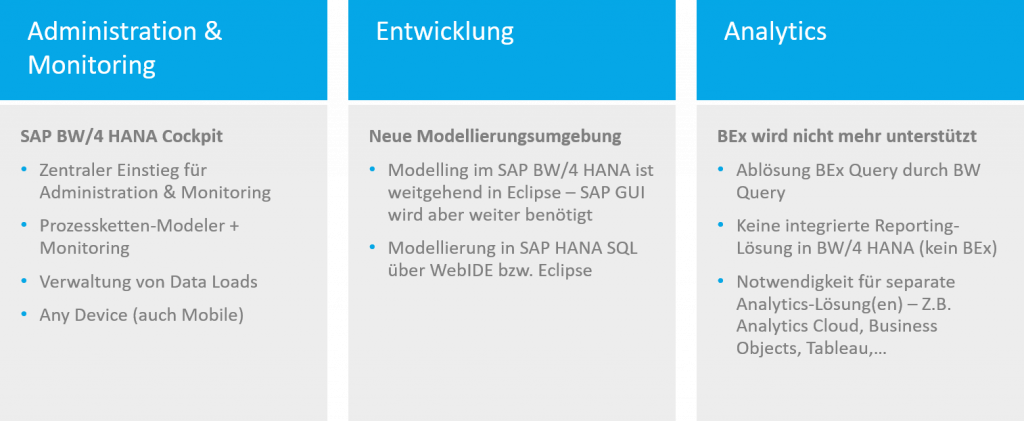
When introducing BW/4, it is important to note that BEx is no longer supported. This means that a separate BI tool must be purchased.
5) Conversion
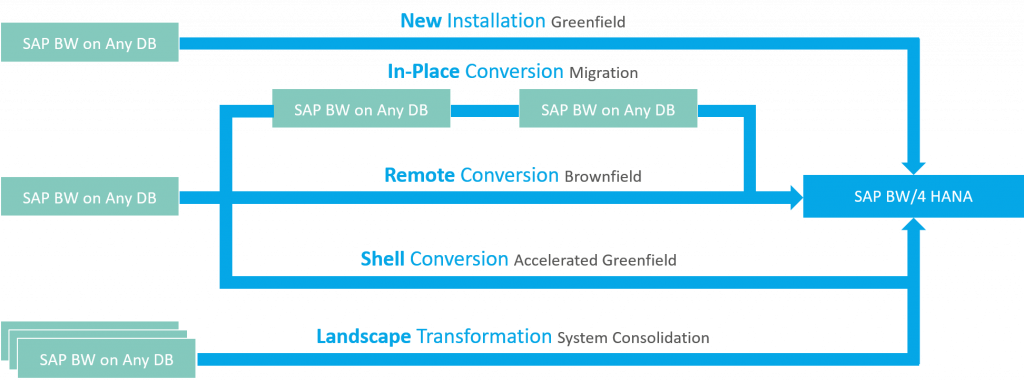
"There's something for everyone here" – With all the changes made by BW/4, SAP is making every effort to ensure that existing BW systems can be migrated. With three migration options for existing customers, SAP offers many ways to do this and has invested heavily in recent years. This means that previous investments in BW systems can be preserved.
Strategic aspects
In addition to the functional aspects, we would also like to formulate considerations from a strategic perspective.
First, the obvious: the SAP product strategy. Support for BW 7.5 will end in 2027. By then at the latest, the transition will be mandatory. Depending on the migration approach, the transition cannot start just one year in advance. By then, the added value of BW/4 HANA over BW 7.5 will become increasingly clear. Significant further developments will now only be available for BW/4 HANA. SAP will no longer invest in the further development of NetWeaver BW systems. Functionally, BW/4 will thus become increasingly superior.
We do not view BW/4 HANA implementations primarily from a functional perspective. Rather, the implementation offers an opportunity to realign analytical systems. SAP Business Warehouse (BW) has been on the market for over 15 years now and has built up a very broad customer base of more than 15,000 since its inception. It has established itself through its deep integration with SAP ERP systems. Over the years, large monolithic systems for reporting and analysis have grown, with a lot of money invested in them. However, in our discussions with customers, we have noticed that the long-standing SAP BW systems generally no longer meet all requirements. These systems often struggle with long development times and little flexibility. This makes agile methods considerably more difficult. Existing systems are generally not prepared for new requirements in the area of advanced analytics and big data. In addition, SAP S/4 HANA will gradually replace existing classic SAP ERP systems. In short, data warehouse systems are undergoing radical change.
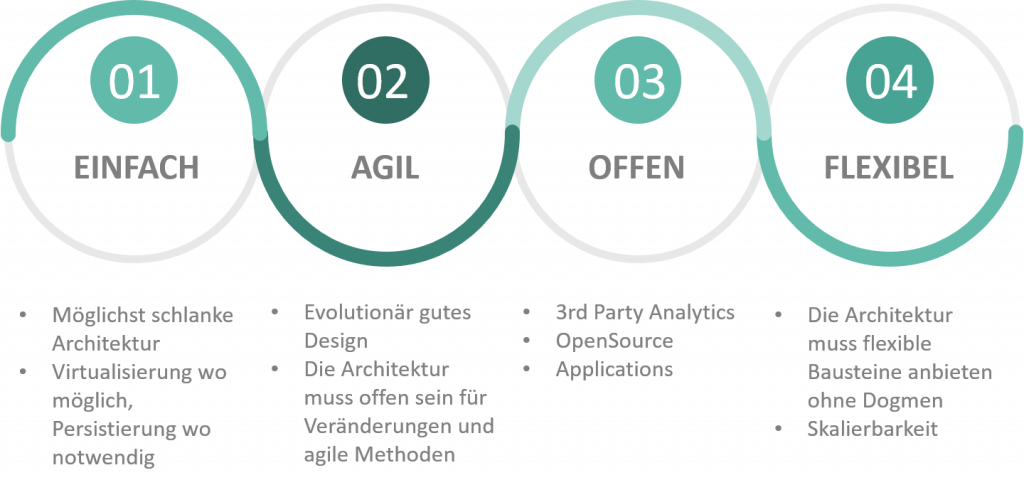
In these times of change, we see BW/4 HANA migration as an opportunity to overcome existing problems and prepare the system for future requirements. Key success factors are the right architecture and development methodology. A modern BW architecture must be simple, agile, open, and flexible. We see these aspects as necessary design principles for data warehouse architectures. The methodology used to implement a BW/4 architecture should also be as needs-based as possible. In our experience, agile principles are well suited for implementation. Customers receive usable features more quickly, which can increase satisfaction. With BW/4 HANA, these ideas and principles can now be put into practice.

Christopher Kampmann
Head of Business Unit
Data & Analytics
christopher.kampmann@isr.de
+49 (0) 151 422 05 448