
Input Management
Input Management
The key to process optimization
A company functions like a well-oiled machine, with each part meshing seamlessly with the others. Input management is crucial to ensuring that everything runs smoothly. It helps to clearly see the flow of information and documents, as if you were spreading out a map on which every path is visible. With this overview, processes can be specifically improved and optimally controlled so that everything works together smoothly.
Table of Contents
- What is input management? A definition
- Why is input management important? What tasks are performed there?
- Input management process – input channels and multi-channel input management
- Challenges in business processes
- Areas of application in input management
- Example: Optimizing the customer service process in the company
- Advantages of input management
- Technologies for your success
- WWhat tools can be used?
- How do we provide concrete support to enterprises?
- Your Point of Contact
What is input management? A definition
Input management is part of ECM (enterprise content management) and encompasses various procedures for capturing business-relevant content and consolidating it digitally. Content can consist of structured and unstructured data from both paper-based and digital sources. An important part of input management is the selection of suitable hardware and software, as well as the connection of input management to subsequent applications and information systems.
Various techniques can be used to capture content as part of input management, including scanning solutions, OCR (optical character recognition), ICR (intelligent character recognition), barcodes, and full-text search. These technologies enable efficient and accurate data capture and processing, minimizing manual intervention and maximizing the accuracy of the information captured.
Another crucial aspect of input management is the integration of multi-channel input channels. This involves the central collection and processing of data from various sources such as email, web forms, mobile apps, social media, and IoT devices. This multi-channel strategy enables companies to respond flexibly to their customers' communication preferences and create a consistent database. Automating and centralizing data collection optimizes business processes, increases efficiency, and improves data quality.
Why is input management important?
- Increased efficiency: Automating document capture and processing reduces manual tasks, resulting in faster turnaround times and higher productivity.
- Cost reduction: Automated processes reduce the need for manual labor, which lowers operating costs. In addition, digitization minimizes the need for physical storage space.
- Improved data quality: Technologies such as OCR and intelligent classification systems increase the accuracy of the data captured, reducing errors and improving data quality.
- Optimized business processes: Input management enables seamless integration of data into existing business processes and systems, supporting more efficient and transparent working methods.
- Compliance and security: Structured input management enables companies to ensure that they meet legal and regulatory requirements regarding data protection and data security.
What tasks are performed in input management?
Input management involves the efficient capture and processing of incoming documents in a company or organization. These documents can arrive via various channels, including email, fax, post, web forms, and other digital communication channels. The document capture process is an essential part of input management and forms the basis for automated further processing and archiving of documents. The capture process begins with the identification and collection of incoming documents. The next step is digitization, if this has not already been done.
Digitization in input management refers to the conversion of physical documents into digital formats in order to increase the efficiency of document processing. This includes scanning paper documents to create digital copies and using optical character recognition (OCR) to extract text from the scanned images and make it searchable. This process improves the flow of information within companies, saves storage space, and increases data security. However, digitization also requires quality assurance measures and the protection of sensitive data in order to comply with legal requirements and achieve maximum benefit.
In input management, verification and quality assurance involve checking the captured and digitized documents for completeness and accuracy. A check is made to ensure that all required documents have been captured completely and without errors. Possible errors such as missing pages, typos, or inaccurate data are identified and corrected using manual or automated processes. These measures are crucial to ensure that the data can be processed correctly and that subsequent business processes run smoothly.
Classification and indexing are essential when processing documents and data in input management. Classification sorts documents by category or topic to facilitate organization. Indexing captures relevant metadata such as date and type to enable quick searches. These steps ensure efficient integration into systems such as document management systems (DMS) and company departments, which optimizes data management and processing.
Documents are automatically categorized and relevant information such as names, dates, and amounts are extracted. This data is then indexed, enabling fast and accurate searches. This automated process increases document processing efficiency, reduces manual input, and creates a structured database. This leads to a significant improvement in accuracy and processing speed.
The secure archiving and storage of digital documents is a key aspect of input management. Encryption, regular backups, and strict access controls ensure protection against loss and unauthorized access. Modern storage technologies such as cloud or network storage ensure both security and fast access to documents. This ensures that documents remain reliably available for future reference or audits.
Professional input management can overcome a variety of challenges that frequently arise in modern companies. Here are some of the most important challenges and how they can be addressed through effective input management:
By efficiently fulfilling these tasks, input management contributes significantly to optimizing business processes, increasing productivity, and ensuring data quality and security.
Input channels and multi-channel input management
Input management process
Input management comprises several essential steps that ensure that incoming documents and information are processed efficiently and accurately. These steps include:
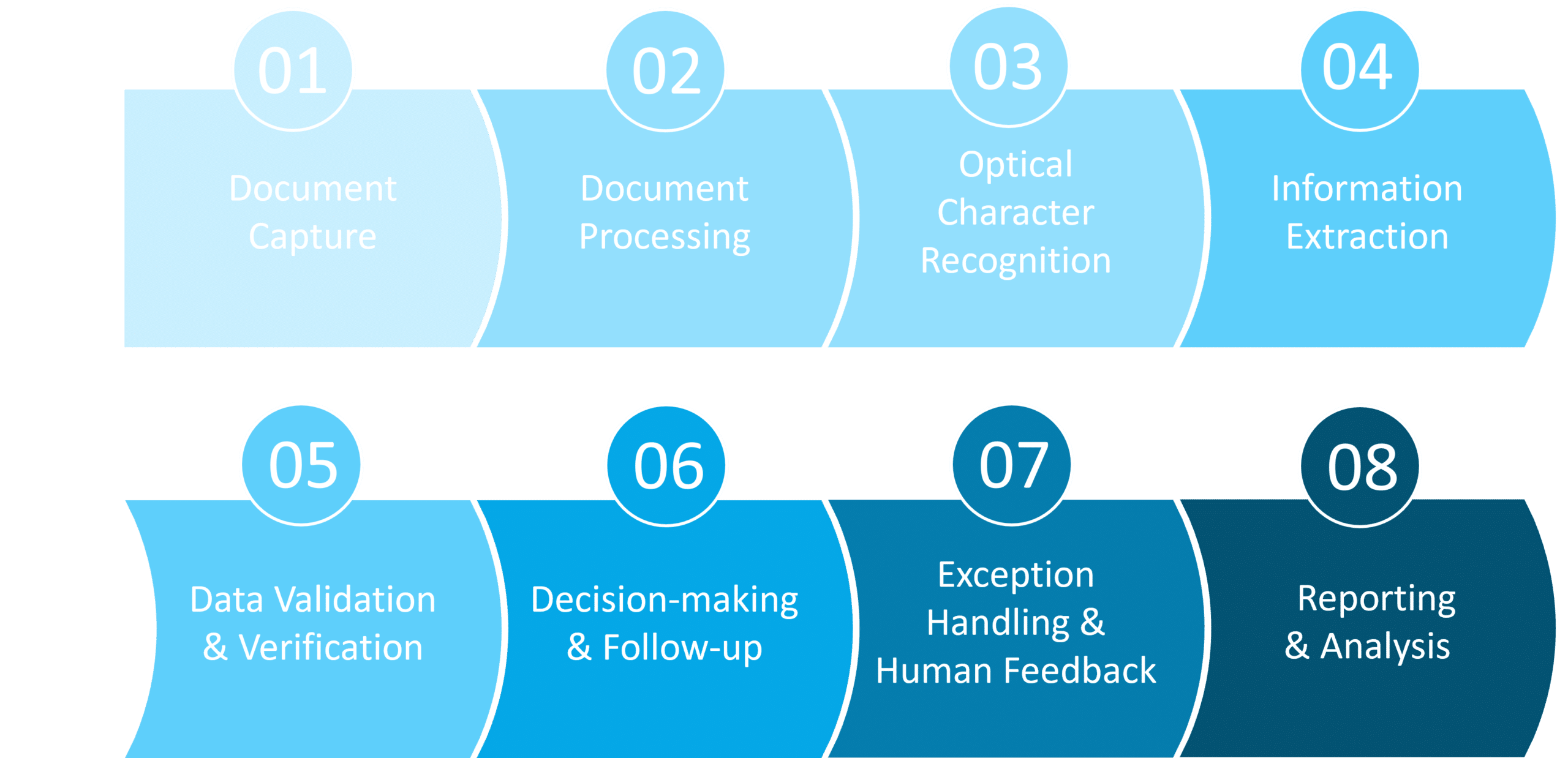
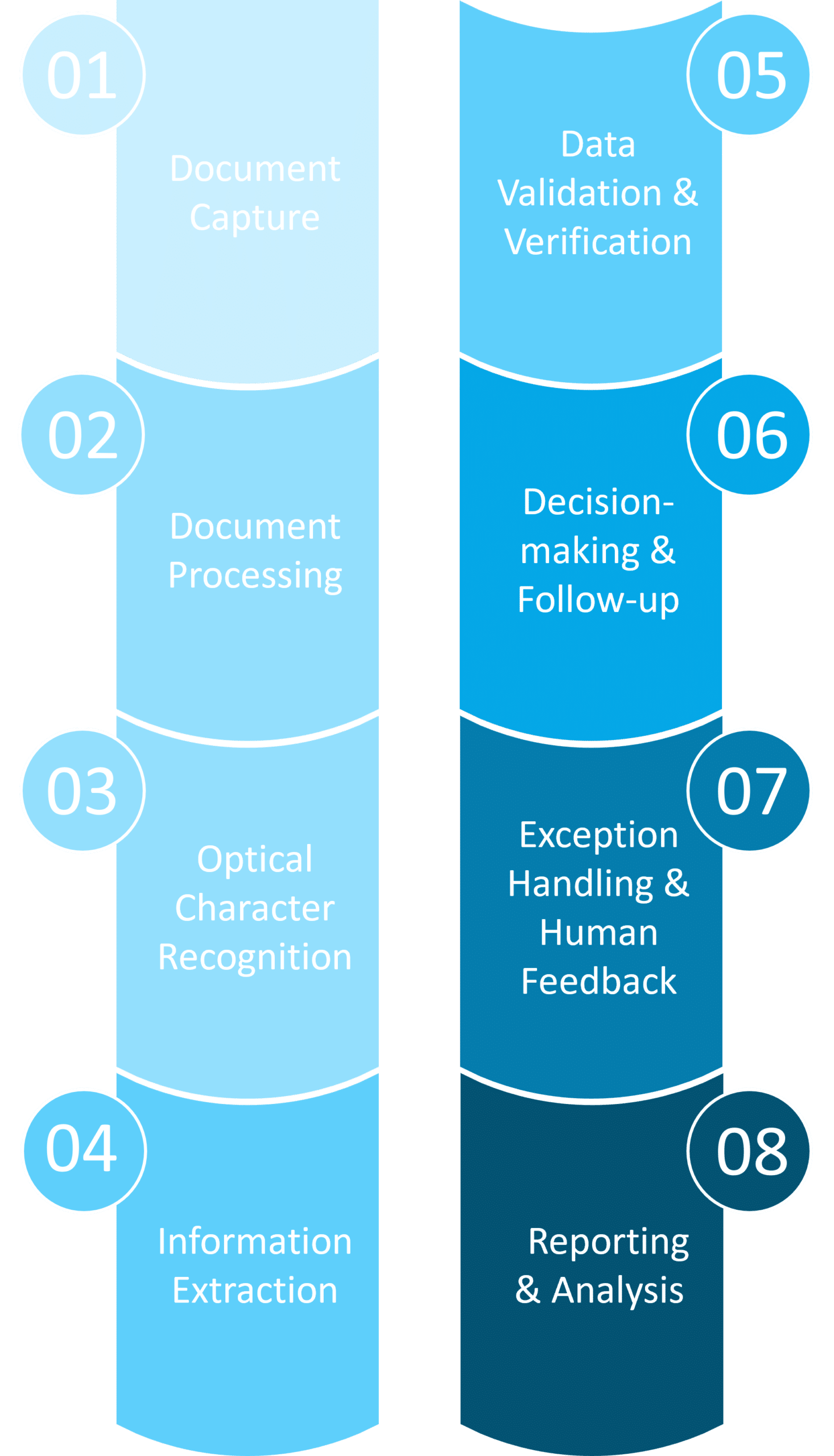
- Data capture: The first step is to capture documents into the system. This can be done in a variety of ways, including scanning paper documents, receiving email attachments, or accessing electronic documents from various sources.
- Document processing: After capture, documents must be prepared for processing. This may include removing distractions such as background noise, smoothing out creases, or rotating skewed scanned documents to ensure optimal readability.
- OCR (Optical Character Recognition): In this step, the text on the documents is captured using OCR technology and converted into machine-readable text. This enables the system to understand and process the contents of the documents.
- Informationextraction: Once the text has been captured, relevant information is extracted from the documents. This can include both structured and unstructured data, depending on what information is needed and how it is presented in the document.
- Data validation/verification: The extracted information is checked for accuracy and completeness to ensure that it meets the requirements. This may include comparison with existing data or reference databases to identify and correct discrepancies.
- Decision-making and further processing: Automated decisions are made based on the extracted information and predefined rules or algorithms. This can include forwarding documents to specific departments, executing actions, or initiating workflows.
- Exception handling and human feedback: In cases where the system cannot act clearly or correctly, exceptions are identified and forwarded to employees. They can then review the situation, correct it, and train the system to better handle similar cases in the future.
- Reporting and analysis: Finally, data about the processing process is collected and analyzed to gain insights that can be used to continuously improve the IDP system. This can include performance metrics, efficiency gains, and areas for improvement.
These steps ensure that incoming documents and information are processed efficiently and accurately in order to optimize the workflow within the company and ensure data quality.
What input channels are available?

Input management involves a variety of input channels through which data and information can enter a system. Here is an overview of the variety of input channels:
- Incoming mail and faxes: increasingly rare but still in use—physical documents such as delivery notes, invoices, etc. are received and digitized.
- Web forms: Data submitted via online forms on websites, e.g., contact forms, order forms, or registration forms.
- Mobile apps: Information and documents submitted or uploaded via mobile applications.
- Social media: Messages and inquiries received via social media platforms such as Facebook, Twitter, or LinkedIn.
- Phone and voicemail: Voice recordings and transcriptions of calls and voicemails.
- Document management systems: Integration with existing DMS, through which documents and information are automatically transferred to the input management system.
The connection of various input channels enables comprehensive capture of data and documents from different sources, thereby supporting efficient process automation and data processing in input management.
Multi-channel input management
The diversity of the various input channels
Multi-channelinput management refers to the ability of a system or solution to efficiently capture, process, and integrate data and information from various input channels (see graphic above). These input channels can be diverse and include both digital and physical sources. The goal of multi-channelinput management is to centrally bundle and harmonize all input data streams to ensure consistent and efficient further processing.
Blog Article
AI in input management:
Opportunities and challenges
The application of artificial intelligence (AI) has revolutionized numerous aspects of our lives in recent years. From medicine to logistics, scarcely an industry remains untouched by the advancements in AI. Propelled by innovations such as ChatGPT, AI has become a pervasive topic, highlighting the transformative potential this technology holds.
What challenges can be overcome with professional input management?
Professional input management can overcome a variety of challenges that frequently arise in modern companies. Here are some of the most important challenges and how they can be addressed through effective input management:
Data overload and diversity
Every day, companies receive large amounts of data from various sources and in different formats. Professional input management enables the structured capture and processing of this data, regardless of whether it is paper-based or digital.
Data security and compliance
Companies must ensure that they comply with legal requirements and data protection regulations. Professional input management ensures that data is securely captured, processed, and archived, and supports compliance with compliance guidelines.
Slow response times
In many companies, manual processes delay the processing and response to incoming information. A well-implemented input management system speeds up these processes so that information can be forwarded and processed more quickly.
Data silos and fragmentation
Manual processing and susceptibility to errors
Manual document processing is time-consuming and prone to errors. By using technologies such as OCR (optical character recognition) and automated workflows, data can be captured and processed quickly and accurately, reducing errors and increasing efficiency.
Scalability and Flexibility
As a company grows, so does the volume of data it needs to process. Input management systems are scalable and can be adapted to meet increasing demands. They also offer the flexibility to integrate various input channels such as email, mobile apps, and IoT devices.
By overcoming these challenges, professional input management contributes significantly to optimizing business processes, increasing efficiency, and improving data quality and security. This helps companies remain competitive and make optimal use of their resources.
Areas of application in input management
ordering process
Automates the entry and processing of orders, thereby reducing processing time and and increasing accuracy.
sales
Supports sales by quickly capturing and distributing sales documents, quotes, or customer information, thereby optimizing sales processes.
contract management
human resources
Supports the management of personnel records, job applications, and employee documents through automated capture and processing.
logistics
Optimizes the processing of shipping documents, proof of delivery, and freight documents through automated capture and forwarding to the appropriate systems.
Example: "Customer service"
Process optimization in the company
In today's digital age, companies, especially in industries such as telecommunications, insurance, and energy supply, face the challenge of handling a large number of customer inquiries every day across various channels. These inquiries, which arrive by email, online form, fax, or post, must be manually sorted, classified, and forwarded to the relevant departments. This process is time-consuming, prone to errors, and often leads to delays in processing, which negatively impacts customer satisfaction.
An efficient solution to this problem is the automation of the customer service process through the use of an input management solution. This solution automates and optimizes the entire process of capturing, classifying, and forwarding customer inquiries. Incoming inquiries are automatically captured—faxes and postal documents are scanned, while emails and online forms are integrated directly into the system. Optical character recognition (OCR) is used to extract text from scanned documents, and artificial intelligence and machine learning algorithms are used to classify inquiries based on their content.
The classified requests are then automatically forwarded to the relevant departments without the need for human intervention. The recorded and classified requests are archived in a central, secure system, which facilitates tracking and ensures compliance with data protection and security standards. In cases where the system cannot make a clear decision, the requests are forwarded for manual review to employees who can train the system for future similar cases.
In summary, our input management solution enables efficient and error-free processing of customer inquiries, increases the efficiency and quality of customer service, and ensures high customer satisfaction.
Advantages of input management
- Time and cost savings: Reduction of manual processing effort through automatic reading and classification of data.
- Increased efficiency: Simplified and faster processing of incoming documents (such as invoices, delivery notes, consumption readings, etc.).
- Multi-channel input: Coordination and processing of data from various input channels such as email, scanners, and mobile apps.
- Optimized process times: Improvements to input processes significantly reduce processing time.
- Increased data security: Consistently consolidated and secured documents minimize the risk of data loss.
- High precision and extraction rates: Use of artificial intelligence for precise data extraction and classification.
- Scalability: Flexible adaptation to growing data volumes and changing business requirements.
- Integration: Seamless integration with existing IT systems and workflows for efficient use of data.
- Compliance with legal standards: Ensuring compliance with all data protection and security requirements.
- Cloud migration: Enabling the migration of existing input management solutions to the cloud for better scalability and accessibility.

Whitepaper
From Document to Digital Process
No more paperwork and manual sorting. From now on, all input automatically enters the correct process, entirely without manual detours or lengthy implementations. Read in our whitepaper how AI-powered automation and modern cloud technologies can transform your Input Management.
What tools can be used?
Various tools and technologies can be used in input management to make the collection, processing, and management of information efficient and accurate. Here is an overview of some of the most important tools and technologies:
OCR (Optical Character Recognition)
OCR software is used to extract text from scanned documents, images, or PDF files. This enables printed or handwritten text to be converted into machine-readable data that can be further processed.
IDP (Intelligent Document Processing)
IDP systems combine OCR with artificial intelligence and machine learning to automatically analyze and understand complex documents and extract relevant information. They can process structured and unstructured data.
IDA (Intelligent Data Automation)
IDA solutions go beyond simple document processing and automate entire data flows. They integrate various data sources, analyze the data, and automatically forward it to the appropriate systems and departments.
scanning solutions
High-performance scanners and document scanners are used to digitize physical documents quickly and efficiently. These scanners are often integrated with OCR software.
Workflow management systems
These systems support the automation and management of business processes by guiding the captured data through predefined workflows.
DMS (document management system)
DMS solutions store and manage digital documents and enable easy searching, sharing, and archiving. They are often integrated with OCR and IDP tools.
Email management systems
These systems capture and process incoming emails and their attachments to extract relevant information and forward the emails to the appropriate departments.
Barcode and QR code solutions
These technologies enable fast and accurate capture of data from barcodes and QR codes affixed to documents and packages.
Mobile capture apps
Mobile apps enable the capture and processing of documents and data via mobile devices. These apps often use OCR technologies to extract text from photos and scans.
By using these tools and technologies as part of input management, companies can increase their efficiency, improve the accuracy of data processing, and reduce manual work processes.
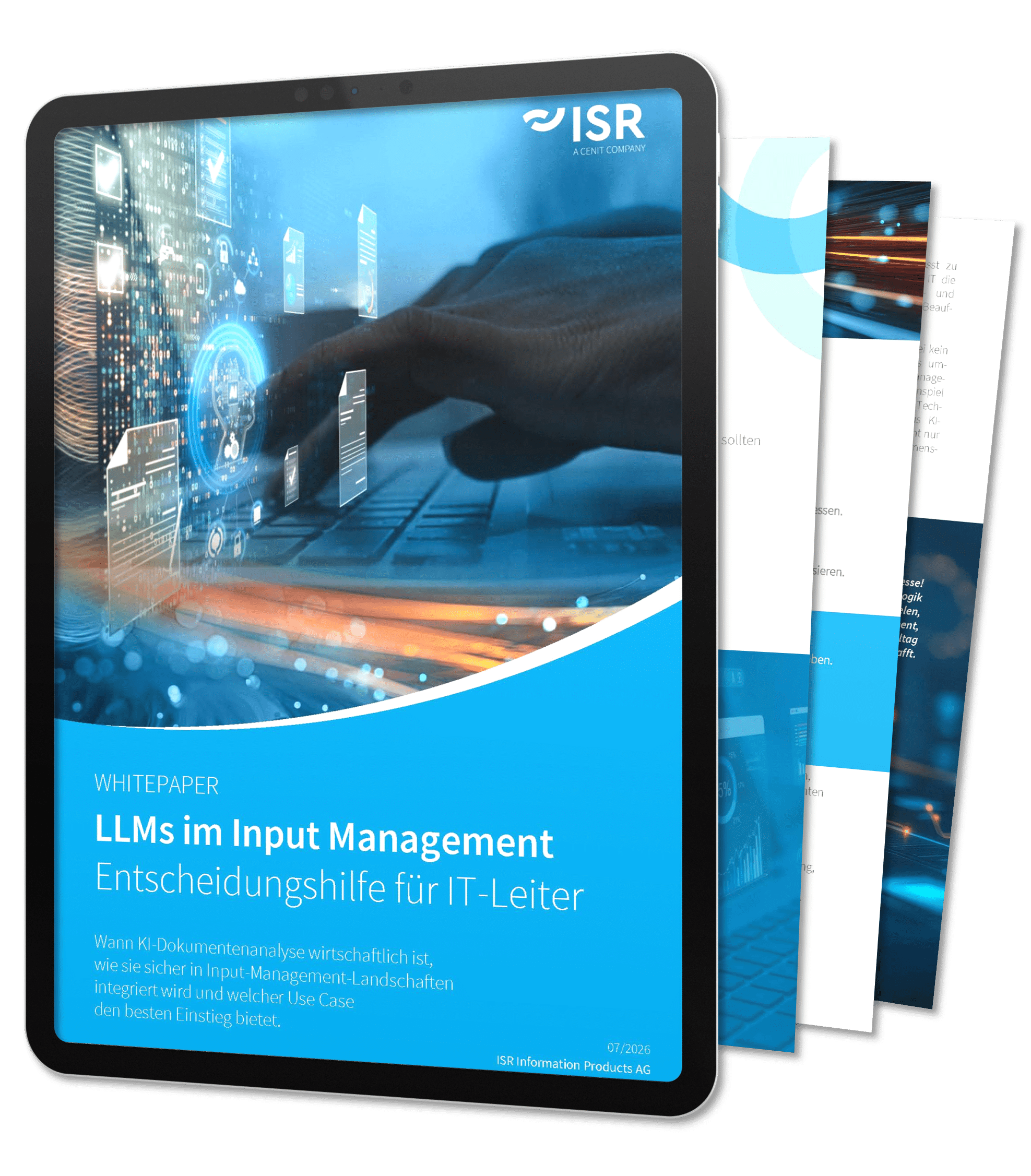
White Paper
: LLMs in Input Management—A Decision-Making Guide for IT Leaders
OCR, machine learning, or LLM—which is right for your input management? Not every document type requires AI. Read our white paper to learn when traditional methods are the better choice, where LLMs provide real added value, and how both approaches can be effectively combined.
In the area of input management, we rely on these
TECHNOLOGIES


We offer the following consulting services
Input Management




Read more in the ISR Blog
Valuable Content on Input Management

Input Management Review: Old Hat or Driver of Digitalization?

AI in Input Management: Opportunities and Challenges
How can we support companies?
ISR supports you in optimizing your input management and related process automation. With Buildsimple or IBM Datacap, we offer scanning and OCR technologies as well as AI for automatic text recognition and classification. In addition, we enable the migration of existing input management solutions to the cloud of your choice.
With our input management solutions, incoming mail, mountains of documents, and a variety of input channels can be quickly and cost-effectively connected and processed. Our business process automation team is available to provide you with detailed advice.
Get in touch with us now
We would be pleased to advise you.

Cihan Klingsporn
Senior Account & Marketing Manager
Document Logistics
cihan.klingsporn@isr.de
+49(0)151 422 05 471