Digital Invoice Processing – We call it a classic!

Share post via

More in Demand Than Ever, Yet an Established Concept: Digital Invoice Processing.

Every time we receive inquiries regarding "electronic invoice verification," we can't help but smile. Why? Because we are inevitably reminded of Franz Beckenbauer's words. When asked by a foreign reporter about the significance of the Germany vs. England match, he famously replied: „We call it a Klassiker!“

On Enduring Topics and Bestsellers in Process Digitalization

And that is precisely what electronic or digital invoice verification represents for us: a true classic among the countless possibilities of digital transformation! No other topic has been more frequently requested by clients or discussed internally by us in recent years. Approximately five years ago, we believed this topic was settled and the demand largely met.
However, the COVID-19 crisis taught us otherwise. For many companies, software-supported processing of their incoming invoices is digital uncharted territory that needs to be explored.
The need for action, especially in the SME segment, is high. Digitalization is still very much in its infancy here. Therefore, we start here with the basics.

Back to the Roots – The Principle of Invoice Processing and Verification

But first, let's take a few steps back and examine what needs to happen within accounts payable so that an invoice can ultimately be authorized for payment.
Automated invoice verification describes the implementation of an administrative accounting process that, due to its scope, extends across all business units.

Essentially, there are four simple steps (see Figure 1) that must be observed and describe the verification process:

  1. Receipt and Entry of the Invoice
  2. Recording and Verification of the Invoice
  3. Posting and Approval of the Invoice
  4. Payment Settlement and Archiving/Filing of the Invoice
The Principle of Invoice Processing and Verification
Figure 1: The Principle of Invoice Processing and Verification | isr.de
The process outlined above is essentially comparable or similar in every company – partly because certain legal requirements must be observed. Practice shows, however, that a great deal happens within each of these four process steps and also in between. Because…

…the larger and more complex the company, the more intricate the process.
As a rule, there are clearly defined competency and approval rules. The so-called four-eyes principle is merely the beginning or a minimum requirement. With the increasing digitalization of accounting, workflows are also changing. Accounts payable is more than ever obliged to guide and control these processes.

Time to Act – Seizing the Opportunities of Digital Invoice Verification

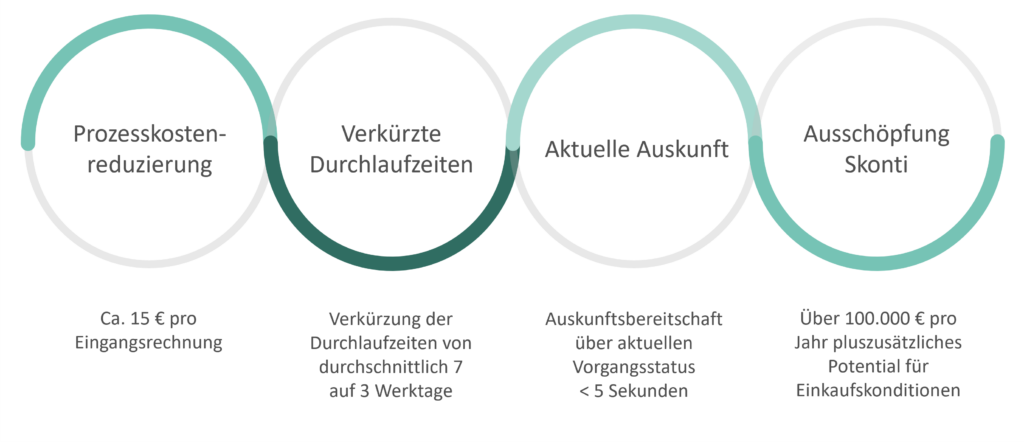
The advantages of implementing electronic workflows (see Figure 2) are clear:
The Advantages of Digital Invoice Processing and Verification
Figure 2: The Advantages of Digital Invoice Processing and Verification | isr.de
In addition to the five advantages mentioned in Figure 2, five more occur to us immediately:

Through my daily collaboration with accountants, I understand the significant relief that implementing electronic invoice verification can provide. One no longer has to chase invoices internally but can ascertain their status with just 2-3 clicks, providing complete transparency that extends beyond one's own organization. Automated checks and proactive notifications assist in focusing on essential tasks. Furthermore, if additional savings are realized by adhering to supplier discount deadlines, management will also appreciate the benefits.

Sandra Bartke | Senior Consultant | Business Process Automation

However, it is important to note:

The implementation of an IT solution alone is insufficient. Crucial is the organizational support provided from project initiation through to the handover of the invoicing solution into regular operation.

Thanks to our extensive experience and numerous successfully implemented projects in this segment, ISR provides you with an expert consultant by your side. Our preferred technology for incoming invoice processing is ISR Account Payable Flow. Furthermore, if your input channels require further digitalization, we also excel in Input Management. Solutions with which we collaborate in this area include Buildsimple, IBM Datacap, and insiders smart FIX.

Do you have further questions? Please feel free to contact us.

The German Value Added Tax Act (UStG) contains clear regulations on the required appearance of an invoice and the mandatory data or information it must contain – § 14 para. 4 in conjunction with § 14a para. 5 UStG – these include, among others:

– Name and address of the service provider and the recipient of the service

– Tax number/VAT identification number

– Invoice date and invoice number

– Quantity and description of the delivered goods

– Time of delivery or service

– Remuneration details, as well as specification of tax rates and tax amounts

– And much more.

With the introduction of EU Directive 2014/55/EU, public administrations, for example, are obligated to work with e-invoices. The electronic invoice (e-invoice for short) contains all essential invoice information, but

– In a structured, electronic format – enabling transmission and receipt purely electronically.

– Further processing of the invoice also occurs automatically and purely electronically.


What is not meant: Paper invoices converted into PDF files and attached to emails. This does not constitute an electronic format.

This refers to incoming invoices that correspond to an open, typically approved, purchase order within the enterprise resource planning (ERP) system. During invoice verification (assuming appropriate APIs are available), a data reconciliation occurs between the incoming invoice and the purchase order. The advantage here is that invoices with purchase order matching can typically be approved automatically, which reduces the verification effort for accountants.
The primary task of Accounts Payable is the processing of all incoming invoices. Key responsibilities include:
– Invoice verification and recording
– Attachment assignment
– Determination of the next processor
– Account assignment
– Payment instruction
– Monitoring of open items
– Resolution of vendor inquiries
– Potentially, master data maintenance

About ISR

Since 1993, we have been operating as IT consultants for Data Analytics and Document Logistics, focusing on data management and process automation.
We provide comprehensive support, from strategic IT consulting to specific implementations and solutions, all the way to IT operations, within the framework of holistic Enterprise Information Management (EIM).
ISR is part of the CENIT EIM Group.

Visit us virtually on these channels:

News Categories
News Archive

Latest Publications

Upcoming ISR Events

[tribe_events_list limit=”3″]