
SAC Planning
Integrated Planning with SAP Analytics Cloud
Jointly Managing Financial and Operational Drivers
When financial planning, operational sub-plans, and forecasts are created in separate systems or Excel files, there is often a lack of standardized assumptions and a consistent view of the income statement, balance sheet, cash flow, and operational metrics. SAC Planning is the planning component of SAP Analytics Cloud and provides a unified environment for budgets, forecasts, scenarios, analysis, and reporting.
In the SAP planning tool, financial and operational drivers can be mapped in shared models. Planned values can be entered, calculated based on rules, and compared directly with actual data. Only when the data model, key performance indicators, and control logic align do dependencies between sub-plans become transparent, providing both Controlling and management with a coordinated basis for decision-making.
As a specialist in enterprise information management, ISR therefore does not view planning projects with SAP Analytics Cloud from a purely technological perspective. We provide support from the business vision and data model through integration into a robust data and analytics architecture, all the way through to implementation, training, further development, and operation. In doing so, we assess whether classic SAC models, a hybrid architecture, or Seamless Planning with SAP Datasphere are best suited to the specific scenario.
What Is SAC Planning? A Definition
SAC Planning refers to the planning functions of SAP Analytics Cloud. It enables companies to manage planning cycles for budgets, forecasts, and scenarios. Companies enter or calculate planned values in models, manage versions, and compare them directly with actual data in stories and dashboards. Planning, analysis, and reporting remain integrated within a single cloud application.
The specific solution is built from modular components: models organize key metrics and dimensions, data actions and formulas control calculations and allocations, and calendars and tasks coordinate the process. This allows for the implementation of both individual functional planning and integrated financial planning. The appropriate scope depends on the management model, the data, and the responsibilities.
SAC Planning for Integrated Business Planning
SAC Planning helps companies develop a common management framework from decentralized planning processes. The value comes not from individual functions, but from their interaction:
Integrating Financial and Operational Planning
Revenue, expenses, personnel, investments, the income statement, the balance sheet, and cash flow can be structured in a modular fashion and combined into a consistent overall plan.
Plan Based on Drivers Rather Than Individual Values
Data Actions, Multi Actions, and Advanced Formulas apply assumptions such as price, quantity, FTE (full-time equivalents), or space costs to the relevant planning objects based on rules. This reduces manual entries and makes the effects traceable.
Comparing Scenarios in a Controlled Manner
Private and public versions enable forecasting, top-down and bottom-up planning, and "what-if" analyses without prematurely changing the approved plan.
Coordinate processes
Calendars, tasks, comments, approvals, and workflows provide clarity regarding responsibilities, deadlines, and processing statuses.
Bringing Planning and Reporting Together
Planners can analyze inputs, variances, and results within the same interface, from the management view down to the line item level.
Making Targeted Use of Forecasts and AI
Predictive functions and AI assistance can support forecasts, scenarios, explanations, and commentary. Calculations and approvals relevant to audits should continue to be based on transparent rules, validated data, and clear governance.
ISR Recommendation: Do not start with a simple feature comparison. First, the target process, control logic, data ownership, and a prioritized planning use case should be defined. A modular approach limits initial complexity and ensures the solution remains scalable.
Technical Aspects of Integrated Corporate Planning
The figure illustrates, by way of example, how integrated business and financial planning is often structured. The starting point is the strategic objective, from which targets are derived for the operational planning areas such as sales, materials and cost of goods sold (COGS), cost centers, and capital expenditures. The results of these sub-plans are then incorporated into the integrated income statement, balance sheet, and cash flow planning.
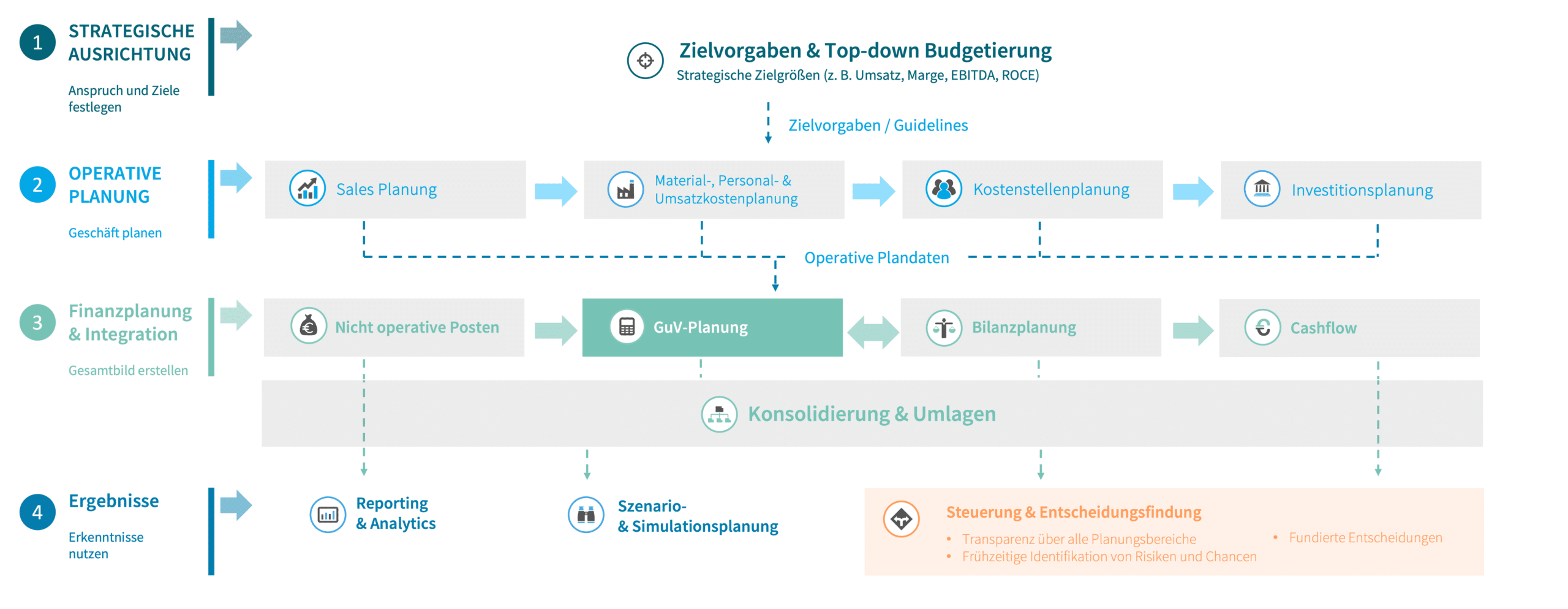
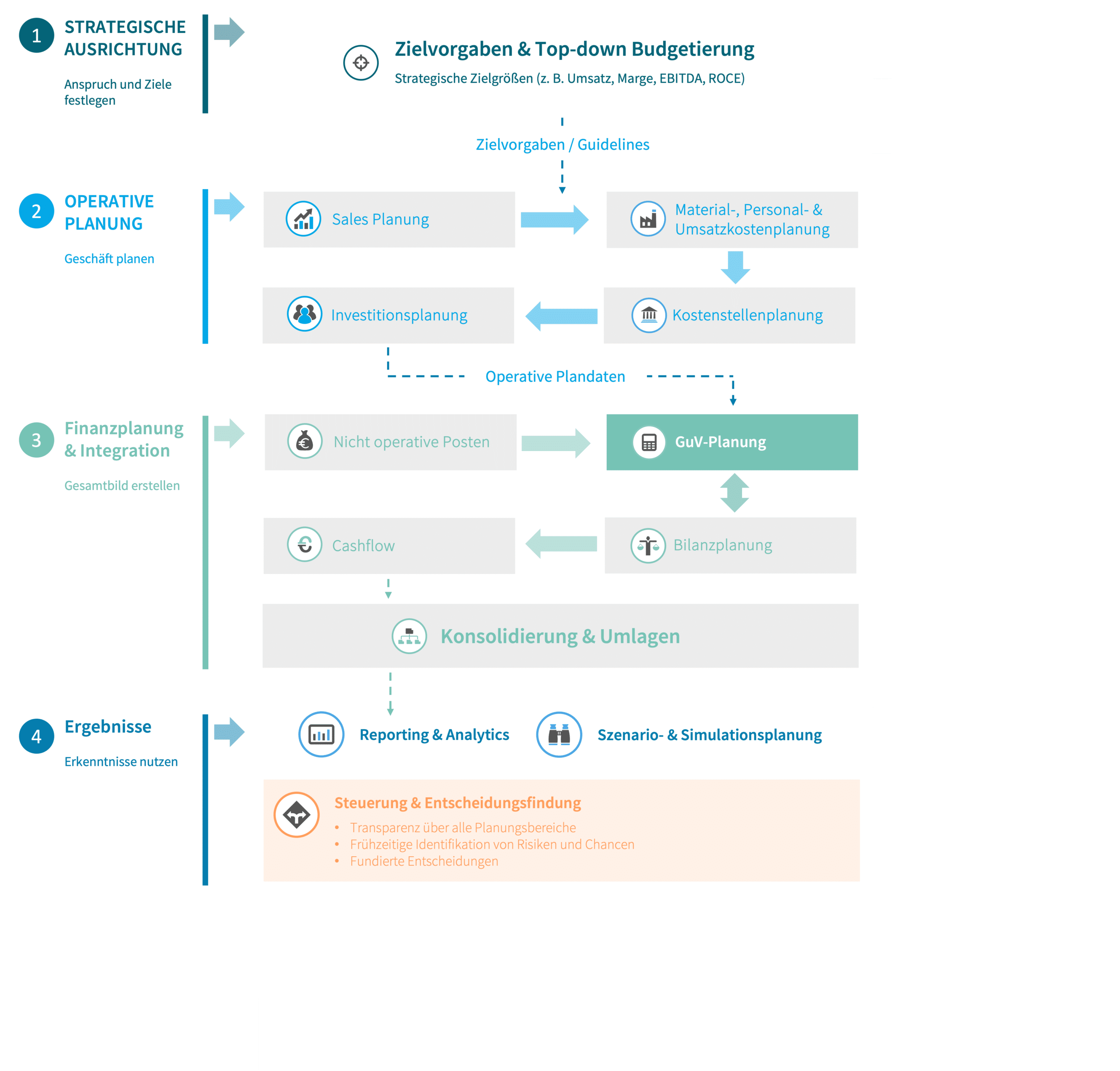
Cross-functional capabilities such as consolidation, allocation, currency translation, and scenario and simulation planning bring the individual areas together into a consistent overall picture. This creates a consistent planning framework that enables plan-to-actual comparisons, management reporting, and well-informed management decisions based on a shared data and planning foundation.
Your start
SAP Analytics Cloud Workshops
Whether it’s reporting, visualization, or planning: ISR’s SAP Analytics Cloud workshops provide you with a hands-on introduction to the features and use cases relevant to your needs. The BI workshop covers topics such as architecture, data integration, modeling, and story building. The Planning workshop focuses on topics such as data models, input screens, forecasting, distribution functions, value driver trees, and planning calendars. There is a special focus on Seamless Planning through the integration of SAP Analytics Cloud and SAP Datasphere—enabling integrated planning processes without additional data replication and with a shared data source for analysis and planning. Together with experienced ISR consultants, you’ll establish a solid foundation for prioritizing requirements and determining the next steps for your SAC project.


Integrated financial planning does not result solely from data consolidation, but rather from a common management framework that spans companies, processes, and planning approaches.
Thomas Riedel
Managing Consultant | Data & Analytics
SAC Planning: From Drivers to Scenarios
A Look at the Tool
The following views illustrate planning and reporting with SAP Analytics Cloud using sample data. The values labeled “Actual” are also provided for illustrative purposes only and do not represent actual business results.
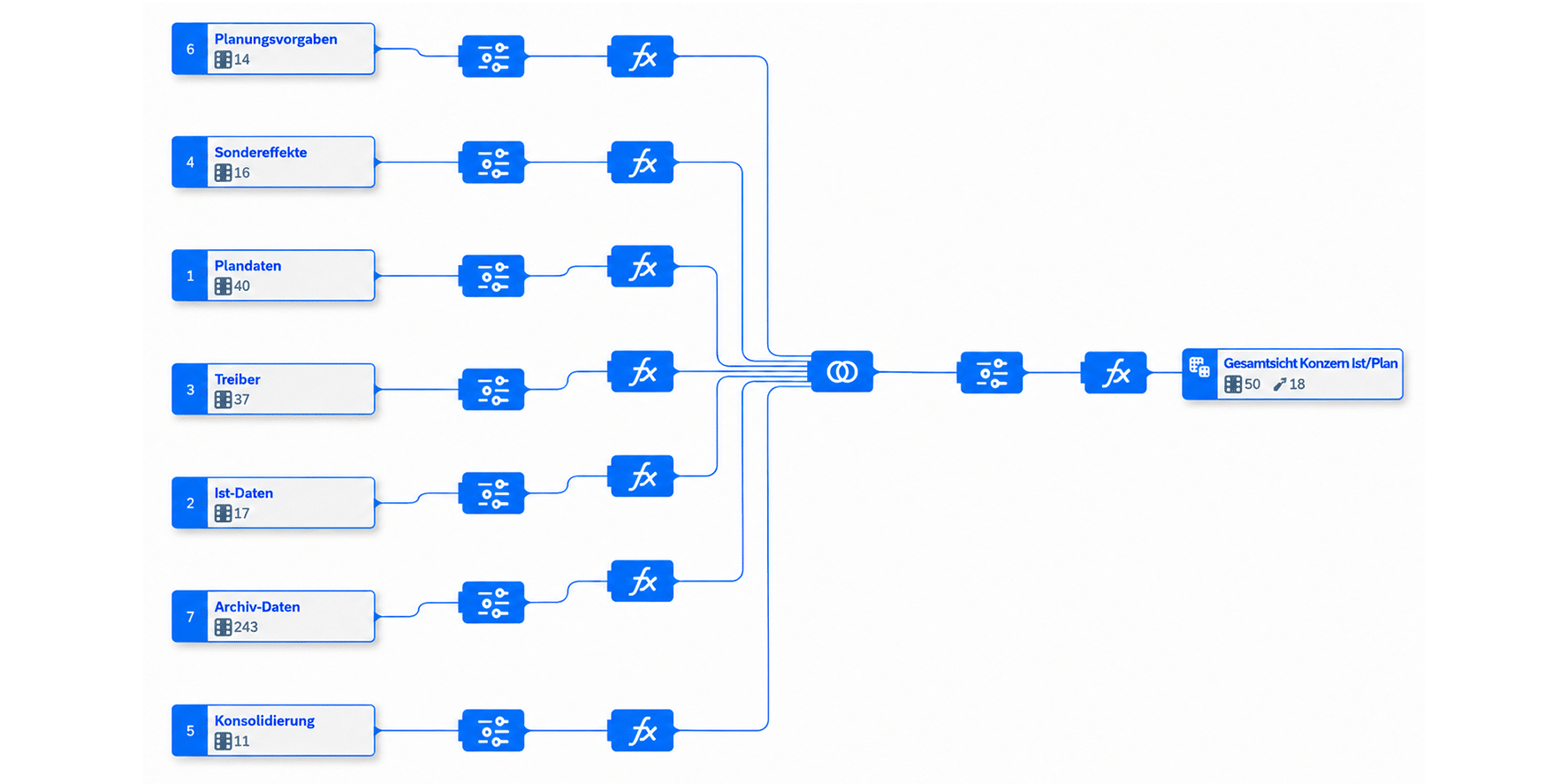
Database in SAP Datasphere
Consolidate detailed plans, actual data, and corporate guidelines into a single view.
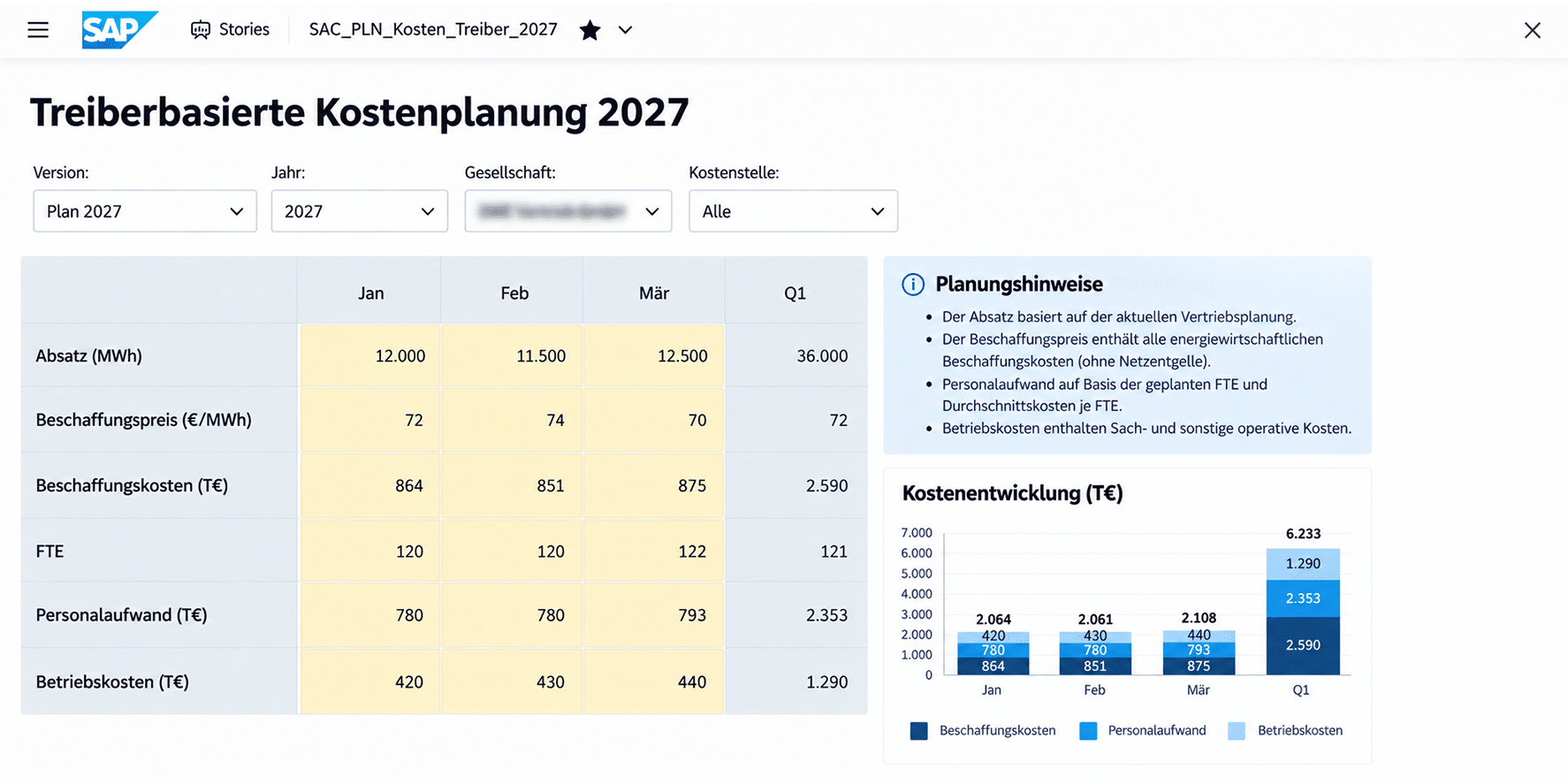
Driver-Based Cost Planning
A planner adjusts the sales and cost drivers in their planning view.
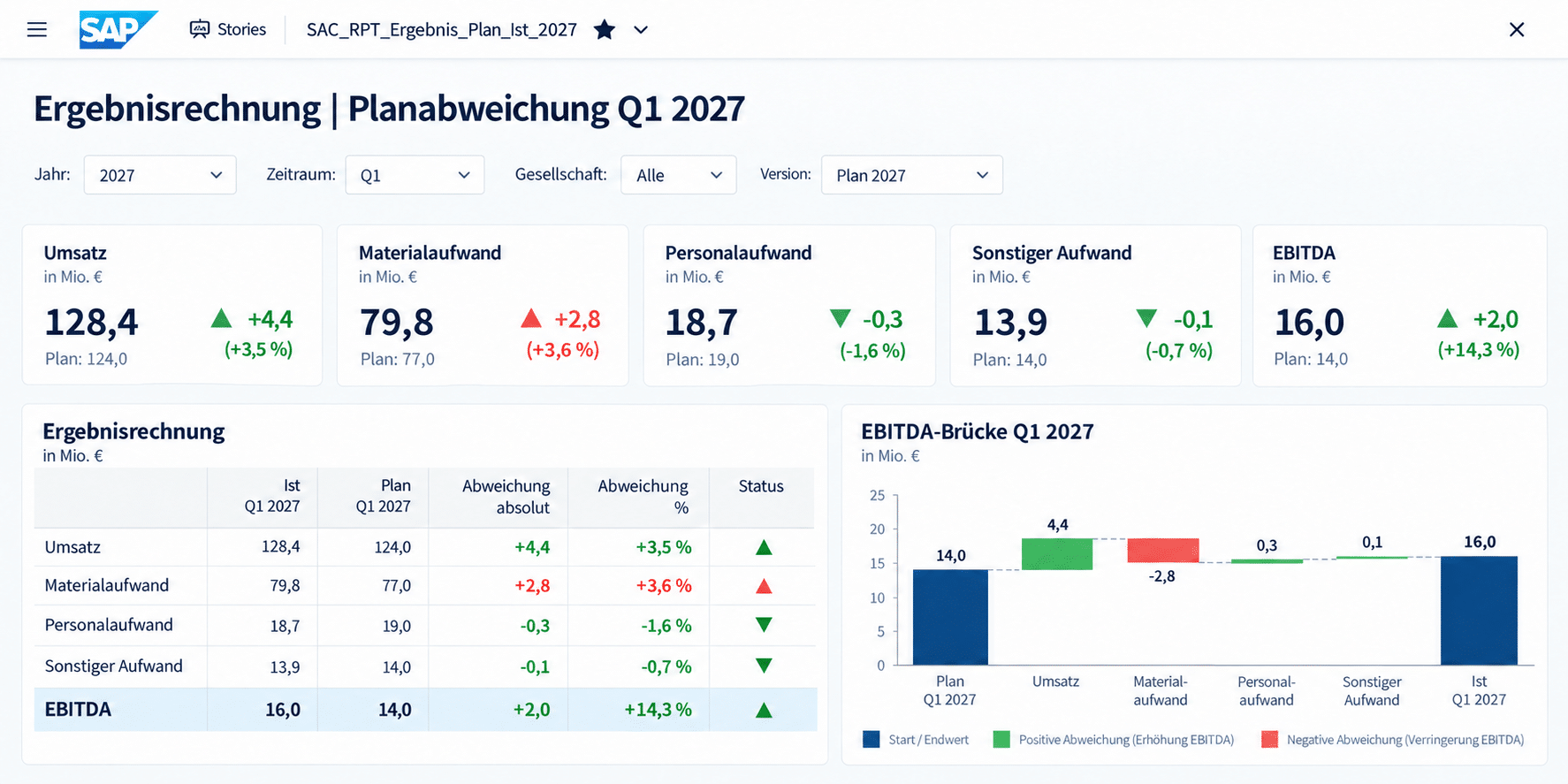
Results Reporting
Analysis of the Key KPIs for planning taking actual data into account.
Integrate SAC Planning into Your SAP and Data Environment
SAC Planning is a cloud-based solution. Which data is used in real time or imported depends on the planning process, the source system, the volume of data, write requirements, and the target architecture.
- Systems and Data Sources: Typical source systems and platforms include SAP S/4HANA, SAP BW or BW/4HANA, and SAP Datasphere. Depending on the existing architecture, data from SAP BPC as well as from SQL, OData, and non-SAP sources can also be integrated. Relevant data primarily includes actual and master data, hierarchies, exchange rates, drivers, plan values, and authorization attributes.
- Seamless Planning with Datasphere: With this approach, SAP Analytics Cloud and SAP Datasphere operate on a shared data foundation. Planning models can store data in SAP Datasphere, where it can be further processed or analyzed alongside harmonized actual data. This reduces the need for traditional data transfers between the planning system and the data platform. However, the suitability of existing SAC models and their migration must be evaluated based on the required functionality and current product limitations.
- Architecture and Security: For hybrid landscapes, connectivity, identities, roles, spaces, permissions, data location, and governance must be designed in tandem. Business-specific access—such as access to companies or cost centers—must be consistent from the source system all the way to the planning interface.
- Operations: The department can manage planning cycles, versions, and defined administrative steps. IT and platform administrators ensure secure connections, access permissions, performance, release management, and support. ISR can support implementation and further development through Application Management Services.
- Common pitfalls: Inconsistent account and master data, conflicting finance and controlling perspectives, unclear currency logic, excessive granularity, a lack of data ownership, and underestimating the need for change management can result in more work than simply configuring the tool and should therefore be addressed early on.
Seamless Planning with SAP Datasphere
Share Planned and Actual Data
With Seamless Planning, planning models are created in SAP Analytics Cloud, while their plan data is stored in SAP Datasphere. Users perform planning and reporting via SAC; actual data can be incorporated as live versions.
Since planning data is already available in SAP Datasphere, it can be used there for reporting or downstream applications without first being exported from SAC. This approach is particularly relevant when SAP Datasphere serves as the central data platform. For existing SAC import models, you should determine what adjustments are needed to the model structure, functions, and authorizations.
ISR combines expertise in architecture and planning. We define modeling specifications and quality gates, empower business units and IT to drive their own development, and support the implementation process through to operation. In doing so, we assess whether the centralized use of planning data justifies the effort required for the transition.
Technical Architecture with Seamless Planning
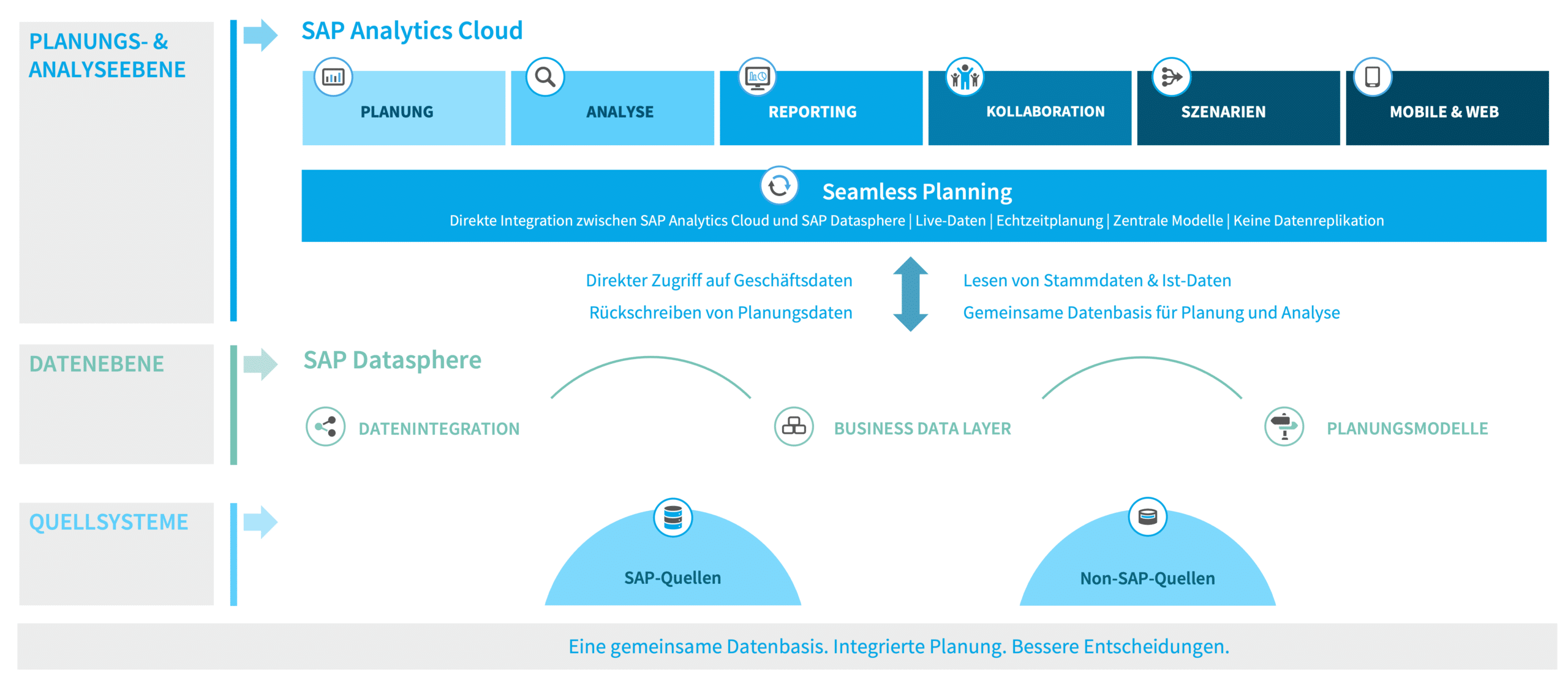
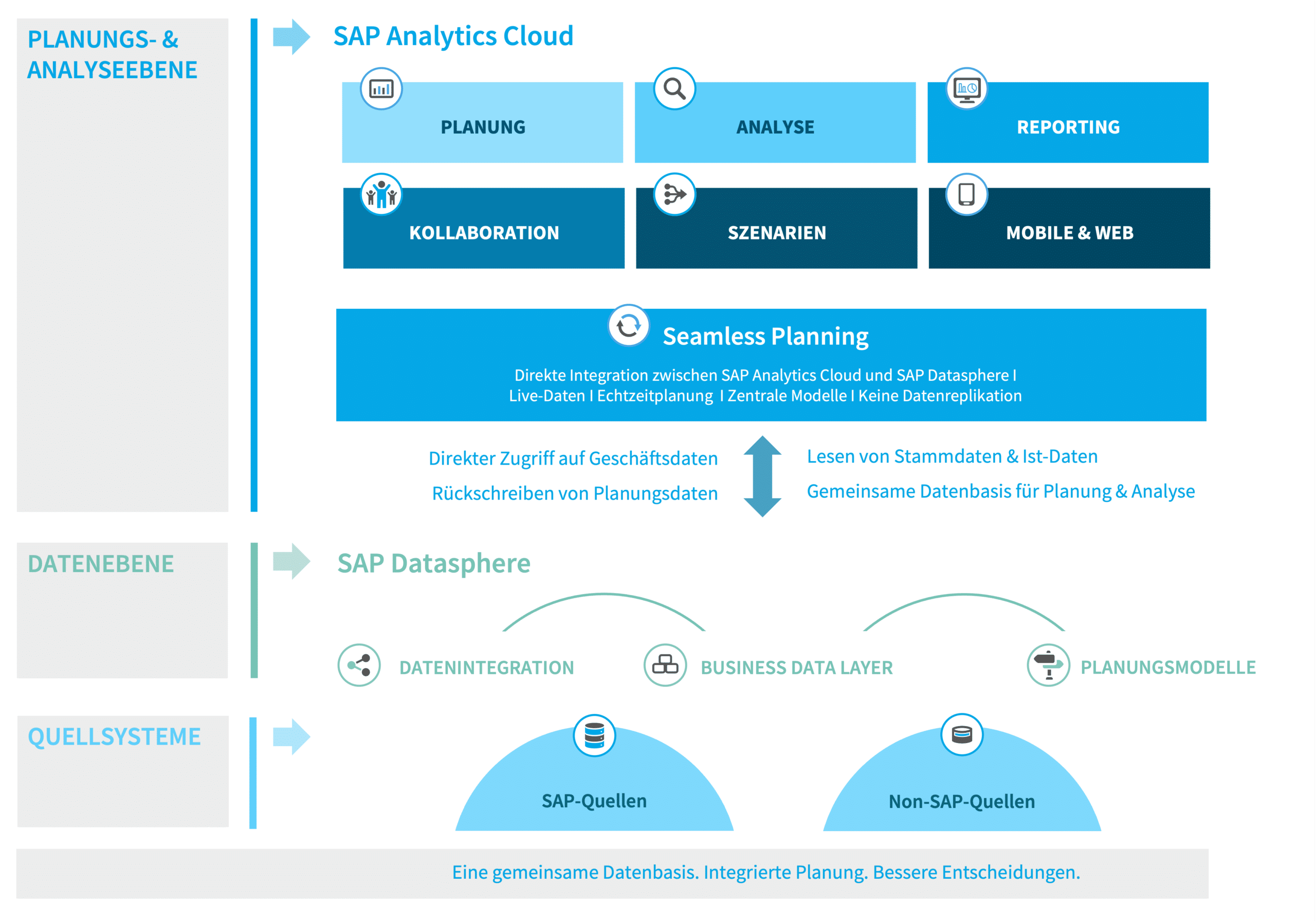
The architecture shown illustrates a possible scenario for an integrated planning application using SAP Analytics Cloud (SAC) and SAP Datasphere. Seamless Planning connects planning, reporting, and analytics directly to a central database. This ensures that transactional data, master data, and operational information from SAP and non-SAP systems are consistently available for various planning processes.
Using this shared database, departments can, for example, carry out budgeting, cost center planning, capital expenditure planning, sales planning, and financial statement planning; simulate scenarios; and analyze results. The end-to-end integration supports collaboration among different user groups and creates a unified foundation for planning, analysis, and well-informed business decisions.
EWE AG (Placeholder, not yet published!)
Strategic Group Planning with Seamless Planning

EWE AG brings together a wide variety of business segments, each with its own business model and planning approach. The company sought a solution to integrate these individual perspectives into a unified group planning process.
To this end, an integrated planning architecture using SAP Analytics Cloud and SAP Datasphere was developed in collaboration with ISR. It combines the driver-based detailed planning of the business units with centralized data storage, consolidated reporting, and clearly defined access controls. A key feature of the project is that the business units themselves continue to develop their planning models within defined standards.
Frequently Asked Questions About
, SAC Planning, and Seamless Planning
SAC Planning is the planning component of SAP Analytics Cloud for budgeting, forecasting, scenarios, and performance management. It is suitable for individual functional planning as well as for integrated business and financial planning—for example, revenue, costs, human resources, capital expenditures, income statements, balance sheets, and cash flow. Which sub-plans are meaningfully linked depends on the company’s functional management model.
Compared to distributed Excel files, SAC Planning offers centralized models, versions, permissions, workflows, and a shared database for planning and reporting. SAP BPC may still be relevant in existing on-premises or hybrid architectures. Whether modernization, coexistence, or replacement makes sense depends, among other things, on complexity, custom logic, cloud strategy, data architecture, and operating model. A sound recommendation therefore requires an assessment of the existing planning logic, architecture, and operating model.
Yes. Drivers such as prices, quantities, FTEs, capacity utilization, or store space can be distributed across planning objects using Data Actions, Multi Actions, and formulas, and then calculated to generate dependent metrics. With private and shared versions, you can modify assumptions, compare scenarios, and assess the impact on the income statement, balance sheet, cash flow, or operational KPIs before a plan is published.
SAP Analytics Cloud can utilize data from SAP S/4HANA, SAP BW or BW/4HANA, SAP BPC, SAP Datasphere, and various cloud, SQL, and OData sources, among others. Depending on the source and planning scenario, live connections, data imports, or data storage in SAP Datasphere may be appropriate. When making architectural decisions, it is important to evaluate the following factors together: data freshness, write requirements, performance, data volume, governance, and existing investments.
Seamless Planning integrates the planning functions of SAP Analytics Cloud with data storage in SAP Datasphere. This allows plan and actual data to be more closely aligned and used for reporting or further planning processes. Whether this approach is suitable depends, among other things, on existing SAC models, required functions, authorizations, and the target architecture.
A robust project begins with a vision, use-case prioritization, and a shared definition of KPIs, drivers, planning logic, and roles. This is followed by the architecture and data model, a prototype core process, integration, testing, training, rollout, and handover to operations. The effort required depends primarily on the number and interdependencies of the sub-plans, data quality, granularity, currency and consolidation logic, access permissions, migration, and changes to established work processes.
SAC Planning is particularly useful when financial and operational planning needs to be based on shared data, drivers, and roles, or when existing Excel and BPC processes need to be further developed. If master data, responsibilities, and core planning logic have not yet been clarified, a business-oriented target vision should first be developed. Only then can a sound decision be made regarding which SAC functions and which target architecture are appropriate.
ISR combines expertise in SAP Analytics, BW, HANA, and Datasphere with project experience in finance and controlling. We provide support ranging from product selection and target architecture to driver-based models, integrations, data actions, and workflows, as well as training, support, and ongoing development. In a demo or a focused workshop, we’ll first review your specific planning process and show you which approach makes the most sense from a business perspective and is technically feasible.
Whitepapers
SAC Planning – Market readiness and project experience
What planning features does SAP Analytics Cloud offer, and how does the solution perform in integrated scenarios? This white paper provides a concise overview of performance, architectural considerations, and ISR project experiences.
Retail
Integrated Financial Planning with SAC
An international retail company faced the challenge of integrating numerous sub-planning processes with different planning logics and data models. Each month, approximately 4,000 active stores in 17 countries, several online stores, and the corporate headquarters had to be included in the planning process without having to set up a separate planning process for each location.
At the same time, revenue, cost of goods sold, and expenses should be consistently reflected in the income statement, balance sheet, and cash flow statement. To achieve this, ISR implemented a modular planning solution using SAP Analytics Cloud (SAC). It links operational sub-plans with financial planning and enables bottom-up planning as well as top-down targets and the simulation of various scenarios.
Our Expertise
Your Advantage
Our project experience ranges from replacing complex Excel-based planning and driver-based business planning to integrated financial and corporate planning with heterogeneous data sources. Time and again, we have seen that technology alone does not determine a project’s success. What matters most is how control logic, data architecture, roles, and collaboration are designed.
- Finance and controlling views, charts of accounts, currencies, hierarchies, and levels of detail must be harmonized from a business perspective. Integrated planning also requires common profit structures and clearly defined data transfers between the various planning modules.
- A focused proof of concept allows for the early verification of driver logic, management control options, and user interface functionality. Based on this, the planning can be expanded modularly to include additional sub-plans or companies.
- Core subject-matter teams should actively help shape planning logic, models, user interfaces, and tests. Modeling guidelines, training, and quality gates help ensure consistent implementation across different planning areas and embed subject-matter expertise within the company.
- Self-service requires a clear operating model. Before going live, it should be clearly defined who is authorized to further develop drivers, models, and master data; who reviews and approves changes; and who provides support in the event of errors or new requirements.
- Transparent data flows, explainable calculations, training, and accessible support are particularly important during the first few productive planning cycles. They help users understand variances and build confidence in new processes and results.
In the context of finance, AI can primarily serve as an assistant, for example, in forecasting, anomaly detection, or providing commentary. Logic related to auditing and financial reporting should continue to be implemented in a rule-based, transparent, and verifiable manner.
Reliable for Day-to-Day Planning:
SAC Planning During Operations
Once implemented, SAC Planning must prove its worth in the day-to-day planning process. ISR supports you in operating your solution, resolves issues, and assists with adaptations to new business requirements. We tailor the tasks we handle to your system environment and your support needs.

- Monitoring and Troubleshooting
- Support and Troubleshooting for Planning Processes
- Maintenance and Further Development of Models, Data Flows, and Permissions
- Transparency through documented processes and regular service meetings
Read more on the ISR blog at
for valuable content on SAC Planning

Integrated Enterprise Planning with SAP Analytics Cloud
Integrated corporate planning plays a crucial role in helping companies effectively translate their business strategies into planned KPIs …

Planning with SAP Datasphere in SAP Analytics Cloud: A Step-by-Step Guide
How can SAP Analytics Cloud (SAC) be utilized with Datasphere for planning processes? …

SAP Analytics Cloud: Planning on Non-Posted Characteristic Combinations
In certain planning scenarios, planning is required on 'unposted' entities/characteristics. This requirement can further …

SAP Analytics Cloud (SAC) – Migration from Account Model to 'New Model'
It's no longer a secret—SAP Analytics Cloud (SAC) is now being used in the area of planning …

SAP Analytics Cloud – We provide insights into the new model type
In addition to creating a planning model as a “Classic Account Model,” SAP Analytics Cloud offers …
Is SAC Planning a good fit for your planning needs?
Please contact us!
Would you like to modernize your Excel or BPC processes, integrate financial and operational planning, or evaluate Seamless Planning with SAP Datasphere? In a demo or a focused workshop, we’ll assess your current situation, showcase relevant SAC features, and outline a realistic initial use case—including data, roles, architecture, and next steps.

Carl Stegat
Senior Professional Sales
Data & Analytics
carl.stegat@isr.de
+49 (0) 15142205480