
Optimize your business processes using Process Mining Simulation: Simulate future scenarios and gain a deeper understanding of your processes.
Table of Contents
1. Process Mining in Action: Challenges in the Procurement Process
2. Identifying Process Issues with Process Mining
3. Understanding the Problem from a Business Perspective with Business Analysts – Towards a Solution
4. From Concept to Measurability: How Clear KPIs Pave the Way for Effective Process Improvements
6. Before-and-After Analysis with Process Mining Simulation: Assessing the Impact of New Process Steps
7. Steps Towards Automation: Efficient Pre-validation with RPA
8. Process Mining Simulation as a Key to Sustainable Business Process Optimization
Welcome to the world of Process Mining, where data transcends mere figures to offer genuine insights into your business processes! Imagine your processes as a mysterious jungle – Process Mining acts as the GPS navigator, guiding you to uncover hidden paths and shortcuts. Through precise analysis of your workflows, these digital detectives reveal exactly how your processes truly operate, identifying areas of inefficiency.
But that's not all: With process improvement simulation, you can explore various ideas and scenarios without incurring real-world risks. It's akin to a video game where you can experiment with different tactics to observe how your 'player character' – in this case, your company – progresses optimally. While everyone discusses the latest AI trends, the straightforward yet powerful combination of Process Mining and simulation often provides the most direct answers to your improvement questions.
To illustrate the potential of this method, this article examines a specific scenario: the approval process for tender documents in procurement, which often proves to be a stumbling block in its final stage. We will analyze the technical tasks and challenges of this process and develop targeted solution proposals. These proposals will then be simulated and evaluated using a Process Mining tool, specifically IBM Process Mining, to assess their practical impact. Finally, we will explore the possibilities of automation through Robotic Process Automation (RPA) to overcome the remaining hurdles.
This example is based on a real customer situation but has been simplified for this article.
Process Mining in Action: Challenges in the Procurement Process | A Practical Example
Our example originates from a mechanical engineering company that regularly procures components for its machine production. For this purpose, a document-driven tender process is in place, comprising the following steps:
- Create Tender Document
- Engineer Review
- Legal Review
- Procurement Review
- Approval for Tender
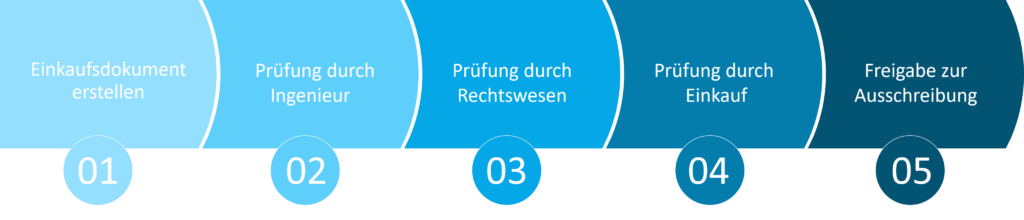
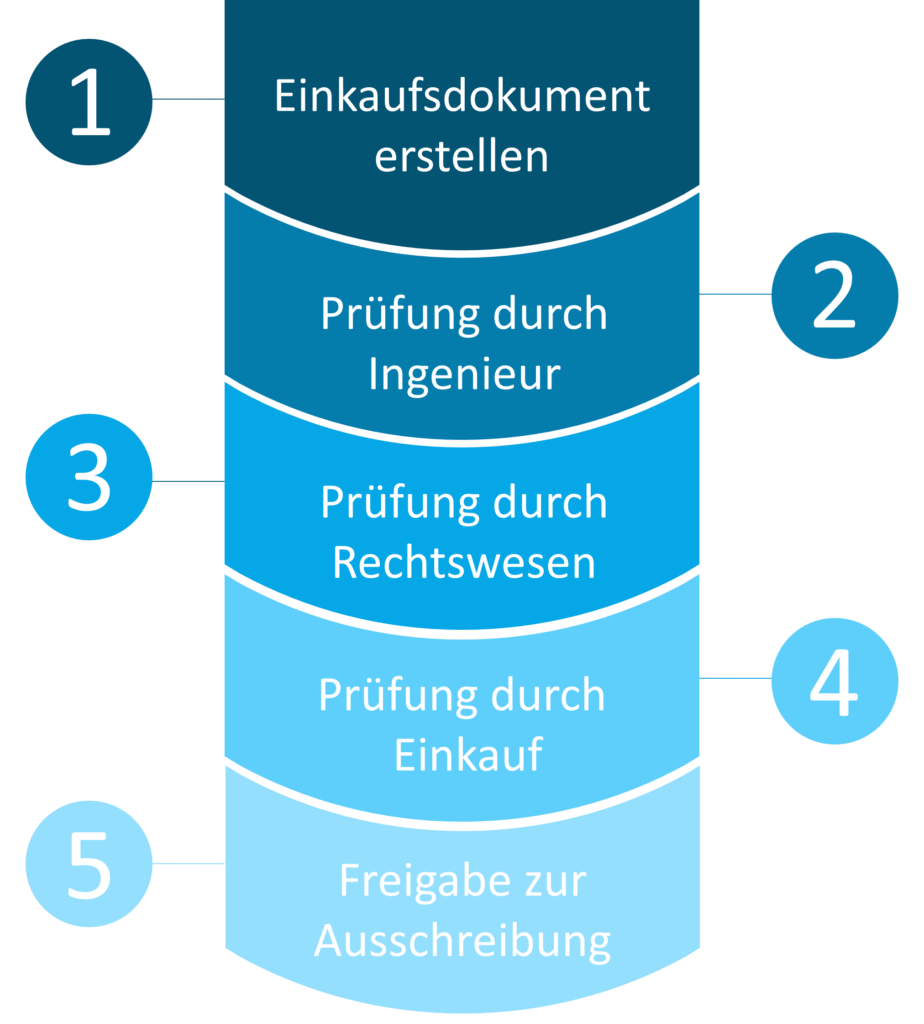
Figure: The tendering process at one of our clients | isr.de
This approval process often extended over a long period, making it difficult for those involved to track the various feedback loops. Employees felt they were completing their tasks correctly, yet documents would suddenly return with additional comments, without clear transparency regarding when or why. This not only led to delays but also to misunderstandings and frustration, as the origin of the feedback and the required changes often remained unclear. The lack of traceability exacerbated communication problems and hindered smooth collaboration.
Identifying Process Issues with Process Mining

In our case, a degree of data cleansing sufficed, as the process is status-driven and allows little room for variance.
As mentioned at the outset, our client faced challenges in promptly approving procurement documents. This presents an ideal application area for Process Mining, where data can be loaded into the tool and analyzed with an expert eye.
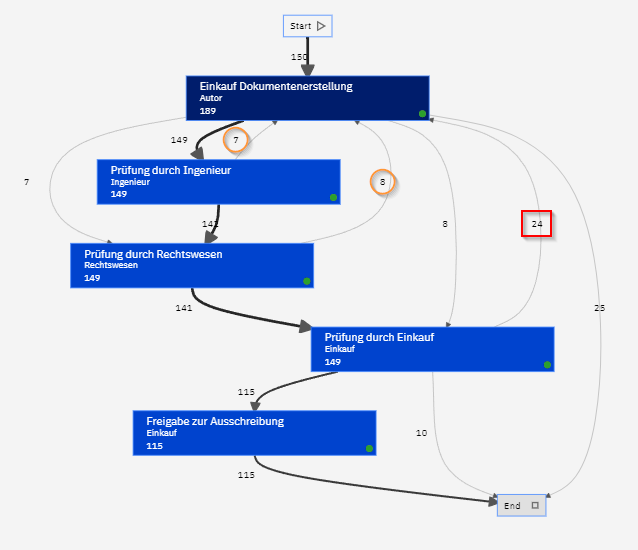
Figure: Initial Situation – It is notable that rejections frequently occur in the final step | isr.de
Analysis of the current process using a Process Mining tool reveals that the 'Procurement Review' step disproportionately often leads to document rejection (24 instances, red box). This necessitates the document being returned to the relevant department for correction and subsequent re-approval by all stakeholders. This process is not only time-consuming but also costly and frustrating, as all approvers must re-engage with the process.
Having identified the problematic stages within the process, it is now crucial to thoroughly understand the underlying causes from a technical perspective. Experienced Business Analysts provide invaluable support in this endeavor.
Gaining Technical Understanding of the Problem with Business Analysts – Paving the Way for Solutions
Upon closer examination, it becomes apparent that the primary cause of rejections lies in formal errors within the procurement document, such as missing standard purchasing terms, item numbers, or standardized document components. These errors stem from the complexity of the subject matter and the multitude of components involved. Furthermore, a lack of routine contributes to this, as tender documents are often created across various departments. In similar projects, we have observed that formal reviews are frequently underestimated and can lead to significant delays.
Addressing this issue requires the expertise of Process Reengineering consultants. To prevent or at least shorten partially unnecessary loops – for instance, a re-review by the engineer is unlikely to yield changes from the previous review cycle when procurement modalities are altered – one solution approach in this case could be to advance the procurement review within the overall process. However, since the processing of tender processes in the observed scenario often terminates within the process due to a lack of feasibility rather than reaching submission, advancing the procurement review would entail partially unnecessary additional effort for the procurement department. Therefore, a solution has been developed involving the introduction of an additional review step, where formalities are checked, but a comprehensive review of all interdependencies is not yet performed. This approach is expected by process stakeholders to significantly reduce the rejection rate in the procurement step (see following graphic), as the quality can be enhanced in the preceding approval process. It is proposed to solve the problem in two stages.
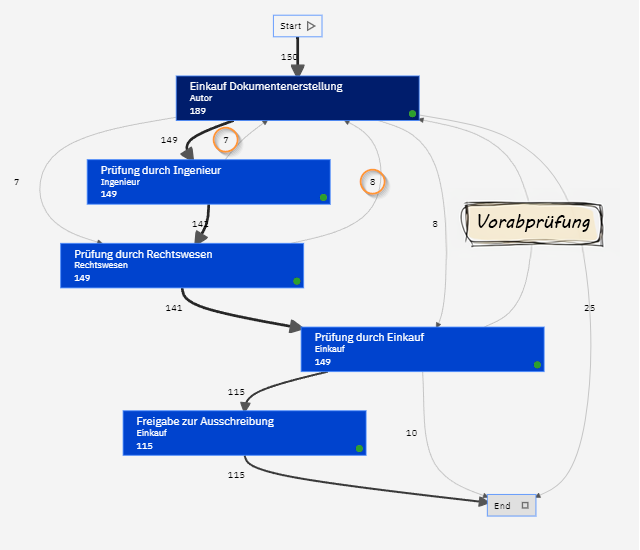
Figure: Solution Approach – Review formal aspects early to reduce late rejections | isr.de
Stage 1: Manual Solution
Stage 2: Automation (Outlook)
From Concept to Measurability: How Clear KPIs Pave the Way for Effective Process Improvements
To ensure that the proposed solution achieves the desired effect, it is crucial to define specific KPIs.
These metrics enable, on the one hand, the objective measurement of the initiatives' success. On the other hand, the development of KPIs has the valuable side effect that desired outcomes must be very clearly defined. To achieve this, requirements that may be somewhat ambiguous must be refined and narrowed down so that they can be expressed numerically. This process helps to redefine the actual core of the requirements and to discuss them with all stakeholders to collectively achieve absolute clarity.
Therefore, before implementing process improvements, it is essential to define measurable KPIs. In our example, both process velocity and the quality of document approvals are the relevant factors.
KPI 1: Total Process Lead Time
This KPI measures the time taken for the entire process, from the creation of the procurement document to its final approval. A reduction in the total lead time indicates that the pre-check leads to more efficient process execution.
KPI 2: Cost Per Case
This KPI indicates the total cost associated with a single case. A reduction in this KPI demonstrates that the pre-check effectively helps in early detection and rectification of formal errors, thereby leading to cost savings.
From "Rule of Thumb" to Precision:
How Assumptions and Process Mining Simulations Enable Informed Decisions
Instead of relying on rough estimates, the Process Mining tool enables us to specifically simulate the impact of a potential process improvement. This allows us to make assumptions in advance and validate them against real data to assess the suitability of the proposed solution. Furthermore, after implementation, the tool can measure the actual effect and verify the success of the initiative based on predefined KPIs.
The existing process model can be extended with the new pre-check step using the Process Mining tool – this is done within the BPMN diagram. For the simulation, assumptions must be developed regarding how a formal pre-check impacts service and working times, as well as the probability of rejection in the respective process step.
In practice, this appears as follows:
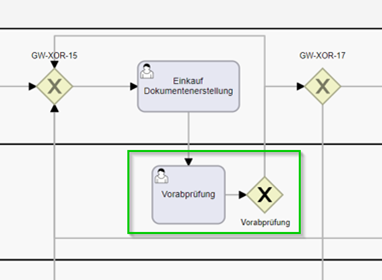
Figure: Insert new process step in BPMN | isr.de
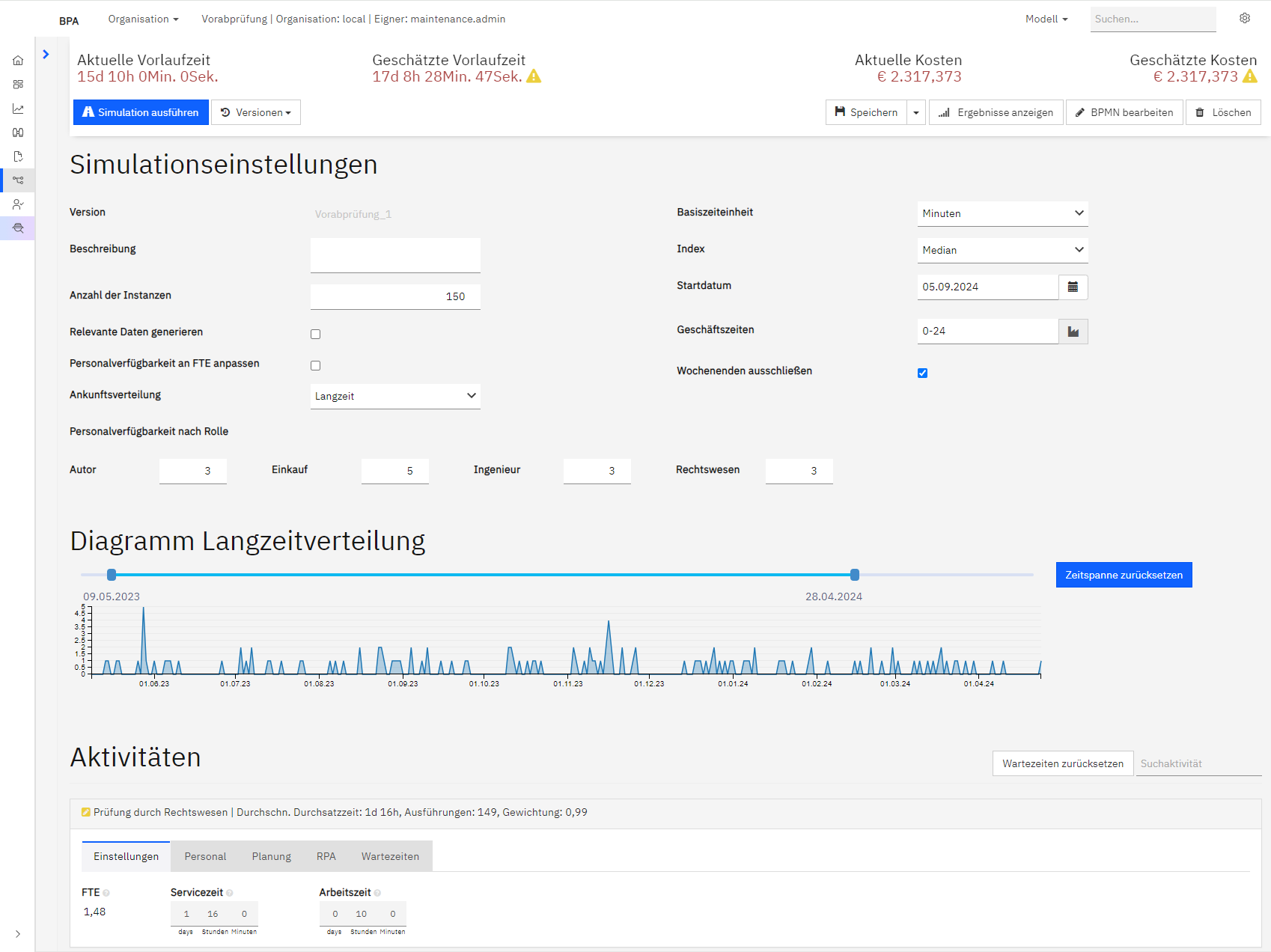
Figure: Setting simulation parameters (General Parameters, Activities, and Gateways) | isr.de
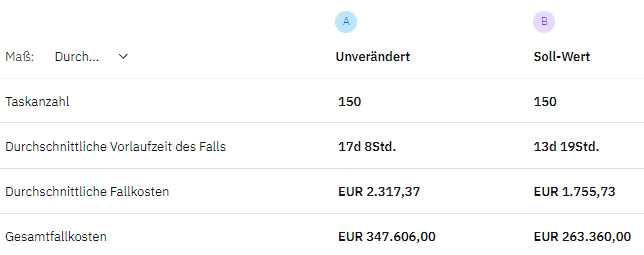
Figure: Comparing the results | isr.de
The simulation demonstrates that the procurement process can be shortened by approximately 3 days, and internal process costs can be reduced by €500 – per case! For the 150 simulated cases considered annually, this would amount to savings of well over €80,000 per year. The time saving of significantly more than one year is even more impressive. Companies with streamlined processes are faster and more agile in the market – a true competitive advantage! Following a thorough review of the simulation parameters, no one will be able or willing to objectively oppose a process adjustment. With these results, implementation costs for the change can now be evaluated, especially if the recorded process costs do not reflect the total costs.
Before-and-After Analysis with Process Mining Simulation: Verifying the Impact of New Process Steps
After the new process step has been implemented, the comparison feature of the Process Mining tool can be utilized to verify whether the change has indeed achieved the desired effect.
The process model indicates that the number of late rejections in the final process step has decreased, as a significant portion of formal errors were identified right at the outset.
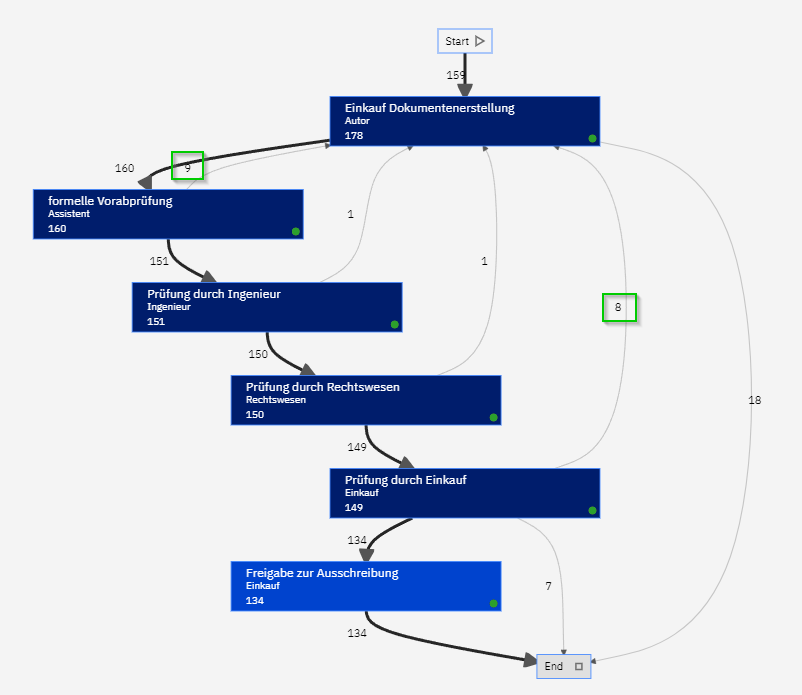
Figure: Simulation – the number of late rejections is significantly reduced | isr.de
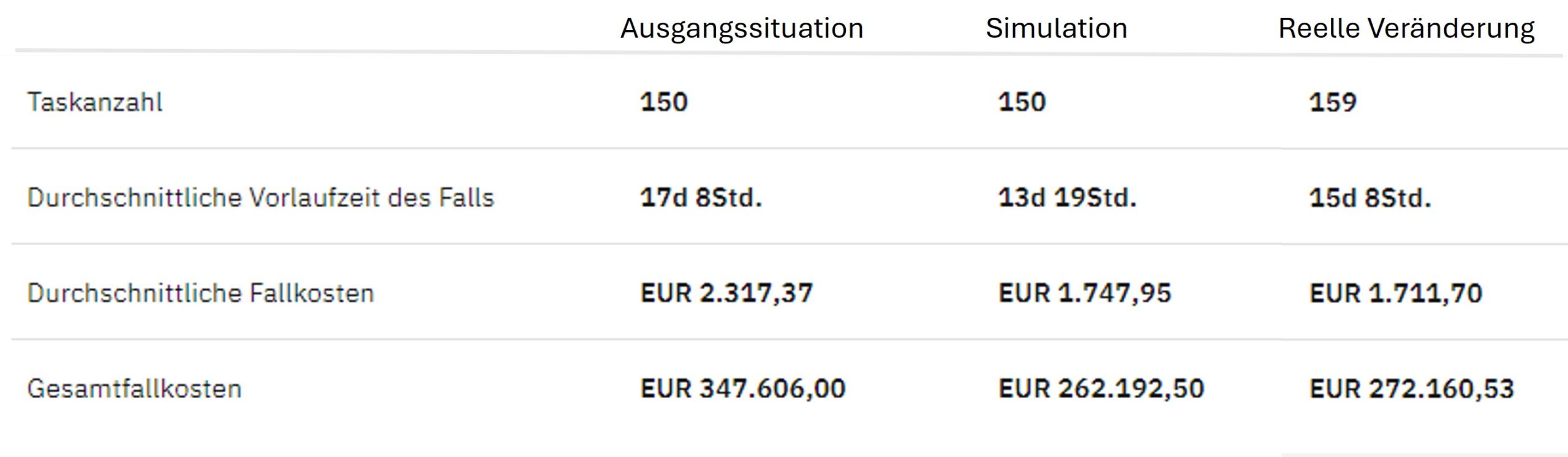
Figure: Comparison of Baseline, Simulation, and Actual Change | isr.de
The comparison between the simulation and the actual implementation reveals that the results are pleasingly close, which underscores the accuracy of our assumptions. Although the actual average lead time was slightly longer than in the simulation, attributable to a lesser reduction in waiting times, overall excellent improvements were achieved.
Steps Towards Automation: Efficient Pre-Check with RPA
A formal pre-check appears ideally suited for maximum automation. To achieve this, initial experience with the process must be gathered, and then the aspects that can be automated need to be distilled. With the aid of Robotic Process Automation (RPA), recurring tasks can be executed efficiently and without errors, leading to further cost savings and process optimizations.
The automation of the pre-check offers several advantages:
- Time Savings: Automated checks are faster and can be performed around the clock.
- Error Reduction: Automated systems operate precisely and consistently, thereby reducing the probability of errors.
- Cost Reduction: Automation enables more efficient deployment of human resources, leading to cost savings.
- Increased Motivation: Employees have more time to engage in meaningful work instead of handling repetitive tasks.
Before implementing RPA, this initiative can also be simulated. Let us assume that 80% of the effort for the formal pre-check can be handled by a bot, and that the bot incurs €2 in operating costs per case. In this scenario, the simulation is as follows:
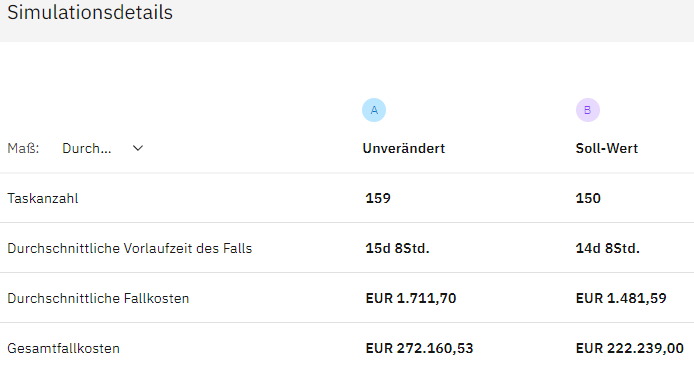
Figure: Simulation | isr.de
The implementation of a bot further reduces lead time and average case costs. However, it is also noteworthy that the impact of process optimization (specifically, the introduction of formal preliminary checks) significantly outweighs the effect achieved through automation via a bot.
Process Mining Simulation as a Key to Sustainable Business Process Optimization
The continuous optimization of business processes is an ongoing endeavor, where Process Mining plays a crucial role. By combining in-depth analysis, targeted process re-engineering, and the application of simulations, organizations can not only identify existing issues and their associated optimization potential but also achieve sustainable enhancements.
In our client example, implementing an additional review step resulted in a substantial reduction in processing time, a significant decrease in late rejections, and ultimately, reduced costs. These optimizations can be further amplified through subsequent automation with RPA. Once processes are optimized, technologies like RPA serve as accelerators to expand upon the improvements achieved. It is critical to continuously monitor the process, implement incremental enhancements, and respond flexibly to changes.
Key Success Factors to Consider
- People at the Core: While technology plays a vital role, it is crucial not to overlook the human element. For seamless operations, processes must organically reflect the realities and needs of employees. The acceptance and understanding of new processes are central to achieving success.
- Processes as a Major Lever: The key to efficiency often lies in reimagining processes and disrupting established patterns. A meticulously designed process can enhance operational efficiency and transparency, consequently boosting employee satisfaction.
- Expertise and Experience: Qualified process consultants can assist organizations in identifying the optimal levers for improvement. Their expertise in process re-engineering is critical for successful implementation.
- Technology as an Amplifier: Technologies like RPA deliver significant added value once the underlying process has been optimized. They enable the further scaling of efficiency gains and secure long-term competitive advantages.
It is paramount to commence with a clear plan, establish measurable objectives, and scale incrementally. This approach not only secures short-term successes for organizations but also lays the groundwork for sustained process optimizations and competitive advantages. Process Mining serves as an invaluable tool in this context, as it centralizes data- and fact-based analysis, thereby eliminating subjective feelings, ambiguous perceptions, and emotions from the assessment. Consequently, process modifications can be implemented based on empirical data, and their effects can be quantifiably measured, thus ensuring both success and adoption.
What's Next? How We Can Support Your Initiatives
If you already possess initial concepts or approaches for optimizing your (digital) processes but are uncertain about their implementation or require validation of their efficacy, Process Mining is unequivocally the optimal solution. Let us collaborate to transform your ideas into tangible successes – contact us today!

Christoph Sünderkamp
Managing Consultant
Business Process Automation
christoph.suenderkamp@isr.de
+49(0)151 422 05 489