In business, we have to make decisions every day. This is often not easy. With the help of DMN, it can be done faster, better, and in a way that is transparent for everyone.
We have already written about the importance and benefits of business automation elsewhere. Terms such as BPM, BPA, and RPA are used here, which together provide an effective framework for optimized processes. But how can the logic behind these automations be understood? How is it decided what needs to be done? How can such a decision be mapped? The answer is DMN. Decision Modeling Notation is one of the technologies that makes business automation possible. The good news is that programming is not necessary here.
What does Decision Modeling Notation mean?
DMN is an international standard for representing and automatically executing decisions. This notation was designed and published by the Object Management Group (OMG). Unlike business rule tools, DMN not only codes and automates individual rules, but also evaluates multiple business-relevant parameters in a weighted manner to arrive at an appropriate decision. The simple notation is essential here. It is not only easy for developers to use, but also easy for non-IT professionals to understand and, at the same time, machine-readable.
The decisions to be handled with DMN are explicitly not strategic or interpersonal decisions. The method is there to outsource recurring decision-making processes. All possible inputs are already known, and all possible further decision options are also fed in beforehand. DMN now takes on the role of bundling the individual pieces of information and assigning them the correct judgment.
What are the advantages of Decision Modeling Notation?
The key to DMN's success is its catchiness and straightforward presentation. This means that draft decisions and decision-making processes can be understood by IT specialists, analysts, and even accounting or sales teams.
Its ease of reading and use facilitates communication between individual departments. This makes it possible to break down opaque decision-making processes and identify errors. DMN thus creates a high level of transparency.
As will be shown in more detail in the next section, understanding simple symbols makes it possible to read and apply a DMN yourself. This notation therefore makes it easy to work independently of the processes in which decisions are made. This means that agile working is possible without having to change business processes themselves. Consistent working is thus combined with rapid responsiveness.
The components of Decision Modeling Notation
So what exactly does the software look like? To better understand DMN, let's first take a look at its individual components. The key elements are
Input Data
Business Knowledge Model
Knowledge Source
Decisions
Figure 1: Elements of the DMN in their symbolic form | isr.de
Decision
A decision is the result, i.e., the output, which depends on input, the business knowledge model, and knowledge sources. Beware of misunderstandings!
The decision is not generated by the DMN. The DMN is merely the notation used to make decision processing accessible. For this reason, all possible results are incorporated into the model from the outset.
Input Data
Input data is all information that is available and necessary for the decision object. It must be fed into the DMN so that it can provide an answer. The variables determine which direction is taken in the flowchart of the assessment.
Business Knowledge Model
The business knowledge model is the internal decision-making logic according to which the input is processed. It is the magic that transforms the input into decisions.
Knowledge Source
This model draws on the knowledge source, which is a database of instructions on how to proceed. Like recipes in a cookbook, the necessary steps can be looked up and initiated.
Decision Modeling Notation: A Practical Example
Let's look at how the individual elements interact using a practical example:
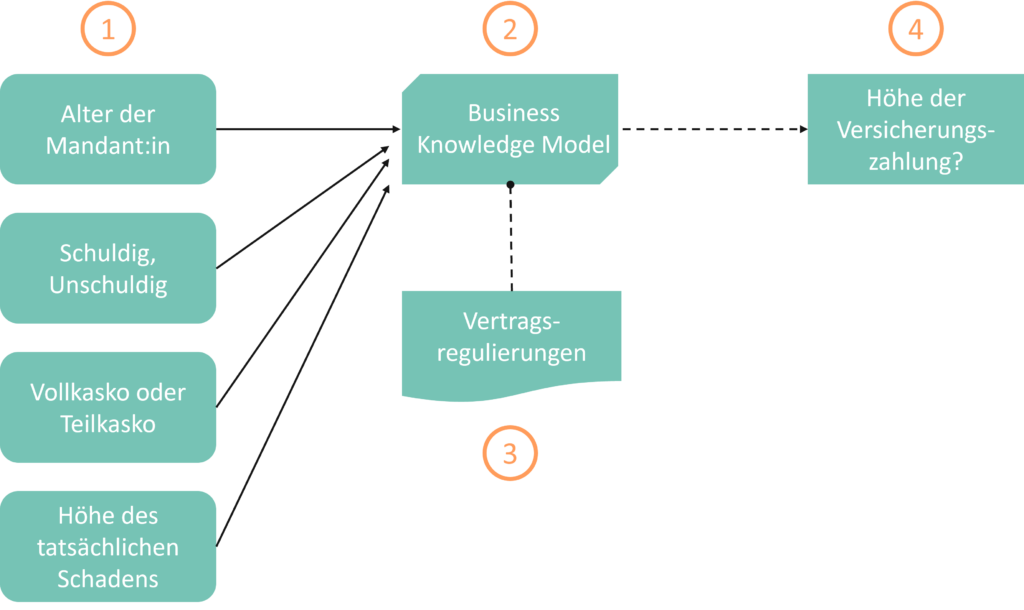
A car insurance company receives a claim. The ruling describes the amount of the contribution to be paid by the insurance company.
Figure 2: Graphical representation of a decision modeling notation using the example of a motor vehicle damage report | isr.de
1. The input data is requested from the client and entered into the DMN (automatically, if applicable).
2. This data encounters preprogrammed "if, then, else rules" in the Business Knowledge Model.
3. The rules are derived from the contract.
4. The individual components combine to form a calculated size.
How can I implement Decision Modeling Notation myself?
DMN itself is a notation. It expresses how decision-making should proceed. It describes the path to a decision, but does not make the decision itself. The execution of the decision made, i.e., contacting employees, calculating contribution amounts, granting approvals, or performing risk assessments, has not yet been initiated. Until then, the DMN still lacks the soul, which is called the decision engine.
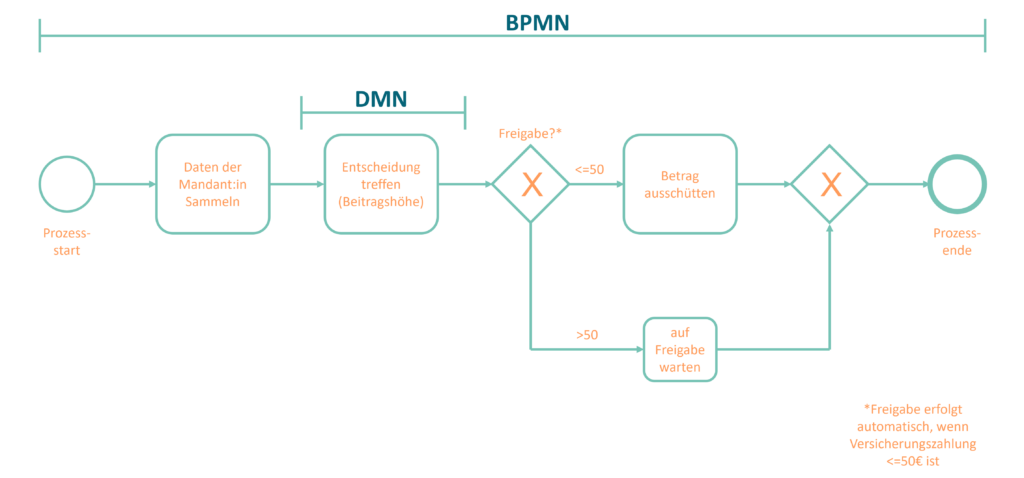
A decision engine, such as Camunda, speaks the language of DMN. Camunda can be used to execute a DMN. Decisions are always part of a process. That is why the engine inserts the DMN into a BPMN (Business Process Management Notation). In addition to Camunda, there are other engines, such as those from our partner IBM. This BPMN works in the same way as the logic of the DMN.
In the insurance case just shown, this could be simplified as follows:
Figure 3: Integration of the DMN into BPMN | isr.de
The DMN can be accessed and modified in a modular fashion. This allows the individual decisions required in the process to be addressed separately, while the process itself remains untouched.
Once again, this logic stands out for its ease of use. It gives all users (e.g., developers, managers, executives) transparent insight into the driving forces behind their business.
When can I start?
Please feel free to contact us at any time to discuss more in-depth and critical questions.
Since 1993, we have been operating as IT consultants for Data Analytics and Document Logistics, focusing on data management and process automation. We provide comprehensive support, from strategic IT consulting to specific implementations and solutions, all the way to IT operations, within the framework of holistic Enterprise Information Management (EIM). ISR is part of the CENIT EIM Group.