Integrated corporate planning plays a crucial role in enabling companies to effectively translate their business strategies into planned KPIs, thereby securing their economic success in the future. In this context, SAP Analytics Cloud (SAC) has established itself as a powerful platform that offers comprehensive capabilities for planning, analyzing, and visualizing corporate data.
SAC has made impressive progress in recent years, particularly in the area of integrated business planning. In this blog article, we will provide a detailed insight into the capabilities of SAC in the context of integrated business planning and share specific experiences from a real-world project.
Companies face the challenge of integrating various sub-plans from different areas and creating a consistent planning scenario. This requires the consolidation of data from different sources and the consideration of various planning approaches. SAC offers a comprehensive solution that enables companies to effectively overcome these challenges.
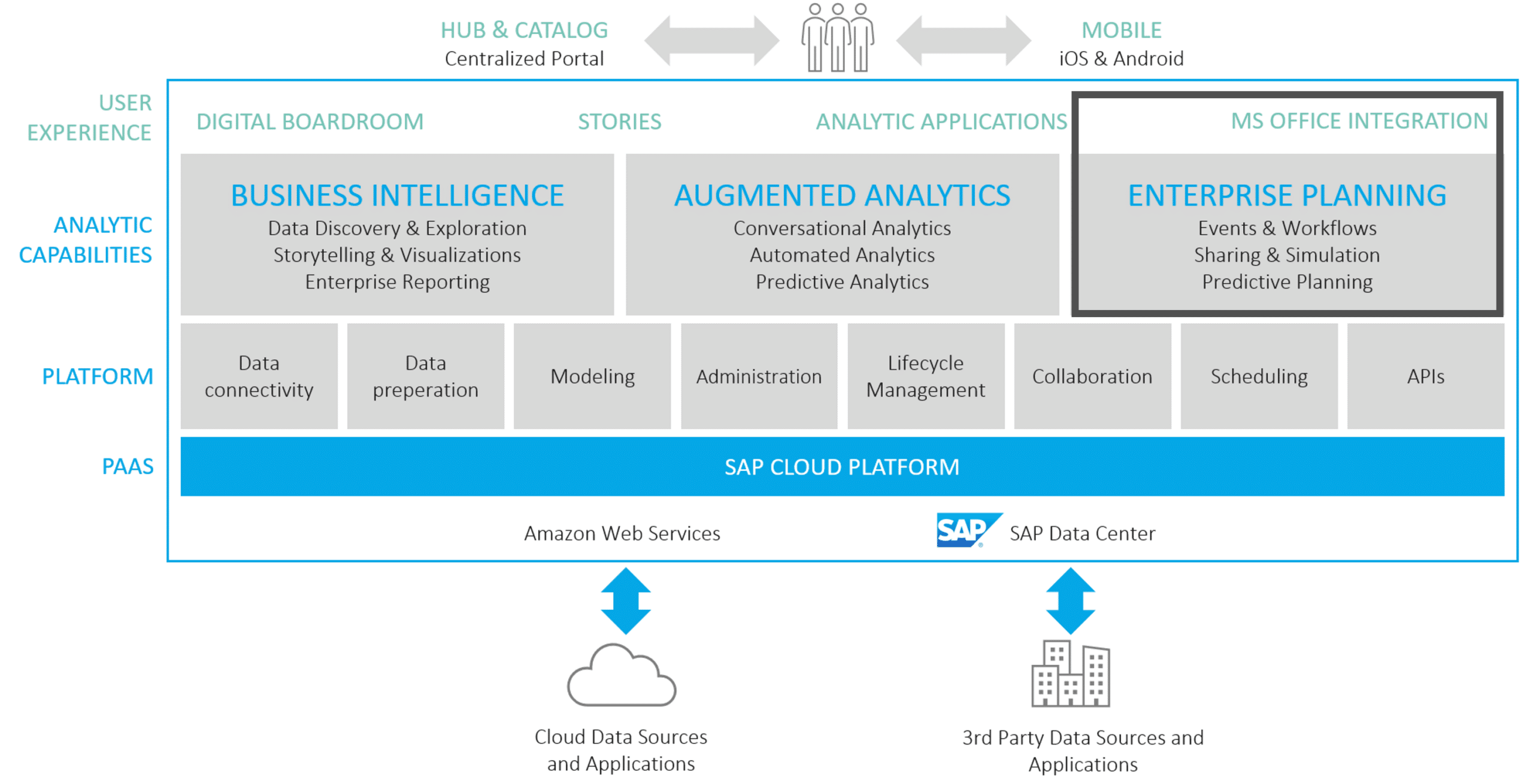
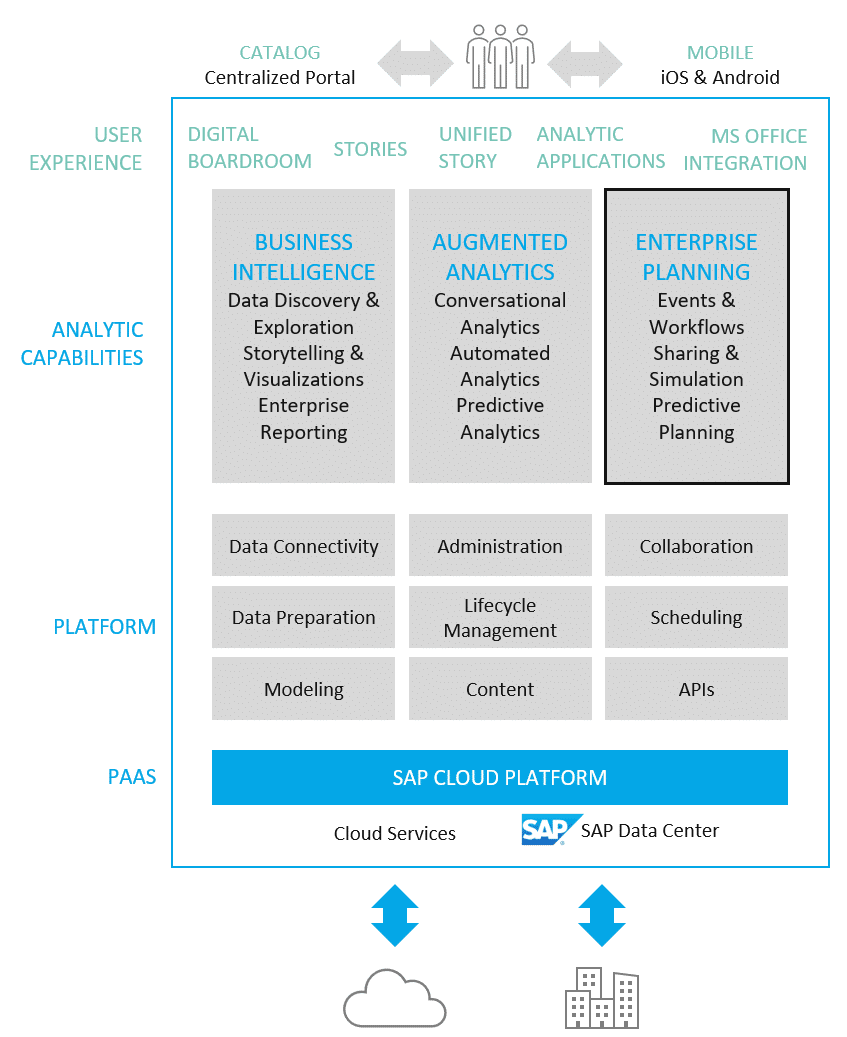
SAP Analytics Cloud Architecture
SAP Analytics Cloud Architecture
2. The performance of the SAC planning component
SAC offers a range of functions and features that enable effective integrated business planning. Some of the key elements of the SAC planning component are explained in more detail below:
1. Driver-based planning:
Driver-based planning is an approach in which planning is based on specific influencing factors or drivers. Instead of manually changing individual values, the driver parameters are adjusted and the system automatically calculates the entire planning horizon based on these drivers. This enables efficient adjustment of plans and accurate projection of future results. For example, a company in the retail sector could use the number of newly opened stores as a driver to forecast the impact on sales, costs, and profits.
2. Data integration and modeling:
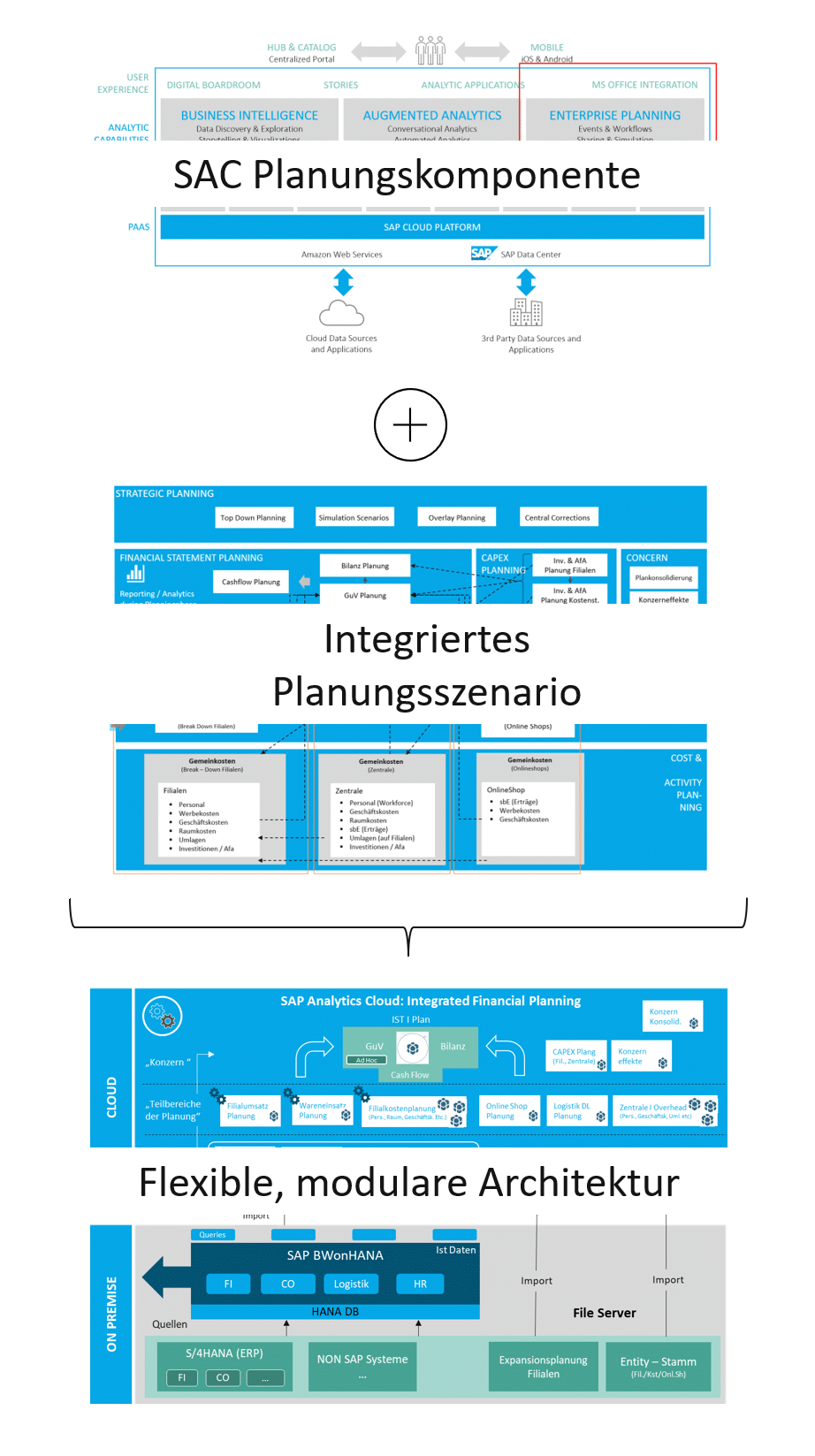
SAC offers extensive options for integrating data from various sources, such as SAP Business Warehouse. Using import models and a powerful HANA database, large amounts of data can be processed and evaluated with high performance. Flexible data modeling enables companies to customize their data structures and map complex planning scenarios. For example, a company can import its actual data from the SAP Business Warehouse into SAC and link it to other relevant data sources to create a comprehensive basis for planning.
3. Modular design and expandability:
The SAC is characterized by a modular approach that enables companies to design and develop individual planning applications separately. This allows for a high degree of flexibility in the design of planning masks and the implementation of specific business logic. In addition, SAC offers a wide range of ready-made business content that can be used as a starting point for individual planning. Companies can adapt these templates to their own requirements and thus create individual planning applications efficiently and quickly.
4. Data Actions:
Data Actions are a feature of SAC that can be used to implement complex planning logic. Companies can use them to perform detailed calculations and projections that go beyond simple allocations and projections. For example, Data Actions make it possible to perform complex cost calculations based on various variables and rules. This feature offers a high degree of flexibility and enables companies to implement their individual planning logic in SAC.
3. Practical example: Integrated corporate planning in the retail sector
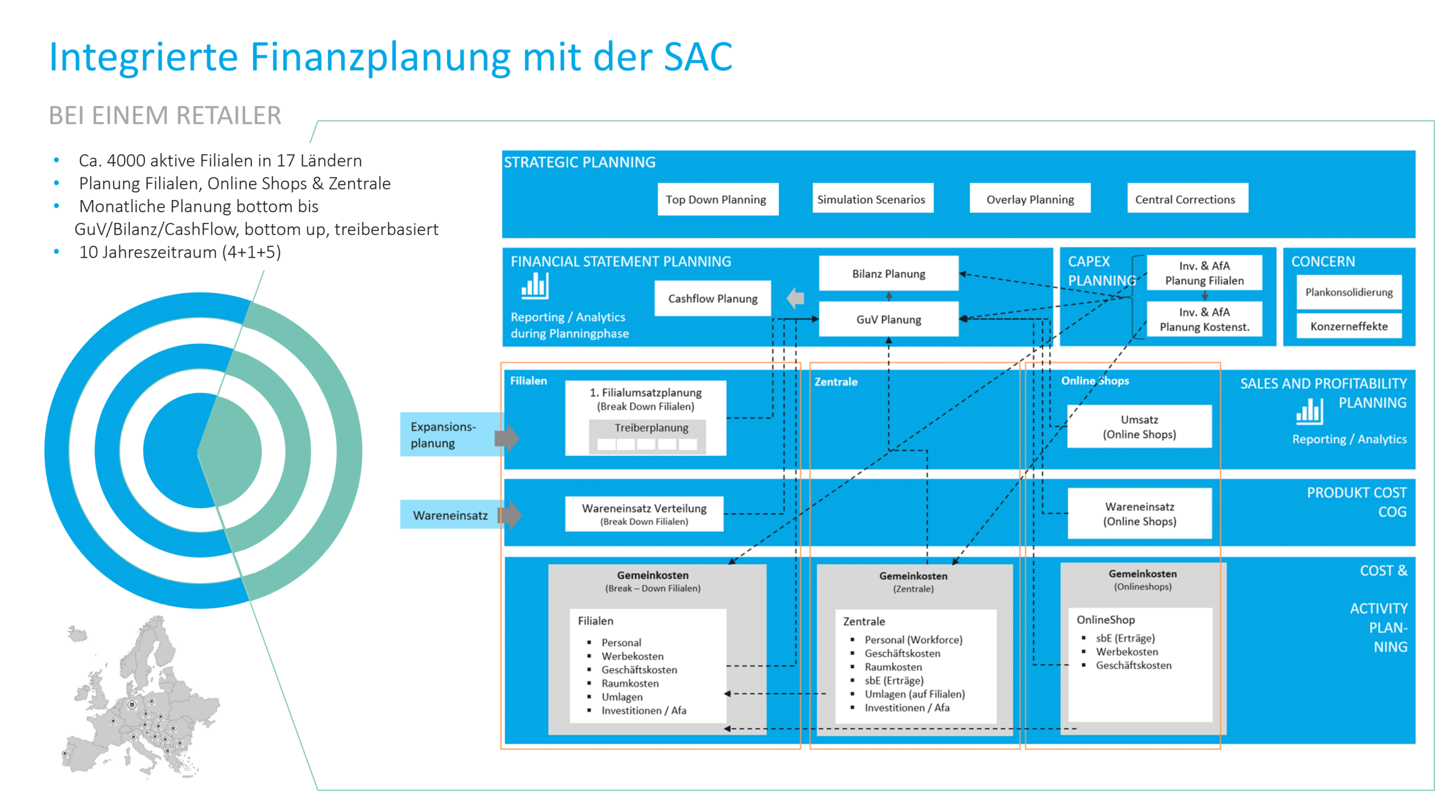
To illustrate the power of SAC in the context of integrated business planning, let's look at one of our customer examples from the retail sector. A large retail company with thousands of stores and online shops faced the challenge of efficiently designing complex planning scenarios. With the help of SAC, the company was able to implement driver-based planning, integrate data from various sources, and create comprehensive projections for the planning horizon. The flexible adaptability of SAC enabled the company to implement specific business logic and calculations and to customize the planning masks. This made it possible to realize effective integrated corporate planning. For example, changes in store locations and their impact on sales, costs, and profits could be modeled quickly and accurately.
Integrated financial planning with SAC in the retail sector: The requirements
Advantages of SAC for integrated corporate planning:
Using SAC offers a number of advantages for companies that want to implement integrated business planning. These include:
Easy orchestration of the planning process: SAC offers functions for easy orchestration and monitoring of the planning process. Companies can set up workflow controls and efficiently monitor the progress of planning. For example, planning steps and approvals can be defined in a workflow control to ensure that planning is carried out and approved properly.
Adaptability and expandability: SACenables companies to customize and expand their planning templates and logic. This flexible approach allows companies to continuously adapt and develop their planning processes in line with changing requirements. For example, a company can implement specific calculations and algorithms in SAC to tailor the planning results even more precisely to its own needs.
Drill-down analysis and detailed data viewing: SACenables users to navigate from the overall view to detailed insights into the data. Companies can analyze data at various levels and obtain specific information for informed decisions. For example, a company can access individual data for specific products or regions from an aggregated sales view in order to identify the exact causes of changes or trends.
4. Summary and outlook
Flexible planning, easy adaptability
High degree of automation in planning
Department-driven
SAP Analytics Cloud has established itself as a powerful platform for integrated business planning. Its functions and features enable companies to effectively implement complex planning scenarios and ensure consistent planning across the entire horizon. SAC's driver-based planning, flexible data integration, modular design, and extensibility provide companies with the tools they need to meet their individual integrated business planning requirements. SAC is continuously being developed to meet the growing demands of companies and to offer an even more comprehensive solution for integrated business planning.
In conclusion, SAP Analytics Cloud helps companies overcome the challenges of integrated business planning and make their planning processes more efficient and accurate. The use of SAC enables companies to make better decisions based on comprehensive analyses and sound forecasts in order to secure long-term economic success. With the continuous developments and innovations of SAC, the future of integrated business planning looks even more promising.
Conclusion: SAC Integrated Financial Planning in the retail sector
Learn more about planning with SAC in our latest white paper.
SAC Planning – Market readiness and project experience
In this white paper, we provide you with detailed insight into the planning component of SAP Analytics Cloud.
Since 1993, we have been operating as IT consultants for Data Analytics and Document Logistics, focusing on data management and process automation. We provide comprehensive support, from strategic IT consulting to specific implementations and solutions, all the way to IT operations, within the framework of holistic Enterprise Information Management (EIM). ISR is part of the CENIT EIM Group.