Agile project management starts in the minds of the developers. What opportunities does the systematic use of certain soft skills open up?
Beyond Specialized Knowledge: From I-Shaped to T-Shaped
An enterprise thrives on the contributions of its employees. Therefore, it is the central task of HR to recruit the most capable candidates. For a long time, this straightforward logic could be applied with relative ease: I need a technical consultant, so I search for a technical consultant; I need an application developer, so I search for such a developer.
However: A consultant is not a developer, and vice versa!?
Experts naturally possess profound knowledge and experience within their respective specialized fields. Today's professional landscape is characterized by strong interconnectedness and an increasing shift towards knowledge-based work. Conditions have evolved such that an overly deep specialization (i.e., I-Shaped) can come at the expense of broader skillsets or know-how.
This is not because specialized knowledge becomes redundant (quite the opposite, skilled professionals are, as is well known, in high demand), but because additional, diverse capabilities are also required. Consequently, pursuing one's work with a narrow focus becomes challenging.
The Various Types of Expertise:
I, X, T-Shaped
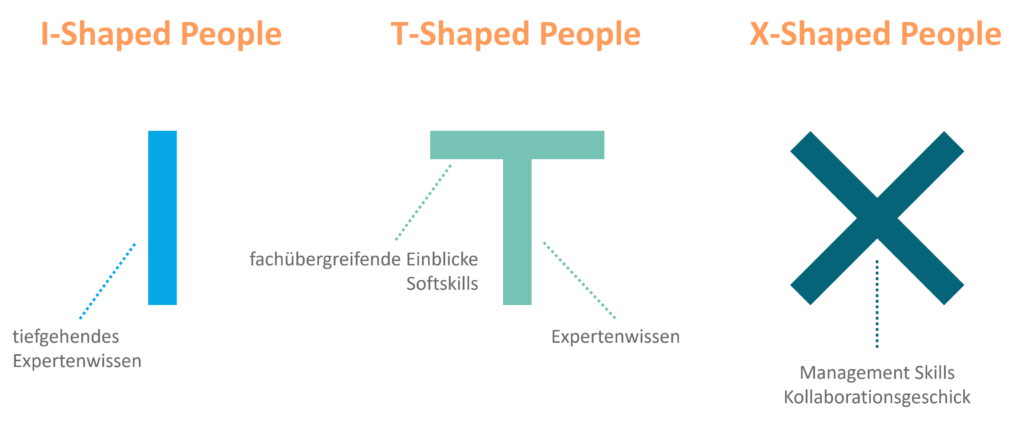
Today, companies face the unprecedented challenge of assembling diverse teams and employees. This pertains not only to what is known as diversity but also to the various qualification profiles, as exemplarily illustrated in Figure 2.
Beyond specialized knowledge, the dimension of soft skills becomes prominent. These include capabilities such as
- Organizational and Communication Skills
- Empathy
- Creativity
- Social Competence
Figuratively speaking, specialized knowledge is positioned vertically, as it delves into depth and characterizes an expert in a particular field. Soft skills, conversely, are positioned horizontally, as these capabilities extend broadly. Furthermore, there is specialized knowledge that, while not particularly profound, is present across multiple areas. This gives rise to several forms (see Figure 2) that constitute a profile.
The Agile Approach for Intelligent Solution Development
The individual needs of all employees are taken into account by Project ManagementWhat is project management? Project management encompasses all—often standardized—tasks,… More Scrum method. It is a framework for distributing expertise, responsibility, and planning in agile software development. In this form of the agile approach focuses primarily on freedom, efficiency, and the development of an ever-improving product.
The distribution of work is carried out through individual roles that interact with one another in the Scrum model.
How do these roles align with the Shapes?
I-Shaped People
As previously mentioned, I-Shaped individuals are absolute experts in their field, possessing profound knowledge that renders them highly valuable. However, they may lack the ability to effectively present themselves and interact appropriately within the structure of their teams and with stakeholders.
The Development Team operates on solving the existing business problem. They are the experts and implementers of the operation, receiving all collected feedback. In theory, their focus is primarily on the product and its functionality. Evidently, I-Shaped individuals are exceptionally well-suited for this role. Someone passionate about software development and unwilling to be constrained by resource limitations is optimally positioned within the DEV team. Their specialized work is crucial, as creations and optimizations are impossible without their profound understanding.
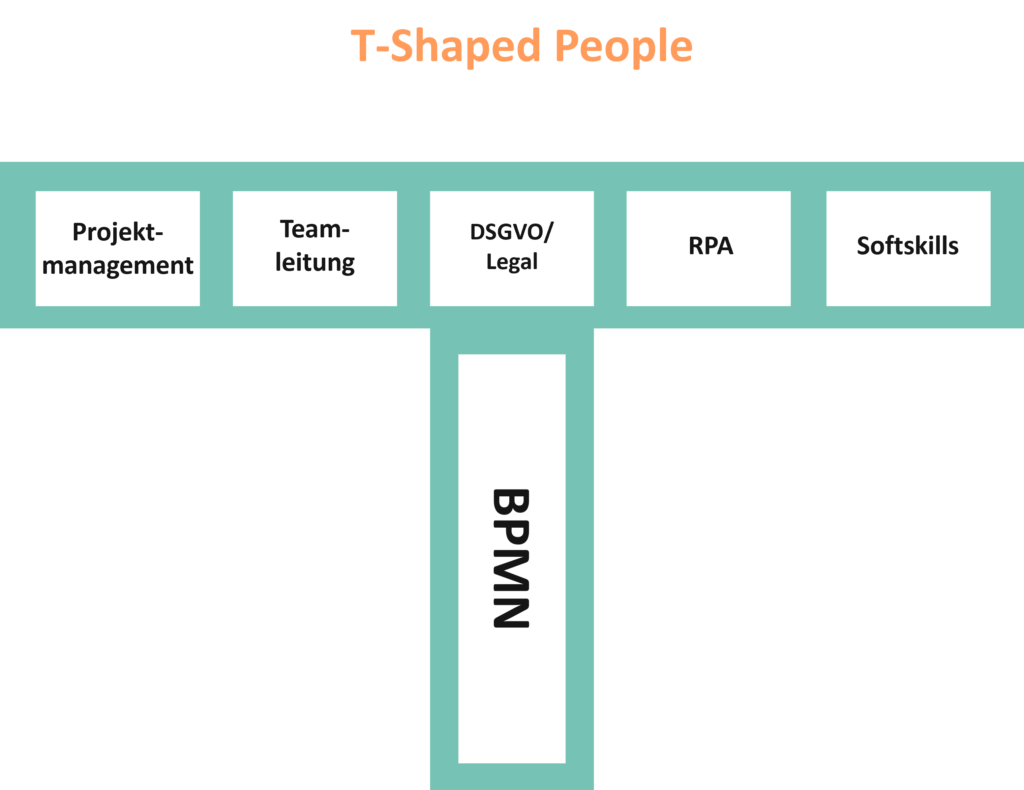
T-Shaped People
The Product Owner develops the concept and vision for the final output. Collaborating with stakeholders (customers, other departments, interest groups), they define the problem statement and formulate a solution approach. They consolidate the requirements for the end product into a Product Backlog. T-Shaped individuals are ideally suited for this role. Their focused expertise, their ability to perceive cross-domain interdependencies, and their excellent social competence enable them to effectively oversee project implementation.
X-Shaped People
In addition to the qualification profiles discussed, a third type emerges: so-called X-Shaped individuals extend the development from I to T and typically comprise management personnel. Specific operational tasks requiring specialized knowledge do not fall within their purview. In this regard, they are more generalists with a broad understanding across many domains. The X-shape symbolizes the convergence of various departments, teams, or companies. X-Shaped individuals, even more so than T-Shaped individuals, are exceptionally interpersonally skilled, often inherently so, without formal training. They excel at bringing people together to establish optimal conditions for collaboration.
The Scrum Master assumes overarching responsibility for the infrastructural fluidity of the project. This entails providing the process and the team with all necessary resources and serving as a competent point of contact for diverse inquiries from all directions. Content-wise, they are less involved. X-Shaped individuals seamlessly fit into this role, as they possess the ability to bring people together, coordinate teams, and establish the optimal conditions for a successful sprint.
The world is not divided into I, X, or T-Shaped People
Naturally, these three "prototypes" of modern employee profiles, like all human constructs, possess fluid boundaries. No individual is purely I-Shaped or T-Shaped. Every X-Shaped individual possesses a specific area of expertise with in-depth knowledge. Thus, the "alphabet" of personality profiles can be further extended:
- M-Shaped People
like T-Shaped, but with multiple areas of expertise - Pi-Shaped People
like T-Shaped, but with two distinct areas of expertise - Y-Shaped People
like I-Shaped, but with two other superficially known subject areas
Team Diversity as the Key to Success
It is evident that not all individuals within an organization can be identical. An I is not a T, a T is not an X, and an X is certainly not an I. Nevertheless, all are required to achieve a common objective. In interdisciplinary teams, it is crucial to effectively orchestrate specialized knowledge, coordination, organization, and other soft skills. Soft skills are less tangible and thus less quantifiable; however, they provide immense added value in team collaboration.
Diversity is therefore not only reflected in the capabilities of employees (=interdisciplinarity) but also in their mindset, which must complement each other just as much as operational productivity.
Within an agile project and its iterative feedback process, continuous exchange is always maintained. Experts engage in reciprocal exchange with others (such as managers, clients, etc.). Inevitably, new knowledge and skills emerge that can be leveraged broadly. Targeted coaching and further training can also rapidly develop soft skills. On the one hand, an agile project requires T-Shaped individuals; on the other hand, no one emerges from such a project without having developed in various directions. The evolution of employees through continuous learning fosters agile solutions. And agile Scrum teams are a valuable asset.
Intrigued?
With over 30 years of experience in developing process solutions, we have encountered a wide range of project management approaches – be it classic, agile, or hybrid. If you wish to learn more or have questions regarding Design Thinking or Scrum, please do not hesitate to contact us.

Cihan Klingsporn
Senior Account & Marketing Manager
Business Process Automation
cihan.klingsporn@isr.de
+49(0)151 422 05 471