SAP released the SAP BW Bridge at the end of 2021. Is this an SAP BW/4HANA system in the Business Technology Platform? Does this mean that SAP BW now has a cloud perspective? What is the BW Bridge? We provide answers to these and other questions.
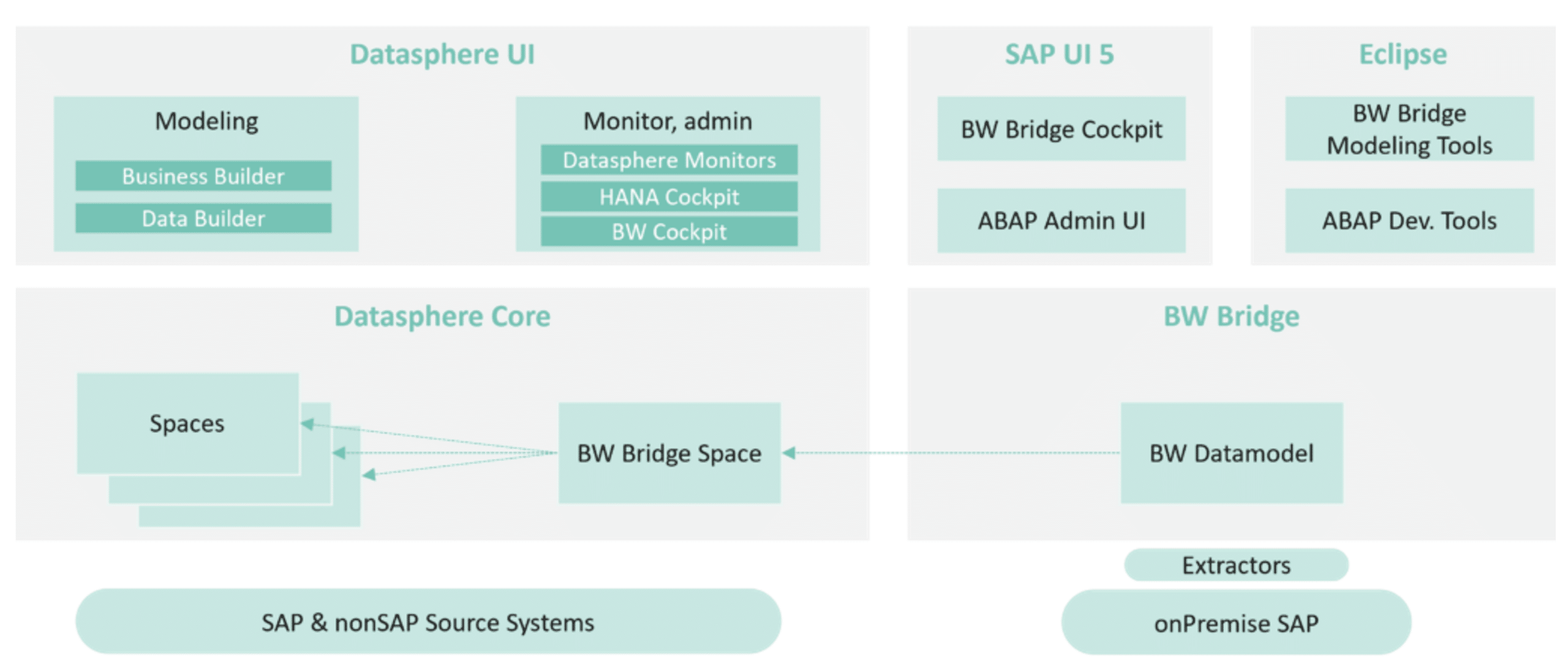
BW Bridge is primarily a service that can be added to SAP Datasphere. When the service is booked, an SAP BW/4HANA environment (BW Bridge) is provided based on the Business Technology Platform. The core application of Datasphere accesses the data models of BW Bridge via an automatically generated space called "BW Bridge Space." The figure below outlines this relationship:
Fig. 1: Relationship between Dataphere and BW Bridge | isr.de
The functionality of BW Bridge is limited to data management and data integration from SAP systems. Analytical functions such as queries are not possible. SAP Note 3117800 contains detailed information on the supported functions. Another important limitation is the restriction to SAP ODP extractors. It is not possible to connect files or Smart Data Access sources.
Does this spell the end for SAP BW?
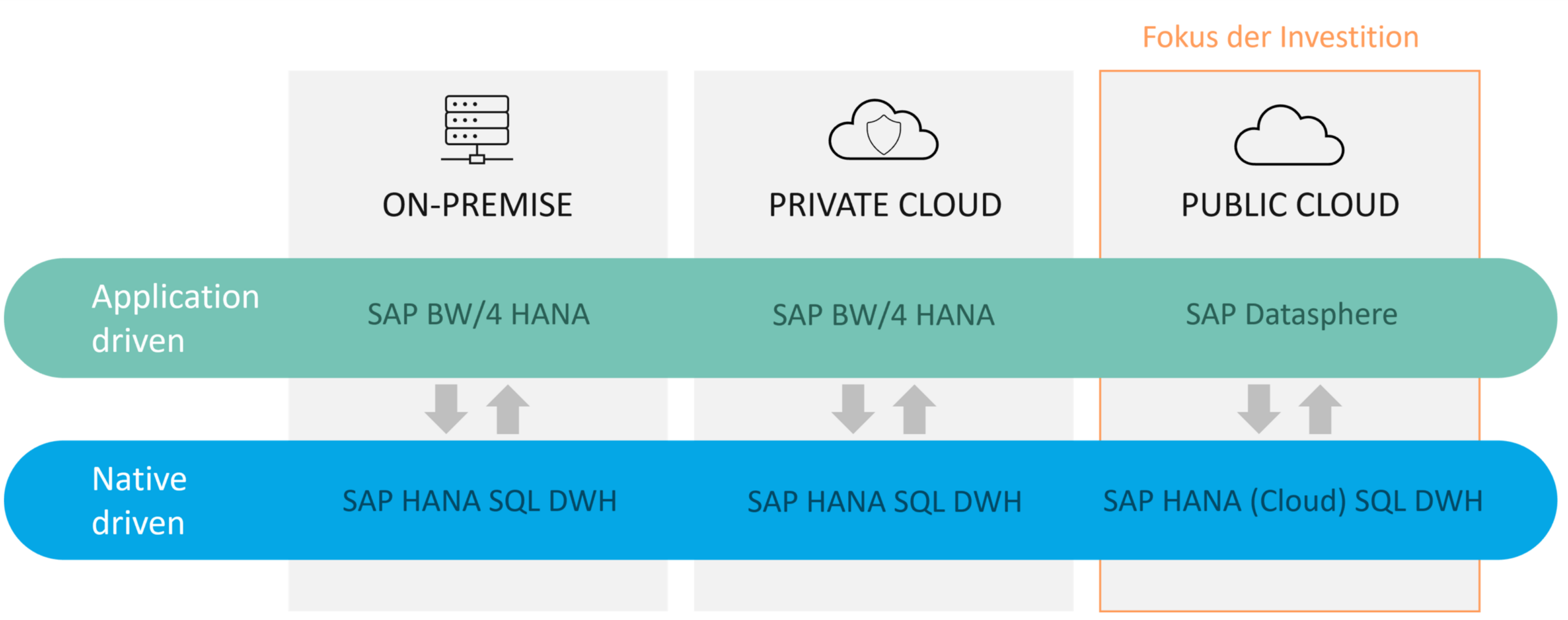
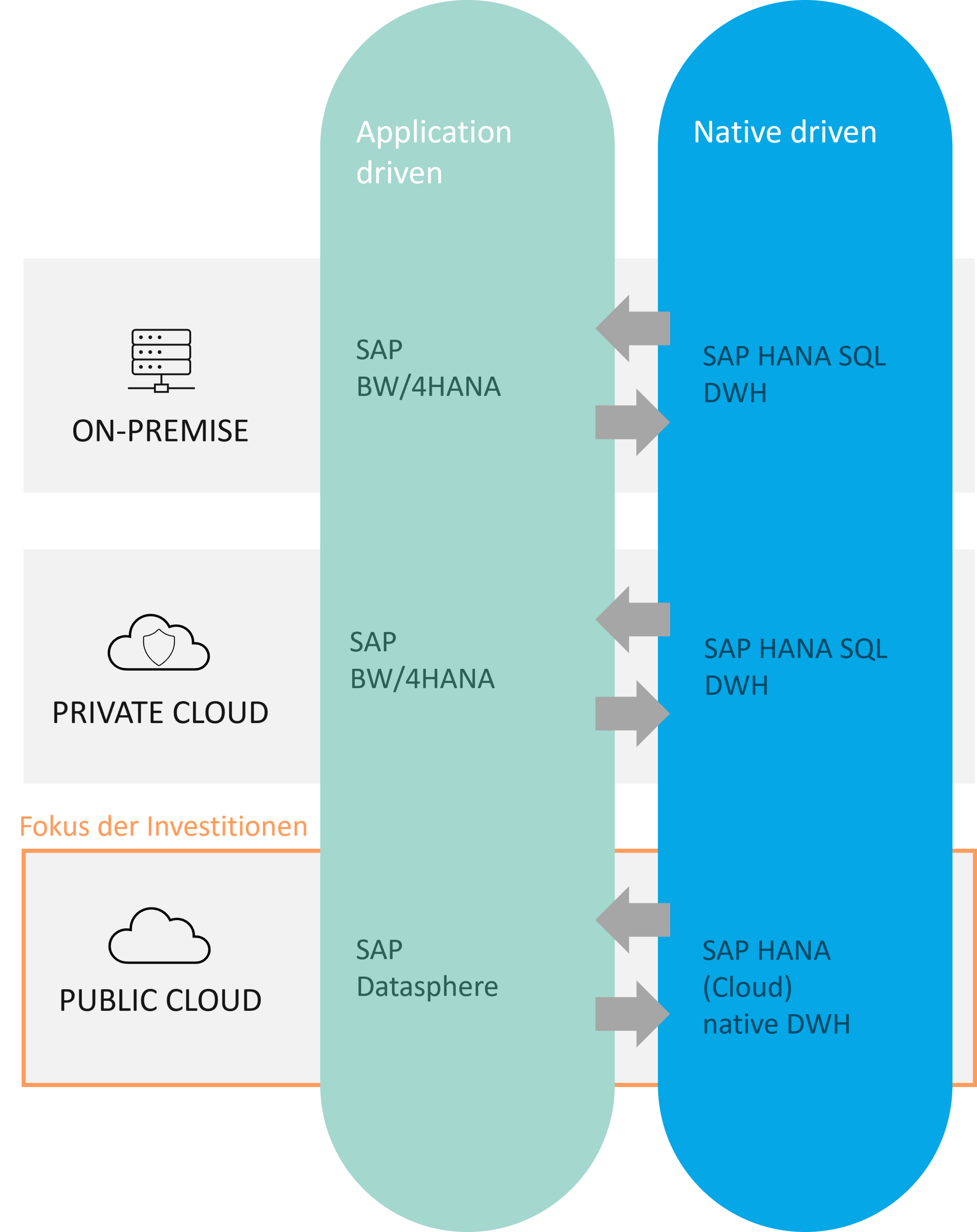
Strategically, SAP is focusing primarily on SAP Datasphere, as illustrated in the following figure:
Does this mean that SAP BW is now at an end? No, not (yet). Although SAP's focus is very clearly on SAP Datasphere, SAP BW/4HANA can still be the answer for customers who do not (yet) want to move to the public cloud. In addition, SAP BW/4HANA is very well proven and can be the basis for large and complex enterprise data warehouse solutions. SAP has also given BW/4HANA a perspective until 2040. This provides a certain degree of investment security.
Prospects for SAP BW customers
Fig. 2: Strategic positioning of SAP | isr.de
Fig. 2: Strategic positioning of SAP | isr.de
SAP BW Bridge gives SAP BW customers the option of migrating parts of SAP BW to BW Bridge, thereby preserving their past investments. This gives customers greater flexibility, as they can move to the public cloud at their own pace.
Fig. 3: Paths for customers to the public cloud | isr.de
Technically, migration in BW Bridge works similarly to a technical migration of an SAP BW system to BW/4HANA – remote and/or shell conversion are possible.
Fig. 4: Technical migration in BW Bridge | isr.de
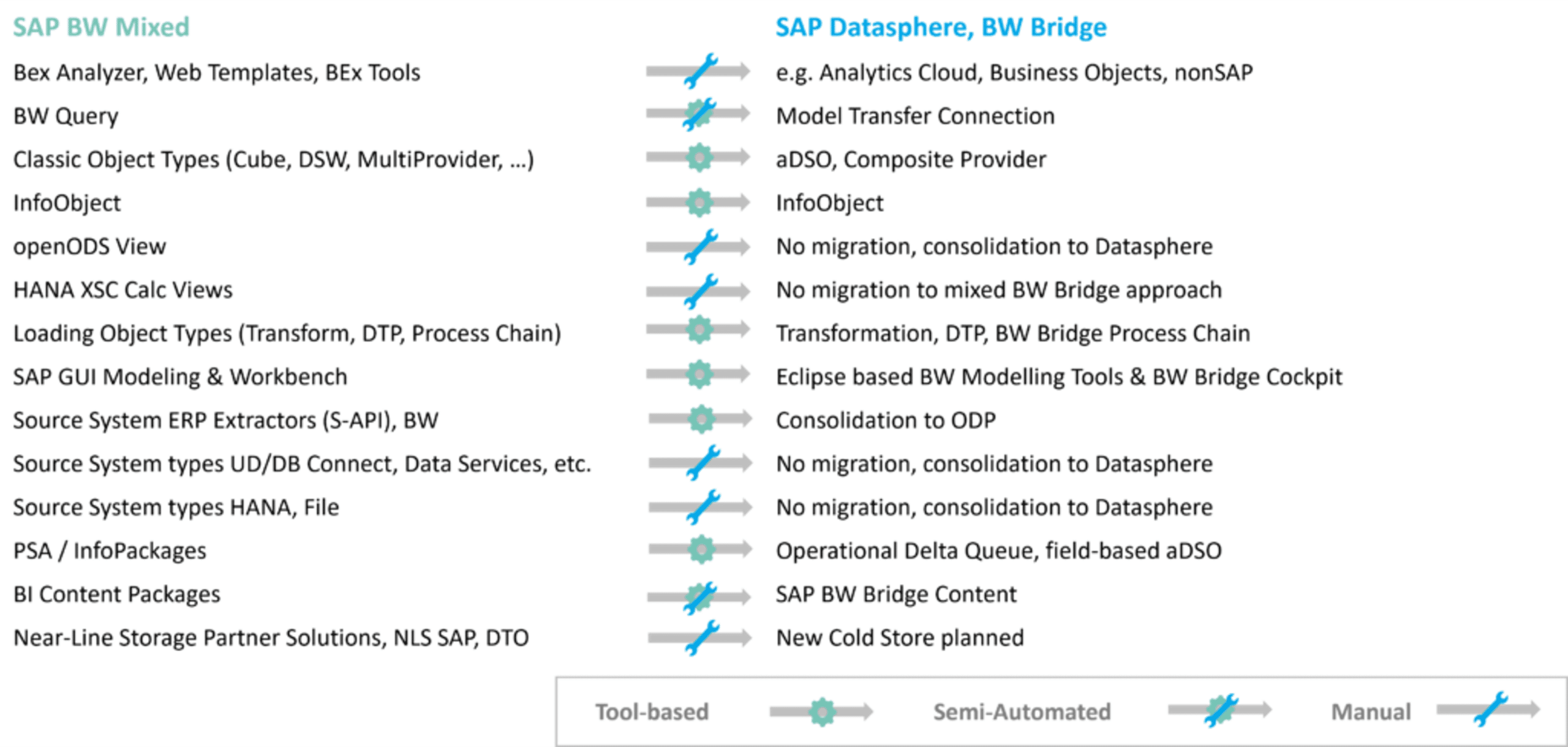
Customers should not expect a complete migration of a complex SAP BW system. Not all objects can be migrated, and some data models will inevitably have to be rebuilt.
What does BW Bridge mean for the Datasphere?
Fig. 5: Migration options for objects | isr.de
The BW Bridge offers advantages not only from the perspective of SAP BW customers. Datasphere gains access to SAP BW's long-proven BI content via the BW Bridge. This allows SAP ERP-centered data models to be set up very quickly, with the BW Bridge acting as an integration layer.
Fig. 6: BW Bridge as an integration layer | isr.de
outlook
In the future, BW Bridge will also be able to access Datasphere data models. This will enable significantly more migration scenarios, because input aDSOs from non-SAP systems can in principle be migrated and their source connection maintained via Datasphere.
Fig. 7: BW Bridge as part of the DWH | isr.de
Conclusion
The BW Bridge is primarily an opportunity to migrate SAP BW systems completely or in parts to the Datasphere. If SAP expands the range of functions even further as planned, it offers a lot of potential. At the same time, customers should not expect to be able to technically migrate their entire systems, including mixed scenarios with HANA Calculation Views. It will not be possible without manual work.
Since 1993, we have been operating as IT consultants for Data Analytics and Document Logistics, focusing on data management and process automation. We provide comprehensive support, from strategic IT consulting to specific implementations and solutions, all the way to IT operations, within the framework of holistic Enterprise Information Management (EIM). ISR is part of the CENIT EIM Group.