
Document Logistics
Document Logistics
For us, the core of digitalization
Document Logistics, a seemingly outdated term, but far from it! This concept conceals a highly modern, digital discipline. It encompasses not only the management of document-driven processes but also describes the transformation towards a modern data-driven enterprise.
The objective in modern process management is the end-to-end integration of all enterprise-wide processes. We ensure that all relevant information arrives precisely where it is needed, at the right time, in the right “place,” and in the correct format – from creation and distribution to archiving and beyond.
The Goal? Ultimately, everything operates seamlessly, digitally, data-driven, effectively, and efficiently.
Briefly Explained
What is Document Logistics?
We define Document Logistics as the holistic consideration of controlling, processing, and optimizing the flow of documents and their associated information and data both within and outside an enterprise. The term, as we define it, encompasses all activities and systems required to efficiently and securely receive, digitize, utilize, process, store, and output documents and information.
We thus understand Document Logistics as a process and a holistic approach that is an integral part of Enterprise Information Management (EIM).
Our definition of the term therefore extends beyond the traditional logistical interpretation, which focuses on physical documents, their transport, and archiving.
In a business context, Document Logistics also includes, for example, automation in Input Management, process management, workflow management, and ultimately Output Management, where newly generated documents are distributed to customers, partners, or authorities.
In this context, we leverage smart technologies like AI to systematically optimize processes. This not only saves time and resources but also enhances security and flexibility within processes. The result is comprehensive solutions that not only transport documents but, more importantly, extract relevant information and deliver it to where it creates the greatest value within the enterprise.
Components in the
Document Logistics Process
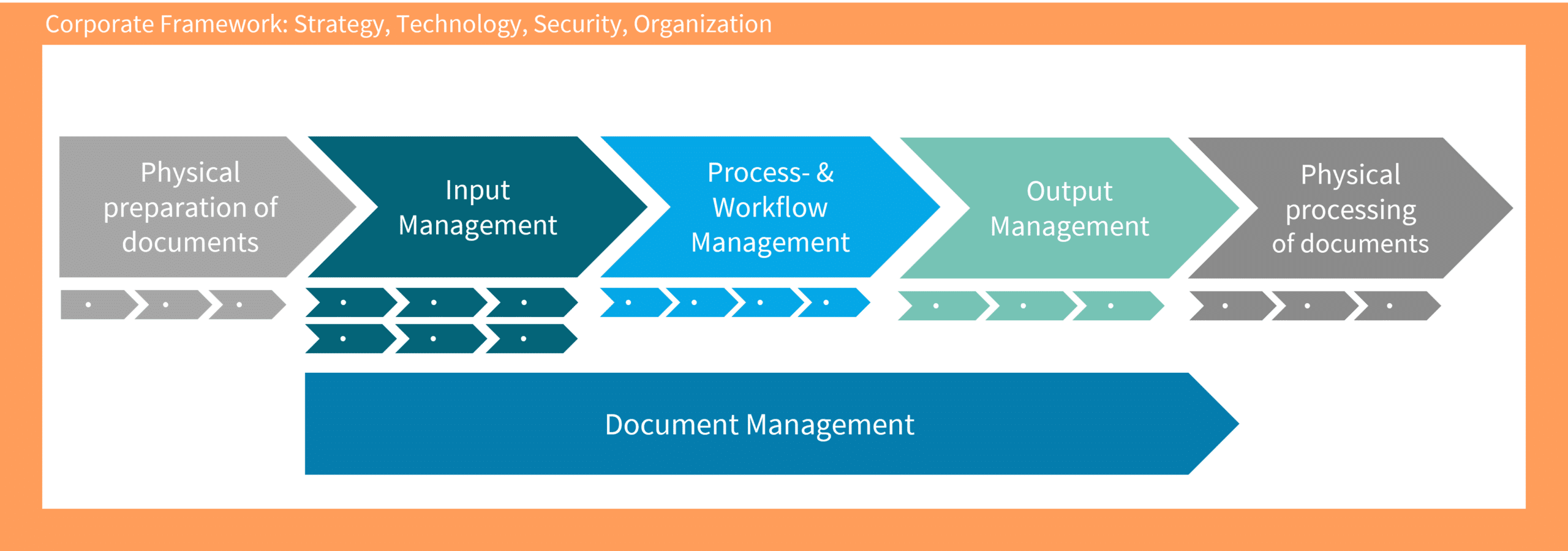
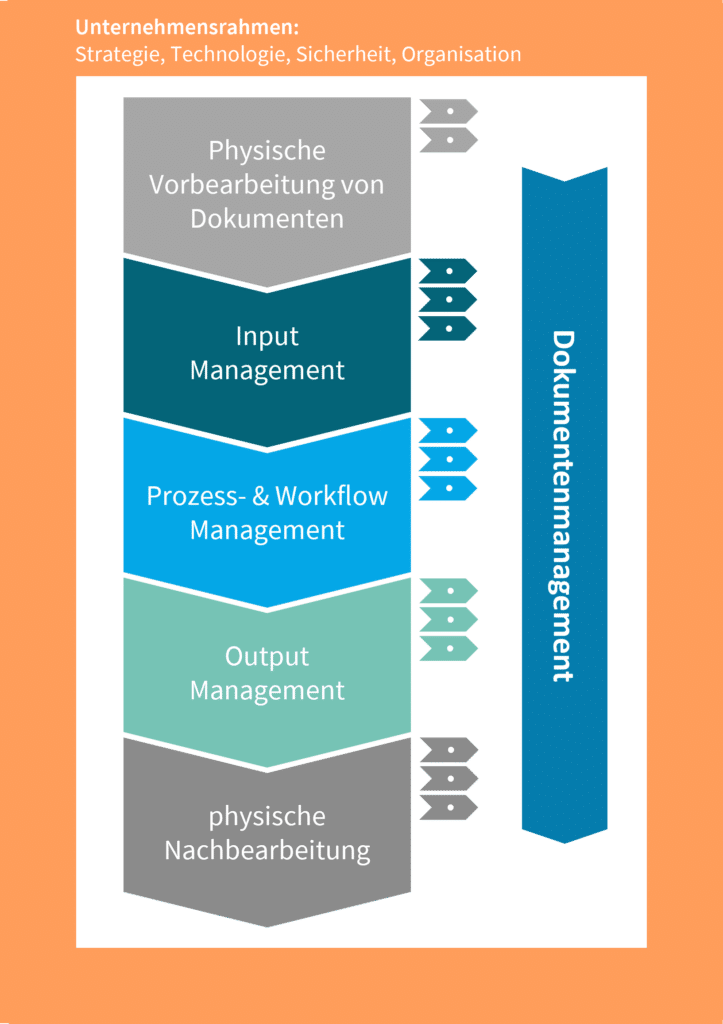
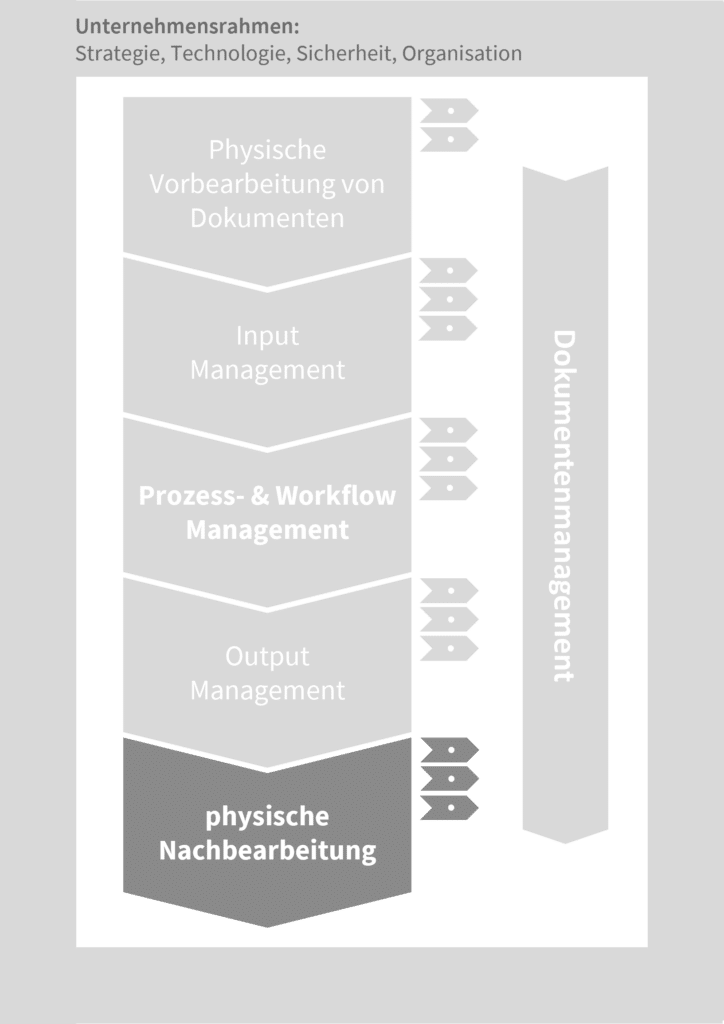
As mentioned initially and clearly illustrated in Figure 1, we define Document Logistics as a process comprising five major digitalization steps, accompanied by robust document management, where the elements of the main process can be subdivided into several smaller sub-steps.
The specific point at which your company stands in this digitalization process, or where you initiate your efforts, varies significantly. Typically, some document types or media are already digitized; however, not all departments or processes are fully automated. Manual tasks and workflows often persist. This is precisely where you should begin.
Before delving into the five essential digitalization steps within Document Logistics, we would like to briefly highlight the framework conditions within your company. For instance, if the corporate strategy mandates establishing Business Process Management or operating in a data-driven manner, these considerations should be integrated into your Document Logistics planning, alongside cost-benefit analyses or, for example, business process optimization projects. The current technological status and prospective developments concerning infrastructure and cloud solutions are also relevant here. Data protection and compliance measures are essential, especially for cloud solutions, where encryption and regular security audits are crucial. Furthermore, for all subsequent processes and approaches, you should engage the involved individuals (stakeholders) and guide them through effective project and change management. This, too, is a framework condition that you should consider.
And now in detail
5 Digitalization Steps in Document Logistics
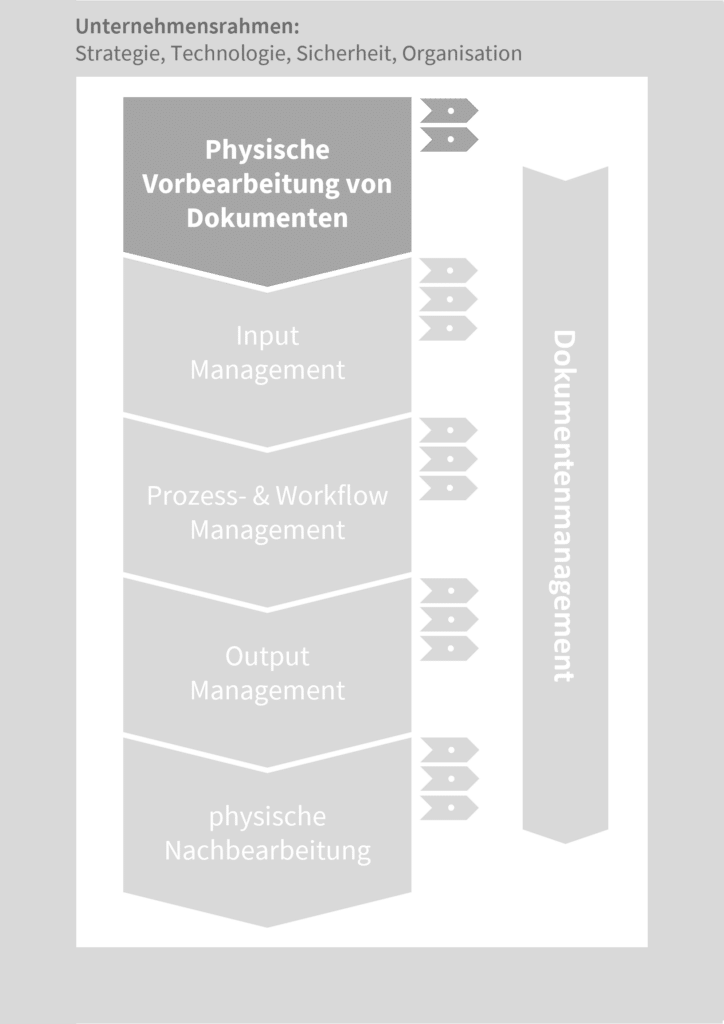
Physical Document Processing
Physical document processing forms the foundation for Document Logistics. First, you prepare the paper documents to subsequently convert them into digital data.
The storage and transport of paper documents must be managed to ensure that important records remain secure and accessible without consuming excessive space. Your documents must be protected from unauthorized access, loss, or damage. Concurrently, you should maintain an overview to enable your employees to quickly access necessary documents at any time. During transport between different locations or departments, you must always be able to track the current location of the documents. Digitalization is ultimately the optimal solution here to save space and significantly enhance accessibility.
The preparation for scanning requires meticulous attention, especially with large volumes of documents. You must remove staples, flatten the paper, and sort the documents. Special requirements, such as wax seals or folded pages on official documents, must also be considered. Modern scanners and specialized machinery can significantly help reduce manual effort.
The scanning process is a critical step where you must ensure that documents are not only digitized but also of high quality and legible. It is essential to prevent blurry or excessively large files from burdening your system. Therefore, you should optimally adjust scan settings such as resolution and color mode. Batch scanning can further accelerate the process by allowing you to process multiple documents simultaneously.
Input Management
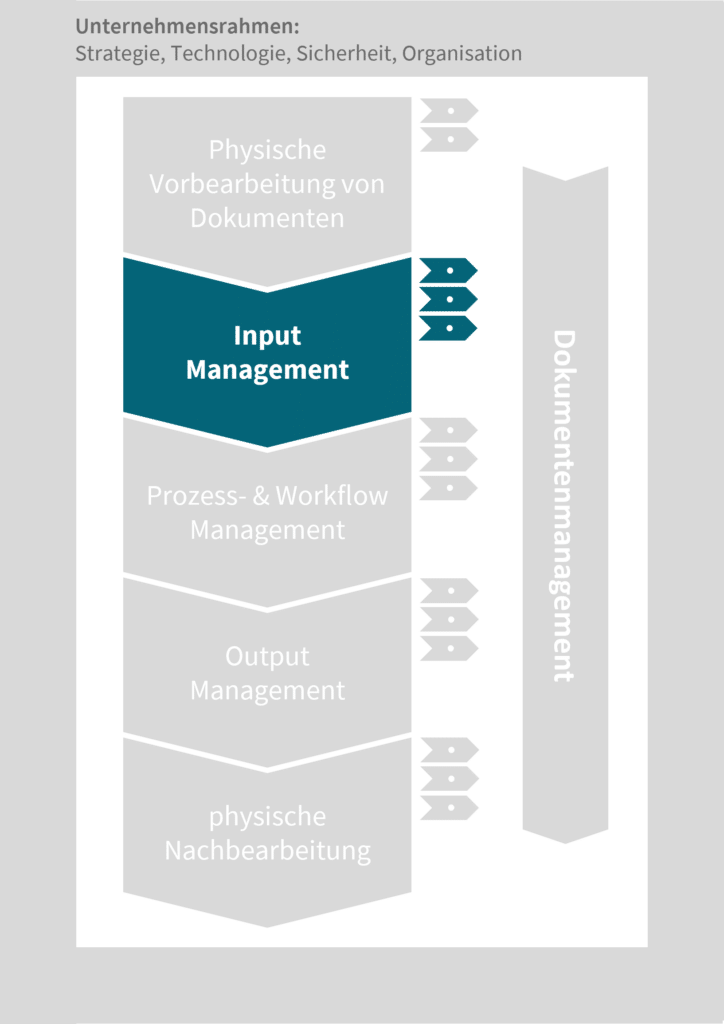
Input Management is the process by which you systematically capture, process, and forward documents and information. Texts are automatically recognized, information is extracted, validated, and securely stored in a repository. Optimizations through machine learning and robust validation mechanisms enhance efficiency. Data protection and compliance measures are essential, especially with cloud solutions, where encryption and regular security audits are crucial.
Document capture encompasses more than just scans; emails, web forms, and file uploads must also be processed. To manage this diversity of documents, you should utilize central gateways and API integrations that consolidate all input channels and convert files into standardized formats.
Document conversion ensures that captured documents are transformed into machine-readable formats, for instance, through OCR for scanned texts. Audio and video information can also be processed by AI-based services to convert them into searchable formats, typically PDF. If audio and video information are to be processed, AI-powered services are integrated to generate machine-readable texts and descriptions for these media. The result of all these conversions and preparations is a uniform format, generally PDF, which allows subsequent processing steps to be designed independently of the input channel.
The information extraction is performed through the classification and indexing of documents. Relevant information is extracted, and documents are categorized by type (invoice, contract, etc.). Machine learning improves recognition rates and reduces errors, especially with complex or handwritten documents. Using AI-based solutions such as Intelligent Document Processing (IDP), summaries can already be generated or initial assessments made during this phase.
Validation & Verification ensure that extracted data is accurate and complete. They automatically check against predefined rules or existing sources to prevent errors and meet regulatory requirements, enabling you to efficiently approve documents.
The correction of recognized data is performed manually or automatically as needed. The system learns from corrections and continuously improves the recognition rate. Intuitive correction tools, such as Buildsimple, accelerate post-processing when manual intervention is required.
Document routing ensures that processed documents are transferred to the appropriate systems. Automated, rule-based workflows or adaptive systems that learn from past processes optimize and accelerate processing.
Workflow Management within document logistics ensures that documents and digital content are processed, distributed, and utilized in a structured manner. Through automation, information enrichment, and defined checks, you can sustainably improve your business processes. A well-integrated Workflow Management software helps you achieve goals such as efficiency and speed.
However, it also means ensuring that information reaches the correct individuals and systems. Documents are reviewed, enriched, and further processed in various downstream systems. Your processes are thus the core of digitalization and document logistics: they facilitate corporate decisions, generate added value and benefits, and ultimately represent business activities. These processes benefit from preceding Input Management activities and rely on the reliable storage of information in the underlying archive.
Processing documents within a workflow system extends beyond mere technical routing. Workflow Management software controls the entire lifecycle of a document and can automatically trigger processing, review, and approval steps. For example, you can automatically subject incoming invoices to a review process, obtain approvals, and finally transmit payment instructions to the accounting system. Automated decisions and reminder functions ensure that the process runs smoothly.
The enrichment of processes with additional information occurs either manually or automatically. This includes, for example, comments, metadata, or supplementary documents that accompany the workflow. Intelligent data validation systems and clear input masks help reduce manual errors and ensure that all relevant information is captured completely and accurately.
Reviews and approvals ensure that critical decisions are examined and authorized by the appropriate individuals or systems. Delays and a lack of transparency can impede the process. Through automated escalation mechanisms and clear responsibilities, you accelerate approvals and ensure that all steps proceed efficiently.
Processing in downstream systems means that approved documents or processes are automatically transferred to subsequent systems such as ERP or accounting systems. Challenges often arise due to differing data requirements of these systems. Standardized interfaces and middleware solutions help automate data transfer. Where interfaces are lacking, Robotic Process Automation (RPA) can reduce manual and repetitive tasks and further optimize processes.

Output Management
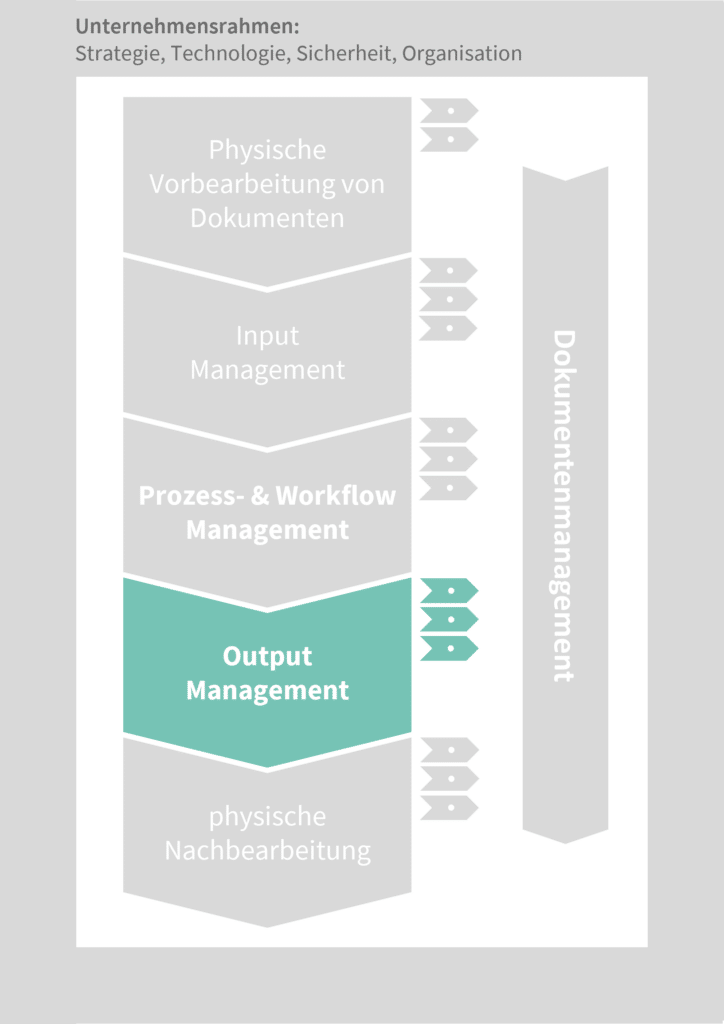
This refers to all processes associated with the creation, management, and distribution of feedback, for example, in the form of order confirmations, delivery notes, contracts, or other documents and information. With the aid of Output Management, you can ensure that this information is provided at the right time, in the right place, and in the correct format – while adhering to legal and economic requirements.
The generation of new documents and their personalization is the initial step in Output Management. Here, all relevant data is formatted appropriately, whether as a letter, email, or invoice. Ensuring data integrity is particularly crucial, especially for personalized documents such as contracts or invoices. Automated data validation systems help minimize errors and ensure compliance with regulatory requirements. Dynamic templates and modular document components enable you to flexibly adapt documents to the recipient's needs, both in content and format. Close collaboration between IT and business departments is vital, as these documents are utilized outside the company.
The final review and approval is a critical step before documents are distributed. You must ensure that all information is accurate, high-quality, and compliant before being sent to customers, partners, or authorities. Time loss and manual effort are common issues in validation. Modern Workflow Management software can automate these processes and check documents against defined quality and compliance criteria. The predefined templates and components assist in maintaining quality standards even with large volumes of documents. However, for particularly sensitive documents, manual reviews should be retained.
Physical Post-processing
In post-processing, for physical dispatch, documents are printed, enveloped, franked, and handed over to a logistics provider as mail. Fortunately, this paper-based post-processing is becoming increasingly rare due to its high cost. Digital distribution of output documents in digital form via email, an online customer portal, or an app is much more common.
Here, the automation of dispatch processes and the implementation of feedback systems ensure that documents are delivered accurately in content and conveniently via the recipient's preferred channel.
Through dynamic templates and automated systems, you can centrally create documents and adapt them to the specific requirements of each output channel. This ensures, for example, that a contract can be provided both as a printed document and digitally via email or in a customer portal, without losing data consistency or document structure.
Multichannel output enhances efficiency and allows you to address customer needs more flexibly, while simultaneously adhering to all legal and corporate requirements. You maintain an overview of the various channels and ensure that all documents are delivered consistently and punctually.
Document Management
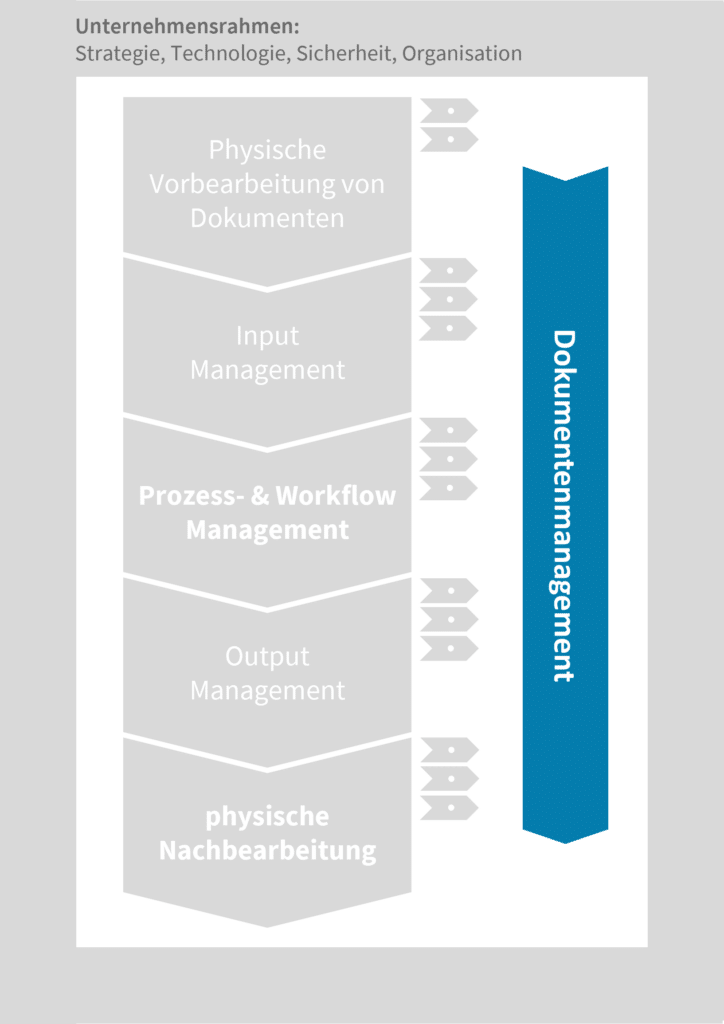
A Document Management System (DMS) is a software solution that assists you in efficiently managing, storing, and organizing your documents. It is thus the core for document archiving. However, modern Document Management Systems are typically very powerful platforms that offer functionalities far beyond this:
Document Storage: Centralized storage of documents that are easily accessible and searchable.
Versioning: Tracking changes and versions of a document to ensure that the most current version is always utilized.
Access Control: Managing who can access and edit which documents to ensure security and confidentiality.
Workflow Management: Automating business processes, such as approvals and reviews, to enhance efficiency.
Search Functions: Rapid document retrieval through powerful search tools and metadata.
In conjunction with AI and straight-through processing, we can transform your DMS into a powerful digitalization and efficiency platform. Document management thus encompasses the phases of input management, process and workflow management, and output management.
Challenges in Document Logistics
A central challenge in digitalization is the varying degree of digital maturity, not only between different companies but also significantly within individual departments or business units. Even within a single process, various document types or media may exhibit differing levels of digitalization. While some processes or workflows have been largely automated and integrated into digital structures, others remain heavily reliant on manual processing. This inconsistency presents a substantial challenge, as each process requires individual assessment and optimization.
Therefore, a thorough analysis of the current state of processes is essential to implement targeted improvements and ensure seamless integration into existing systems.
On the path to efficient and digitally networked document logistics, each phase presents its own challenges:
- Storage and Transport of Paper Documents
- Preparation for Paper Scanning
- Efficient Capture and Harmonization of Diverse Formats
- Data Protection
- Acceptance of New Systems
- Unclear Process Structures
- Delays in Approvals
- Integration of Document Information into Other Systems
- Distribution of Generated Documents Across Multiple Channels
- Cost Control
As with all digitalization initiatives and general innovations, professional change management is essential. Only when your employees are trained and integrated into the new processes can acceptance be fostered and seamless implementation ensured.
Do I Truly Need Document Logistics?
Whether your company should address the topic of document logistics significantly depends on your specific challenges. However, if you answer more than half of the following questions with 'Yes,' our experience suggests it would be advisable to closely examine your current document-driven processes and workflows to enhance their efficiency through digitalization and automation.
- My company still utilizes a significant volume of paper documents.
- Our paper documents still pass through several hands via internal mail.
- I am responsible for managing large volumes of documents.
- We handle various types of documents, such as contracts, invoices, technical specifications, or HR documents, each with distinct archiving and access requirements.
- Are our documents organized within complex, hierarchical structures or projects?
- My company must comply with regulations such as GDPR, ISO standards, or industry-specific regulations.
- We are obligated to securely retain specific documents for a defined period.
- Our employees spend considerable time locating files or performing redundant tasks.
- We encounter numerous approval processes.
- Access to specific documents, such as human resources or financial information, must be controlled.
- We must protect our data from loss, unauthorized access, or unintentional modifications.
- My company plans for significant growth.
- We operate internationally and/or in distributed teams, frequently working remotely.
- We utilize ERP/CRM systems or other business tools into which document information must be integrated as data.
If you have inwardly affirmed many of these points, a cost-benefit analysis is worthwhile. Naturally, optimizing your document logistics with the guidance and consultation of an expert like us represents an investment. In addition to workshop costs for the as-is analysis, and license and implementation costs for new software, training expenses for your employees may also arise. We would be pleased to discuss in direct conversation whether the long-term benefits, such as increased efficiency, reduced risk, and compliance with legal requirements, can outweigh these investment costs.

In document logistics, we consolidate all services for process automation within enterprises, spanning the entire lifecycle and value chain of information and documents. From consulting and selection, through delivery and implementation, to Software-as-a-Service and operations, the optimization of these processes and customer value are central to our solutions. This commitment has established us for many years as “the” reliable and innovative partner for our clients and a leading provider in document logistics.
Stefan Jamin
Senior Executive Manager | Business Process Automation | ISR Information Products AG
How We Specifically Support Companies
YOUR ADVANTAGE?
Following a detailed as-is analysis of your document-driven processes, we not only develop a solution concept and manage the project during implementation, but we also fully provide migration services, product and methodology training, and operational support.
Our approximately 60 employees are engaged in consulting and development within the field of document logistics. Customer proximity and their passion for new challenges and IT solutions distinguish us.
In the field of document logistics, we rely on these
TECHNOLOGIES



We offer these consulting services
Document Logistics




Get in touch with us now
We would be pleased to advise you.

Mark Hommola
Head of
Document Logistics
mark.hommola@isr.de
+49(0)151 422 05 426