
With the new ZUGFeRD 2.2 release package, digital invoice processing is now even easier and more efficient. But how has digital invoice processing developed in Germany, and how can ZUGFeRD 2.2 help companies optimize their invoicing processes?
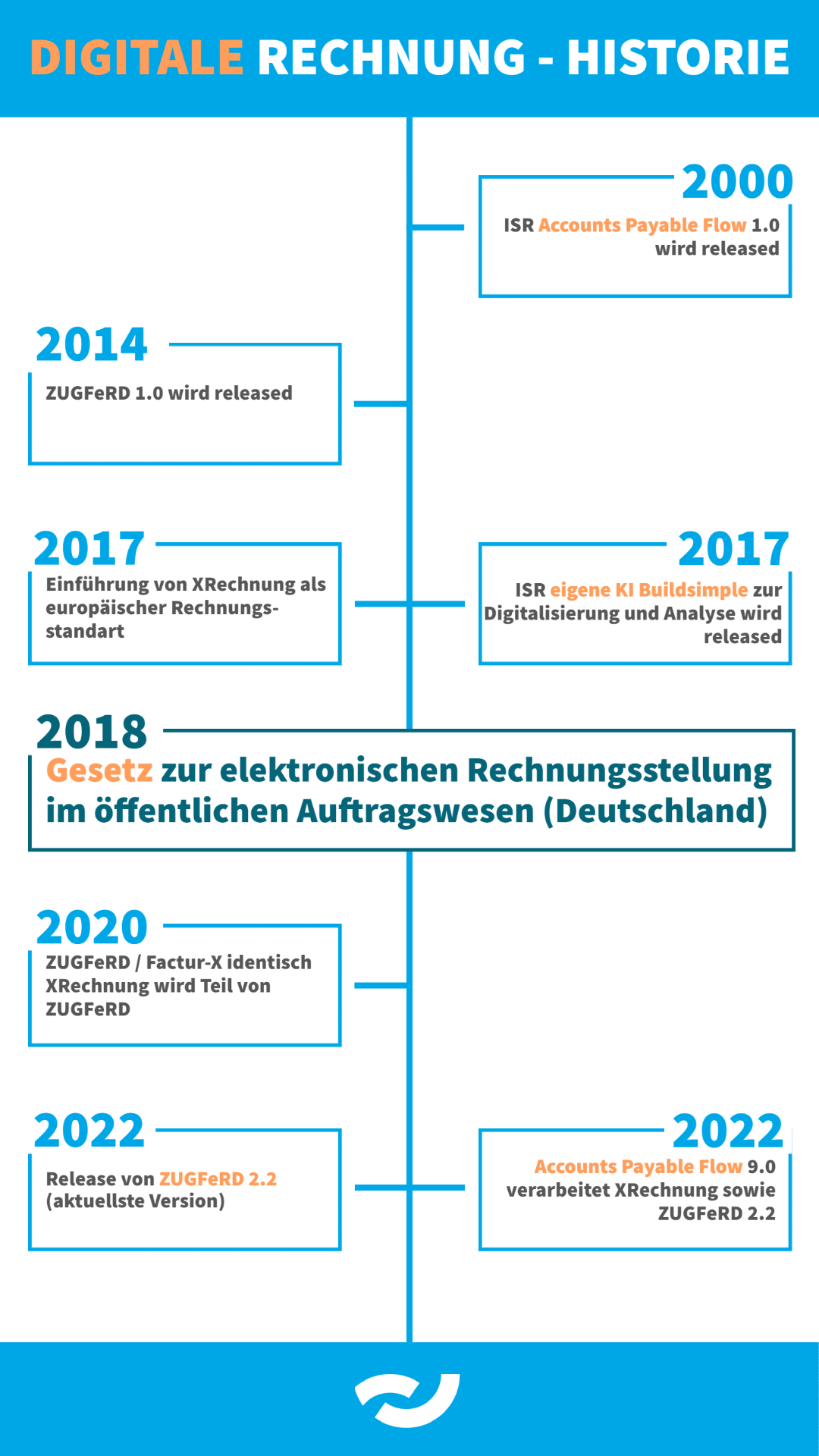
The history of digital invoice processing and the“Central User Guide of the German Electronic Invoicing Forum”(ZUGFeRD for short) began in 2014. That year, the EU introduced a directive on electronic invoicing.
In this directive, the European Union established the framework for a uniform approach to the transmission of invoices to public administrations.
EU member states must ensure that public contracting authorities are able to receive and process electronic invoices that comply with European standards for electronic invoicing. A corresponding legislative process was initiated in Germany in 2016. The relevant law finally came into force on November 27, 2018.
Since then, the topic of “digital invoice processing” has been a focus at both the European and national levels and is constantly evolving.
What to Expect Here – An Overview
2. ZUDFeRD 2.0 = Faktur-X – a German-French cooperation
3. The new features of ZUGFeRD 2.2
4. Digital invoice processing + artificial intelligence = ISR
ZUGFeRD – Who invented it?
ZUGFeRD was developed by various organizations, such as the Federal Ministry for Economic Affairs and Energy and the German Tax Advisors Association. It is a format that combines a PDF invoice with an integrated XML file. The PDF document is readable by humans, while the XML file contains the invoice data for automated processing.
Another important format is XRechnung. It is a European standard that was introduced in 2017 and enables a uniform data structure for processing invoices. Unlike ZUGFeRD, XRechnung is exclusively an XML file that can be processed directly by IT systems.
ZUGFeRD 2.0 = Factur-X – A German-French cooperation
In June 2017, the European standard for the core elements of an electronic invoice, EN 16931, was published by CEN (European Committee for Standardization). This led to the need to adapt ZUGFeRD 1.0 within the framework of the Franco-German agenda. The result of this adaptation was ZUGFeRD 2.0, also known internationally as Factur-X, which meets all the requirements of the newly published standard.
The three most important are:
ZUGFeRD 2.0 expands the hybrid invoice format to include new business processes such as credit notes, orders, and delivery notes.
ZUGFeRD 2.0 makes it easier for people with visual impairments to read by integrating accessible PDF and XML elements.
ZUGFeRD 2.0 has been adapted to the European standard for the core elements of an electronic invoice EN 16931 and thus meets all the requirements of the EU Directive on e-invoicing. This makes the format even more attractive for companies and facilitates cross-border trade.
The new features of ZUGFeRD 2.2
Version 2.2 of ZUGFeRD focuses primarily on expanding the profiles, particularly through the introduction of the “XRechnung” reference profile, which enables companies to map various types of invoices using a single format.
Another important innovation is interoperability with the Order-X format. This electronic data format for orders is tailored to the needs of small and medium-sized enterprises and enables automated order processing.
The interoperability of ZUGFeRD 2.2 and Order-X should enable companies to seamlessly integrate and automate their ordering and invoicing processes.
Digital invoice processing + artificial intelligence = ISR
At ISR, we are strongly committed to intelligent invoice processing. Find out why we also have to think of Franz Beckenbauer here.
We recognized the importance of this issue over 20 years ago. The use of smart technologies can greatly increase the efficiency of processing incoming invoices. Whether paper, PDF, XRechnung, or ZUGFeRD—with ISR Accounts Payable Flow, you have all your invoices under control at all times.
Based on our own artificial intelligence, invoice data is automatically classified and imported into our system. There, it can be further processed and transferred directly for review. In addition to our own product, Buildsimple, we also use other software products such as IBM Datacap when necessary. For example, the invoice number, gross amount, and recipient's IBAN are automatically recorded.
Still not quite convinced? Here are three more arguments to conclude:
You get an overview of all invoices in the company. In the digital invoice file of ISR Accounts Payable Flow, all related data is securely stored in one place. Relevant information (from the scan date to the due date) can be accessed with just one click of the mouse.
The invoice processing time is reduced to just a few days. If everyone involved acts quickly, invoices can even be processed within a few hours. No additional emails or phone calls are required!
Direct access to all audit processes allows you to check the current status of each invoice at any time. This means that any queries from departments or suppliers regarding the invoice can be answered quickly and accurately.
In conjunction with our contract management tool, ISR Contract Manager, and ISR Information Office, this creates transparency across all business-related economic processes.
Would you like to learn more about our services?

Jens Brettschneider
Head of Business Unit
Application Management
jens.brettschneider@isr.de
+49(0)151 422 05 425