
CRITICAL VULNERABILITIES REQUIRE QUICK DECISIONS. WE SHOW WHAT MATTERS MOST WHEN IT COMES TO SECURITY AND PATCH MANAGEMENT IN IBM ENVIRONMENTS.
Current Event: Cyberattack on the Berlin State Network
The current cyberattack on parts of the Berlin municipal administration demonstrates just how immediate the consequences of a successful attack can be: Systems had to be taken offline as a precaution, data was stolen and later published on the dark web. The full extent of the incident is still under investigation. Based on current information, the incident is not related to the IBM vulnerability discussed below. However, it illustrates the impact that successful cyberattacks can have on business-critical IT environments. Both companies and public institutions face the challenge of operating complex IT environments while new vulnerabilities in standard software are continually being discovered.
Even business-critical enterprise applications and their underlying technology components are no exception. IBM regularly publishes security bulletins regarding identified vulnerabilities and provides corresponding fixes or recommendations for action.
For companies, the key question is therefore: How quickly can we identify relevant vulnerabilities, assess the actual risk to our environment, and take the appropriate measures?
1. Security vulnerabilities don't stop at enterprise software either
2. The Real Challenge: Identifying Security Vulnerabilities and Assessing Them Accurately
3. Why Response Time Is Important for Known Vulnerabilities
4. Security requires structured patch and vulnerability management
5. Security for IBM Analytics as part of our Application Management Services
6. Conclusion: When it comes to critical vulnerabilities, responsiveness is key
Security vulnerabilities don't spare enterprise software either
Security vulnerabilities are also regularly identified in IBM products and disclosed through official security bulletins. In these bulletins, IBM provides information on which products and versions are affected, how critical a vulnerability is rated, and what measures are recommended.
However, a disclosed vulnerability does not automatically mean that every IBM environment is equally at risk. The key factor is which products, versions, components, and configurations are in use.
Especially in complex analytics environments involving IBM Cognos Analytics, IBM Planning Analytics, IBM SPSS, or underlying platform components such as WebSphere, it is therefore essential to first determine: Is our specific system environment affected, and if so, how urgently do we need to act?
What does the CVSS score tell us about a vulnerability?
The Common Vulnerability Scoring System (CVSS) provides an initial indication of a vulnerability’s technical severity. This standardized rating system assigns a score between 0 and 10. Generally, the higher the score, the more critical a vulnerability is considered to be.
For example, the assessment takes into account whether an attack is possible over the network, whether special permissions or user interaction are required, and what potential impacts there may be on confidentiality, integrity, and availability.
However, the CVSS score is only one part of the risk assessment. The actual risk always depends on the specific system environment and configuration.
Current Example: Critical Vulnerability in IBM WebSphere Application Server Liberty
The vulnerability CVE-2026-49875 in IBM WebSphere Application Server Liberty, disclosed in September 2026, illustrates just how important a rapid assessment can be.
IBM published a security bulletin regarding this issue. Certain versions of WebSphere Application Server Liberty between 17.0.0.3 and 26.0.0.9 are affected, provided that the relevant features are enabled. The vulnerability was assigned a CVSS Base Score of 9.8 out of 10.
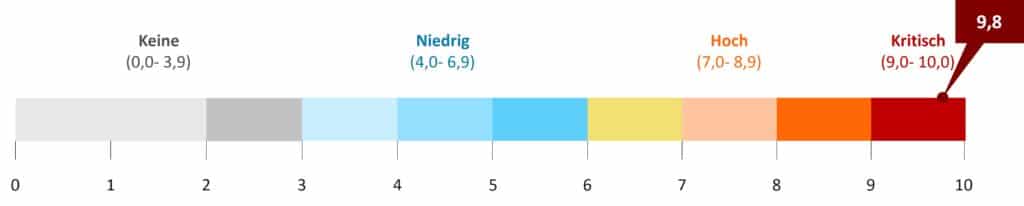
Technically, it involves the processing of external XML entities in the Apache CXF library used. A potential attack can be carried out over the network without prior authentication or user interaction. IBM recommends promptly addressing the vulnerability by installing the appropriate interim fix for APAR DT497707 or by upgrading to Liberty Fix Pack 26.0.0.10 or a newer version.
This example illustrates that the CVSS score alone does not determine the need for action. The decisive factor is whether the affected versions and features are actually in use in your own environment.
The Real Challenge: Identifying Security Vulnerabilities and Assessing Them Accurately
Once a security bulletin is published, the real work begins for companies. New reports must be monitored continuously and compared with their own system infrastructure.
The following questions are particularly relevant in this context:
- Which products, components, and versions are affected?
- Are these used in our own community?
- How significant is the risk in this specific context?
- Are there any fixes or alternative solutions available?
- How quickly must action be taken?
- How will the implementation affect day-to-day operations?
A high CVSS score provides important guidance, but it does not replace an individual risk assessment. A general security alert must therefore be translated into specific, prioritized recommendations for action tailored to one’s own IT environment.
This requires product knowledge, an understanding of the system environment, and established processes.
Why Response Time Is Important for Known Vulnerabilities
A critical window of time can arise between the disclosure of a security vulnerability and its resolution. After all, information about known vulnerabilities is not only available to companies and IT managers—it can also be exploited by potential attackers.
If a significant security vulnerability remains unaddressed, the consequences—depending on the vulnerability and the system—can be significant:
- Data loss or data leakage
- Manipulation of Data and Systems
- Failures and Service Interruptions
- Malware or ransomware infections
- Compliance and Data Protection Issues
- financial and reputational damage
Analytics and planning systems often require a particularly high level of protection. Among other things, these systems process financial data, forecasts, planning information, and management reports.
At the same time, the response to a critical vulnerability is not necessarily to install a patch immediately. In production enterprise environments, dependencies, necessary testing, and potential impacts on ongoing operations must also be taken into account.
It is therefore crucial to quickly prioritize critical vulnerabilities and implement necessary measures in a controlled manner.
Security Requires Structured Patch and Vulnerability Management
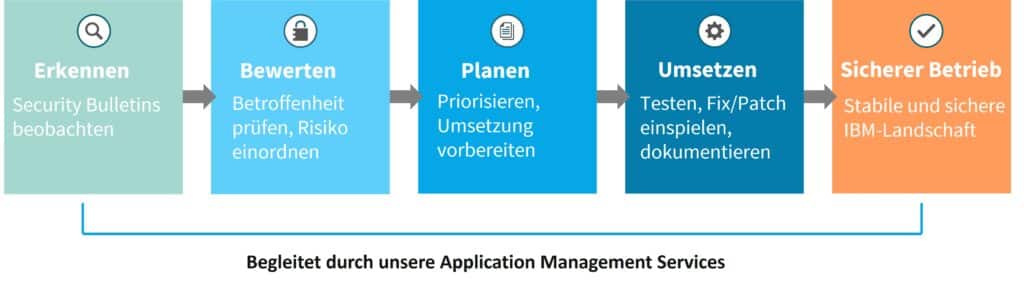
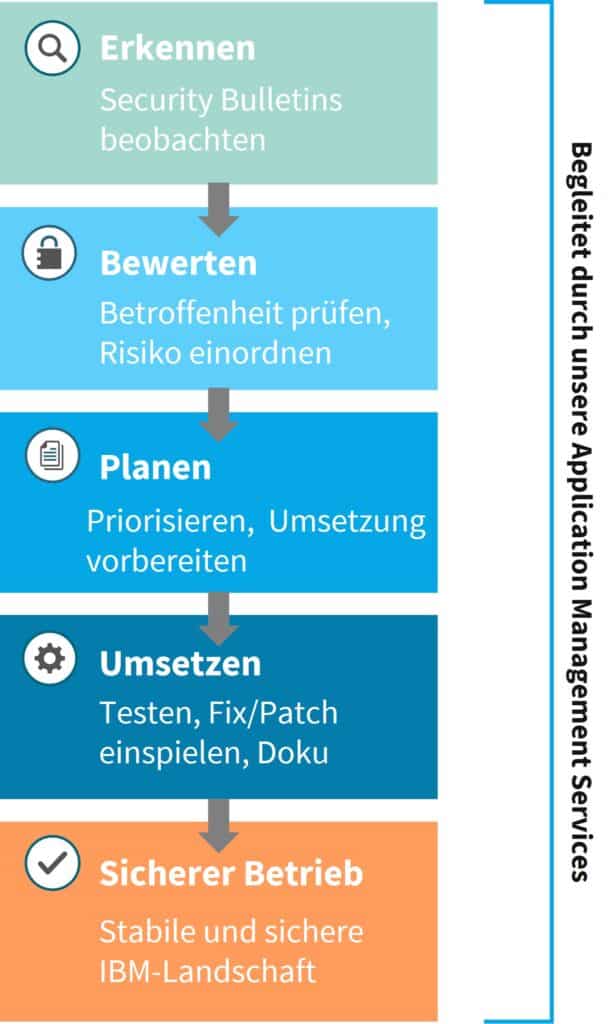
Structured patch and vulnerability management provides a reliable process for this:
1. Monitor security alerts
Continuously track relevant security bulletins and known vulnerabilities.
2. Check for impact
Compare affected products, versions, components, and configurations with your own environment.
3. Assess risk
Evaluate technical criticality and potential impacts on the individual system environment.
4. Prioritize measures
Determine the need for action and the required response time.
5. Plan implementation
Prepare fixes or countermeasures, taking into account dependencies, maintenance windows, and operations.
6. Test and apply fixes
Review changes, implement them carefully, and then verify that they were installed successfully.
7. Document measures
Record the assessment, impact, and measures implemented in a way that is easy to follow.
Continuity is key. Patch and vulnerability management should not wait until a critical security advisory is published to begin. Established processes, clear responsibilities, and a thorough understanding of your own system environment lay the groundwork for a rapid response in the event of an emergency.
Security for IBM Analytics as part of our Application Management Services
For ISR, this operational aspect is part of a comprehensive enterprise information management strategy: Business-critical data and analytics solutions must not only function properly from a technical standpoint, but also remain manageable during day-to-day operations.
As part of our Application Management Services (AMS), we help companies ensure the reliable and secure operation of their IBM environments. These include, among others, IBM Cognos Analytics, IBM Planning Analytics (TM1), IBM SPSS Modeler, IBM SPSS Collaboration and Deployment Services (C&DS), and IBM WebSphere Application Server.
Our specialized team monitors relevant IBM Security Bulletins and assesses their potential impact on the customer environments we support.
From Security Advisory to Implementation
When a relevant vulnerability is identified, we assess the specific need for action and determine appropriate measures based on that assessment. In doing so, we take into account both the severity of the vulnerability and the individual system configuration, as well as the requirements of ongoing operations.
After consulting with our clients, we also handle the technical implementation and deploy the necessary fixes or patches in a controlled manner.
In this way, we support the security process from the identification and assessment of a vulnerability through to the technical implementation of necessary measures.
Responsiveness Even in Critical Situations
When particularly critical vulnerabilities arise, swift action may be required. Our Application Management Services can therefore be tailored to our customers’ specific requirements and service levels—from ongoing support during normal operations to extended service hours and 24/7 support.
This ensures that even in time-sensitive situations, designated points of contact and processes are in place to quickly implement appropriate measures.
Conclusion: When it comes to critical vulnerabilities, responsiveness matters
The recent security incident in Berlin once again highlights the potential impact of cyberattacks. It is not related to the IBM vulnerability discussed here. However, the incident underscores the importance of a professional approach to managing IT security risks.
For companies with business-critical IBM Analytics environments, established processes are therefore crucial for identifying security alerts early on, assessing their own exposure, and implementing the necessary measures in a targeted manner. With our Application Management Services, we support companies in this process—from evaluating relevant IBM Security Bulletins to deploying the necessary fixes and patches. After all, when a critical security vulnerability arises, it’s not just about taking action, but also about how quickly and effectively you do so.
Would you like to explore how security bulletins and necessary patches can be systematically assessed and implemented in your IBM environment? Talk to us about your patch, vulnerability, and application management needs.