
PROJECT OBJECTIVE: A NEW ERP SYSTEM, FROM POLICY ADMINISTRATION TO DWH
The insurance industry faces challenges such as increased competitive pressure, intense cost pressure, advancing digitalization, and stricter regulations. In this demanding environment, one of our clients in the insurance sector has initiated a comprehensive digitalization program. To address current challenges, our client from the life insurance division is focusing on implementing the msg.Insurance Suite as an end-to-end integrated solution platform. The suite comprises several standard software modules that can be used individually or in any combination and integrated into the IT landscape.
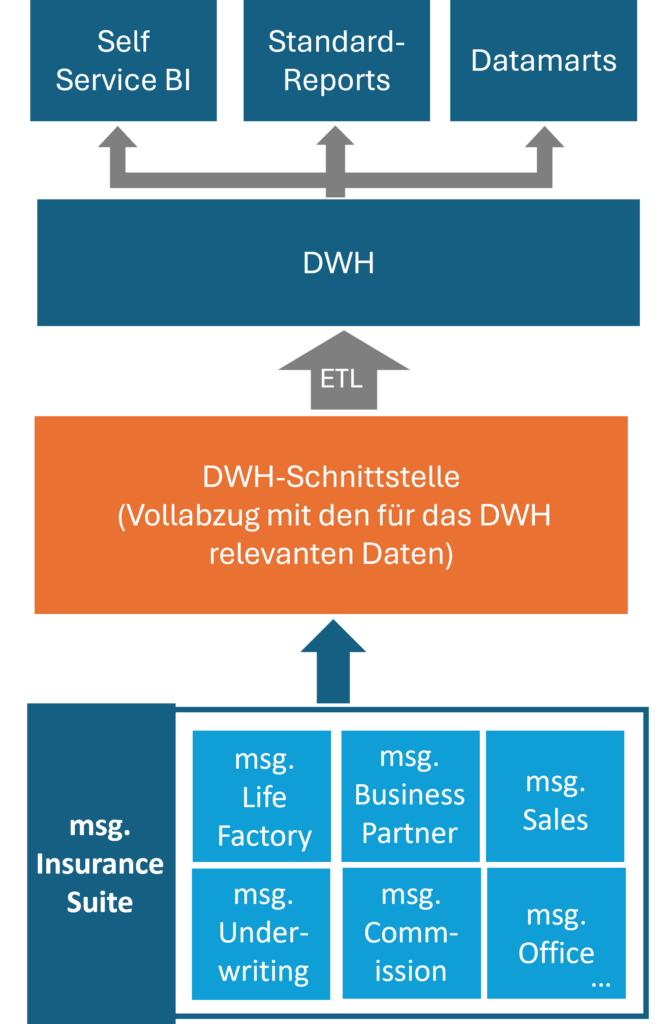
Concurrently with the successful implementation of the msg.Insurance Suite, the wealth of data from these applications is to be leveraged for comprehensive analyses. However, this proves more complex than anticipated, as data is stored according to each module's specific logic, and further complexity arises from customization. Therefore, developing an interface for connecting to the Data Warehouse (DWH) is critically important. This interface enables efficient extraction, transformation, and unified integration of data into the DWH. Without implementing a stable interface to a query-optimized storage model for decision support, changes made by the vendor msg or the Insurance Suite implementation team would always have to be synchronously replicated in the DWH. The interface decouples both system environments and can conceptually be understood as a contract for coordinated data provisioning. Should other recipient systems require data from the msg.Insurance Suite in addition to the DWH, they can also access this interface.
The DWH to be integrated provides the opportunity to gather valuable insights for strategic decisions, thereby enabling data-driven decision-making. On one hand, standard reports offer a consistent overview of key performance indicators, while on the other hand, self-service analytics empowers users to conduct individual analyses. Additionally, data marts provide specialized data views for specific business areas, such as sales, portfolio, or marketing, which can be utilized with various tools, including AI.
The Success Formula – Key Factors for Successful DWH Integration
Establishing a DWH requires not only a deep understanding of analytics but also, crucially, of the source system, the processes mapped within it, and how process data is stored. Only with this knowledge can seamless data processing be ensured. The following key factors contributed to a successful DWH integration in our client project:
1. Comprehensive Industry-Specific Requirements Analysis
It is crucial to thoroughly understand the specific requirements and technical terminology of the insurance industry. What is the objective of the evaluations? Which data needs to be integrated? What types of analyses are to be performed? These questions form the foundation for the entire integration process.
2. Understanding the Complex Data Model
Each individual msg software module has its own data model with distinct logic and structure; some data is used multiple times, and some is maintained in parallel copies. For DWH integration, it is essential that data utilization is efficient and, where necessary, integrated, despite the modularity. The data model should reflect the requirements of the business departments while simultaneously being optimized for consistency and performance. All data must be extracted only once at a defined point in time, and data copies must be integrated and synchronized. Attention must be paid to the module-specific cut-off date logic, which is particularly relevant for portfolio analyses. Meticulousness and accuracy in data preparation then even enable the use of historical information embedded in the data for "time travel" through portfolio development.
3. Data Integration and Interface Design
It must be ensured that data from the msg.Insurance Suite can be transferred correctly and unambiguously. The conception and implementation of an efficient interface are therefore crucial and directly contribute to the system's data quality and integration capability. Complexity in the source system's data model can, if necessary, be resolved and simplified directly through the interface design using in-house development.
4. Transparent Communication and Collaboration
Successful integration requires close and agile collaboration between the IT and business department teams responsible for the msg.Insurance Suite and the Data Warehouse. Clear communication minimizes misunderstandings and helps foster mutual trust and a shared understanding of project objectives.
5. Testing and Quality Management
A successful DWH project requires high-quality, consistent, and up-to-date data. Comprehensive end-to-end tests, covering all steps from data acquisition in the source system, through the interface, to the business-oriented DWH evaluations, have proven extremely effective. Through extensive testing of business-relevant data constellations, potential data quality issues can be identified and resolved early, ensuring data accuracy and reliability. Testing and quality management contribute to ensuring that the DWH meets business requirements and provides genuine added value to the company. The tests are designed to be repeatable and automatable, allowing data quality to be continuously measured and secured even after rollout during ongoing operations.
6. Security and Data Privacy
In the DWH, as a single point of truth, data privacy is of critical importance, as sensitive and protectable data is also stored. Data must be protected through measures such as authorization concepts, encryption, or anonymization/pseudonymization to ensure data confidentiality, integrity, compliance, and reliability.

Thorsten Stefanski
Head of Division
Analytics & Insights
thorsten.stefanski@isr.de
+49(0)151 422 05 420