
SAP product management has positioned SAP HANA Cloud and Datasphere as central building blocks for creating a business data fabric. In this blog post, we discuss what this means for companies in concrete terms.
1. The expansion of the SAP Analytics strategy
A central component of the SAP Analytics strategy is its focus on a data fabric architecture. SAP's offering in this area is Business Data Fabric, with Datasphere positioned as its central component. Now,in a joint announcement (seeFig. 1), the product management teams for SAP HANA Cloud andDatasphere have presented an important and forward-looking extension of this strategy: SAP HANA Cloud and Datasphere together form the central building blocks of SAP's future data fabric offering.
2. What is a data fabric?
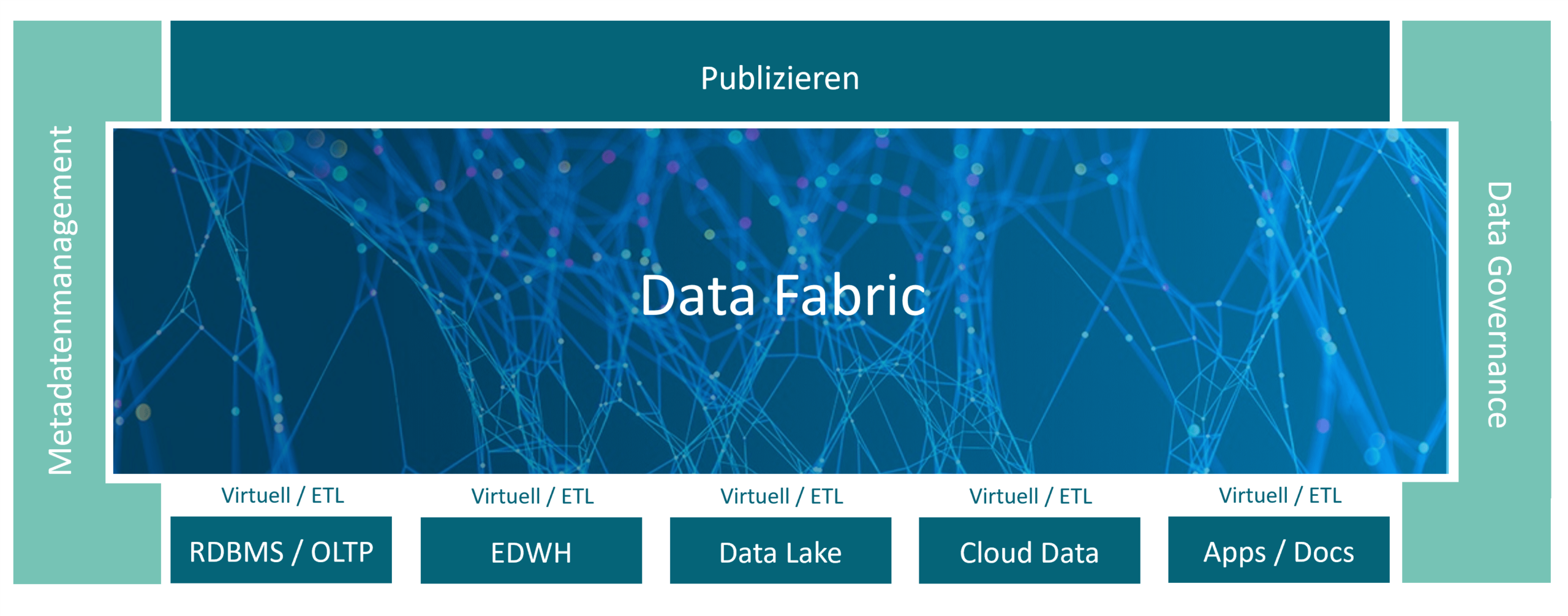
Data Fabric is a data architecture in which data in a heterogeneous, distributed data landscape is linked, managed, and made available in an integrated layer to form a data network .
Stefan Kahle | Senior Executive Manager (ISR)
A data fabric therefore links data from different systems to form an integrated data network (seeFig. 2). The supplying systems form the basis for this. An important foundation is usually an enterprise data warehouse (EDWH), in which data is integrated, historicized, harmonized, and integrated into the data fabric architecture in a stable and quality-assured manner.
3. How should SAP's expanded Business Data Fabric approach be understood?
In the now expanded understanding of the business data fabric, HANA Cloud, together with Datasphere, is seen as part of the SAP data fabric approach. What does this mean? To answer this question, we first need to consider the differences, but also the similarities, between HANA Cloud and Datasphere.
HANA Cloud brings together the services on the Business Technology Platform (BTP) that are required for the native development of applications and analytical models. Essentially, these are HANA DB and Business Application Studio, flanked by services that support the development process, such as Cloud Foundry. This means that all the requirements for developing and operating an EDWH natively are essentially met.
Datasphere is an application based on HANA Cloud technology, with HANA DB forming the foundation of Datasphere. Similar to BW/4, Datasphere's unique selling point is that it provides a development and runtime environment. Two aspects are particularly noteworthy here: First, the focus on specialist departments, enabling them to develop analytical models in a self-service manner. The second aspect is the enrichment of data with semantic information, giving the data a business context or allowing it to retain this context, hence the term " business data fabric."
Both approaches are necessary for a functioning data fabric architecture. Data fabric usually requires a strong foundation in order to integrate and consume data from different sources in an agile and flexible manner in the spirit of self-service.
This is precisely what defines SAP's expanded strategic positioning: by combining SAP HANA Cloud and Datasphere, SAP is strengthening an approach that provides excellent coverage of both areas. While HANA Cloud is ideally suited for building a stable, quality-assured backend (EDWH), SAP Datasphere can be used to develop the Business Data Fabric based on this, together with other sources.
4. What does this mean for companies?
The expanded strategic approach offers companies more options for building a stable foundation. Of course, HANA Cloud is not the only option here.
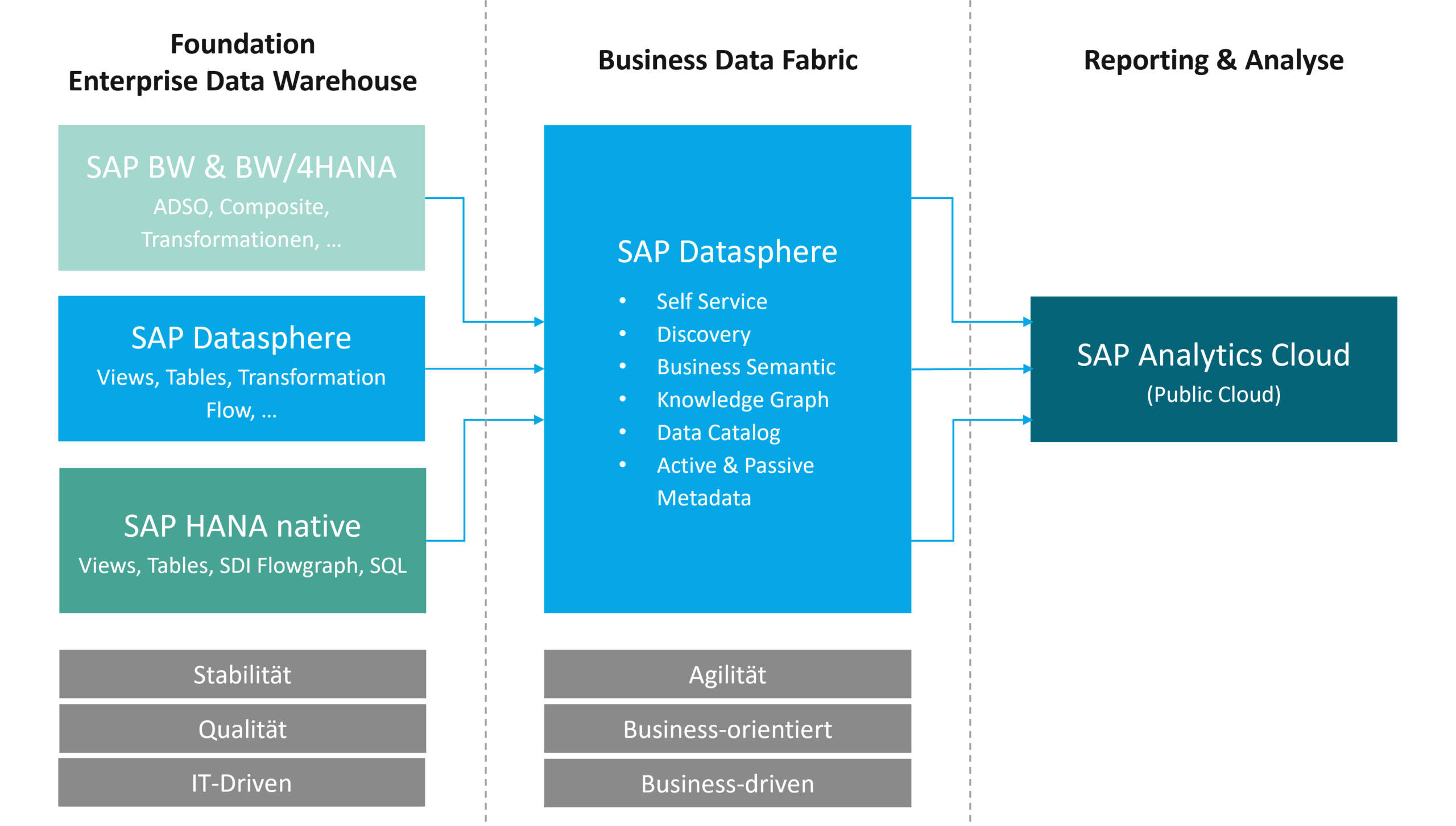
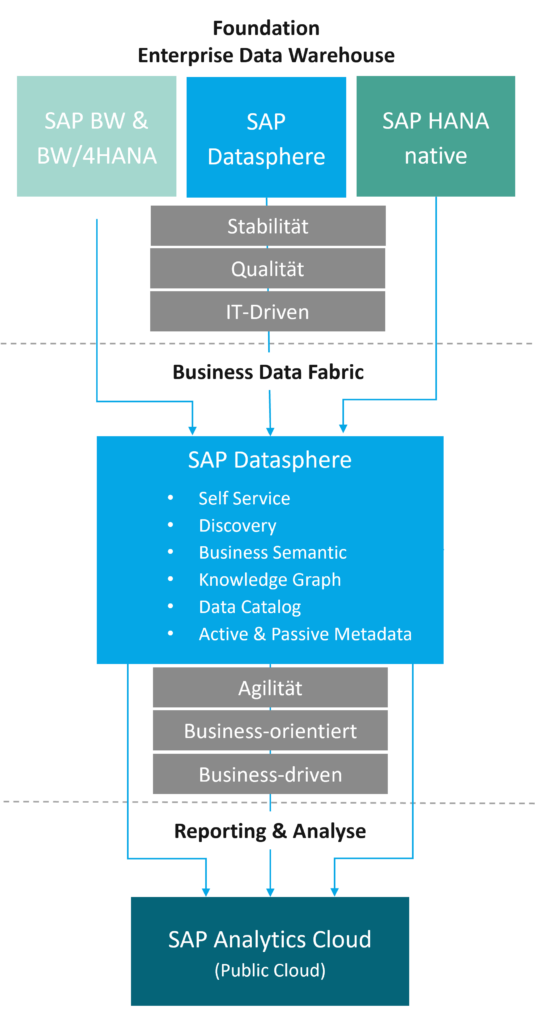
The figure shows the business data fabric with Datasphere as the link between the stable database as the foundation and the front end with reporting and analysis (seeFig. 3). Basically, an EDWH-oriented back end can be set up with BW/4, Datasphere, or HANA Cloud. The three variants differ significantly from each other and each has corresponding advantages and disadvantages, which will be briefly presented here:
- SAP BW is the current EDWH solution in many companies and continues to be well suited for this purpose. However, maintenance for BW on HANA will expire in 2027, and BW/4HANA is also scheduled to end in 2040. To make matters worse, contrary to SAP's clear strategy, BW/4 is not a true cloud solution.
- SAP Datasphere, on the other hand, is a public cloud solution, but as an EDWH solution, it has functional gaps that mainly result from the fact that it tends to address the self-service needs of specialist departments and is also increasingly defined as a data fabric layer. Datasphere lacks a certain degree of enterprise readiness.
- SAP HANA Cloud is a fully-fledged cloud solution that is absolutely enterprise-ready and can therefore function as an EDWH solution. On the other hand, HANA Cloud is rather IT-heavy, which means that self-service and data fabric are not well established here.
Each option has its advantages and disadvantages. However, HANA Cloud and Datasphere form an excellent combination when it comes to combining enterprise readiness with self-service and data fabric. Since both have the same technological basis, they are inherently highly compatible, which is further strengthened by this strategic alignment. One example of this is "semantic integration" (seeFig. 4). This involves translating calculation views into a Datasphere virtual table, providing an interface that ensures not only technical integration but also integration of semantic information (business data fabric).
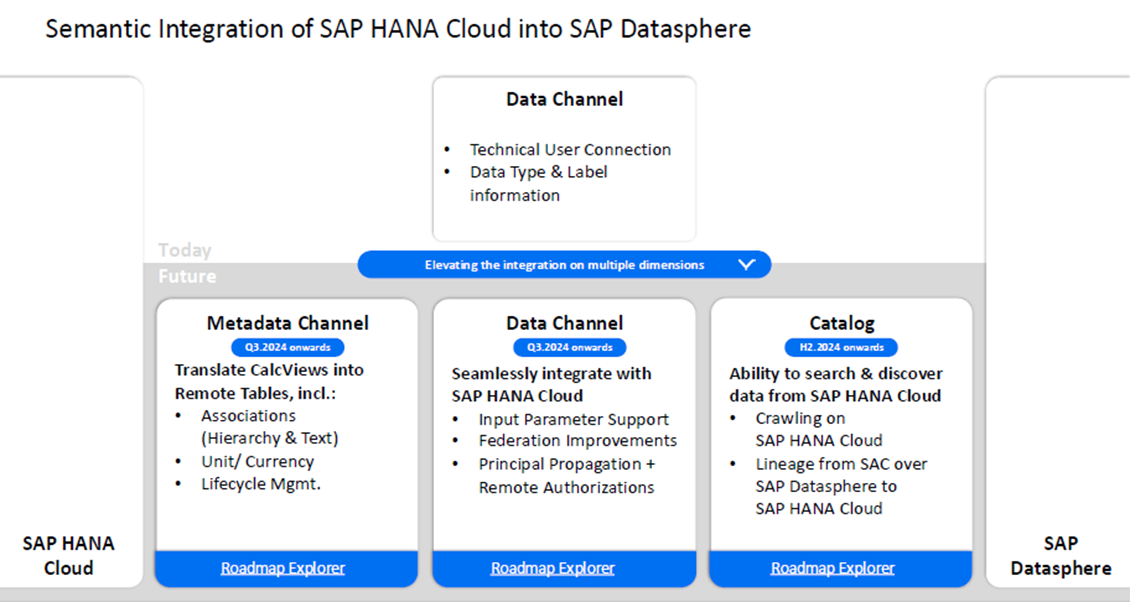
This provides another very important and powerful option. This combination in particular offers the possibility of a completely cloud-based architecture that maps an end-to-end scenario from a stable foundation to self-service and data fabric.
5. Conclusion
The positioning of HANA Cloud as part of the Business Data Fabric is an important extension of SAP's strategy.
- SAP is thus strategically expanding its data and analytics offering to include HANA Cloud. Datasphere and HANA Cloud are now available as an integrated offering for data and analytics.
- HANA native modeling can thus serve as a strong foundation for Datasphere. In such a scenario, Datasphere acts more as a platform for self-service scenarios and as a data fabric layer.
- This combination is not new. Both are integral components of the Business Technology Platform (BTP) and could already be used in combination. However, this step by SAP now makes this combination part of the expanded data and analytics strategy and brings even better integration.
- Investments already made in the development of a HANA-native DWH are secured for the future. It does not matter whether the implementation is on HANA on premiseWhat does on-premise mean? On-premise refers to infrastructures that are physically... More or already in the HANA Cloud, migrating from HANA on premise to the HANA Cloud is a small step.
- This gives companies the freedom to use the full range of SAP offerings in a way that is optimal for their individual business situation. Complex integration processes, which are a classic component of an enterprise data warehouse, can be transferred to the HANA Cloud, which is ideally suited for this purpose.
Overall, this announcement is a long-awaited step in the right direction. SAP is significantly increasing the options for responding to different business situations with flexible approaches.

Your Point of Contact

Christopher Kampmann
Head of Business Unit
Data & Analytics
christopher.kampmann@isr.de
+49 (0) 151 422 05 448