
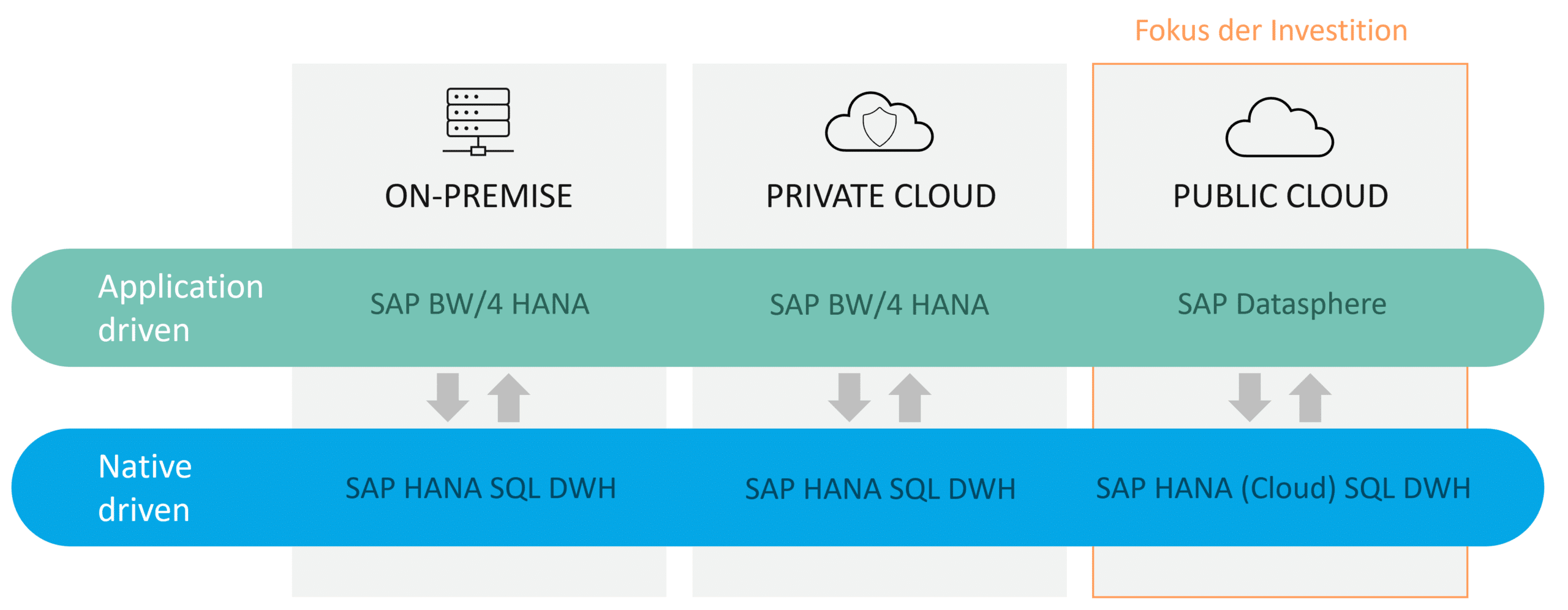
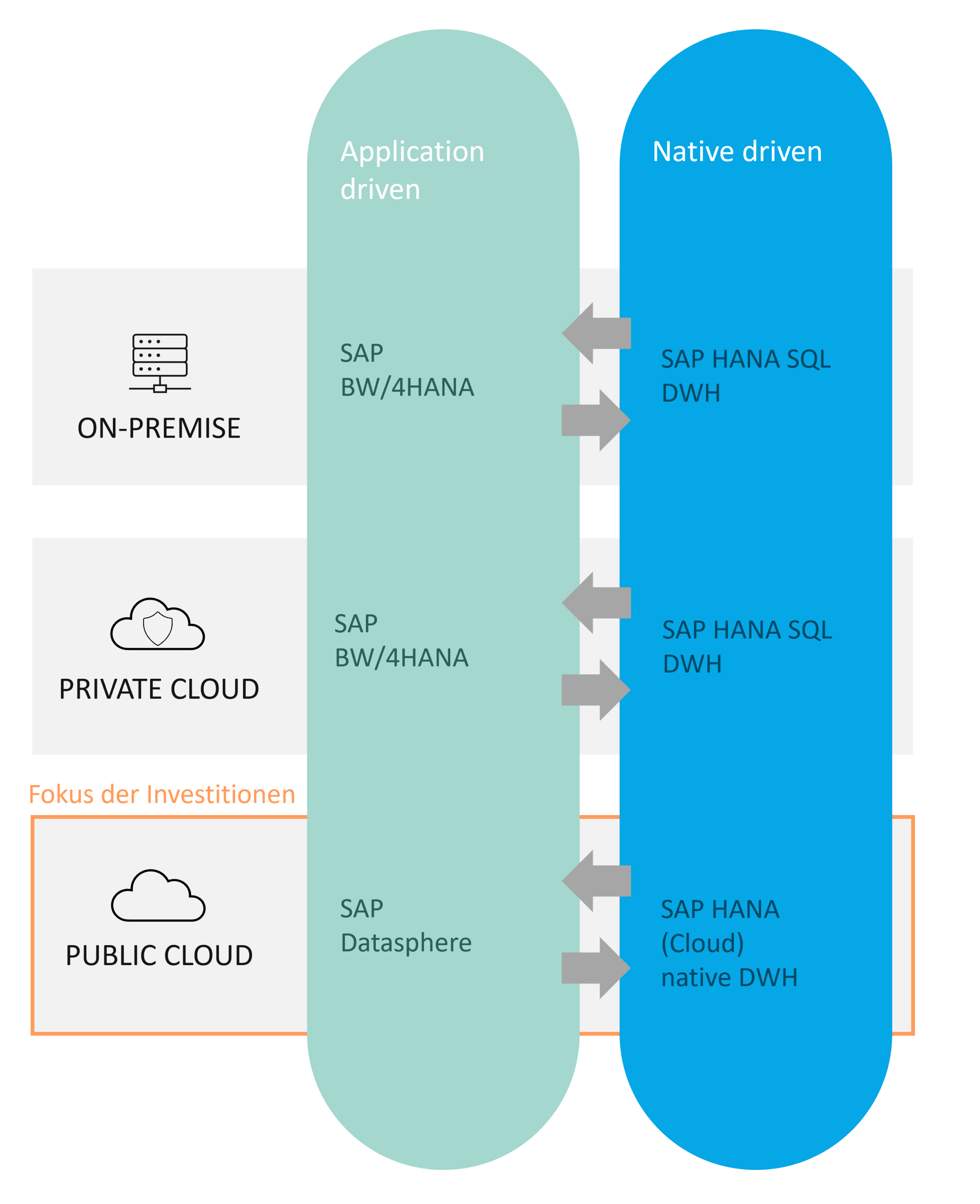
With SAP BW/4HANA, SAP HANA SQL Data Warehousing, and SAP Datasphere, SAP offers three different data warehousesolutions. The strategic focus on public cloud products based on the Business Technology Platform (BTP).
Further developments and future innovations are only to be expected in this area. Conversely, this means that all other solutions will no longer be developed intensively. Datasphere is SAP's strategic application-driven cloud data warehouse solution and will therefore be the focus of future investments and innovations by SAP.
🛈
For more information about Datasphereand a good overview, please visit our Themepage and in our overview flyer.
- Power Designer
- XSA
- Web IDE
- Smart Data Integration (SDI)
- Git
- Jenkins / Bamboo
- tracking tools
- Model-driven development process
- Agility and DevOps orientation
- Use of software development standards
- Automation in data warehouse development
- Cloud readiness
🛈
🛈
How is SAP's Datasphere positioned?
The analytical landscapes at companies are becoming increasingly complex. In addition to an enterprise data warehouse (more than one solution is conceivable for special topics), data lakes are often found in architectures. The EDWH is managed by IT and is subject to central governance. In the specialist departments, there are increasingly more employees with analytical skills who want to independently expand data models and calculate key figures, especially for short-term issues. Therefore, there are local departmental solutions (e.g., SQL Server, Tableau Data Prep, Power Query, etc.) to close this gap. Until now, these components have often functioned as loosely coupled units that are (too) poorly integrated.
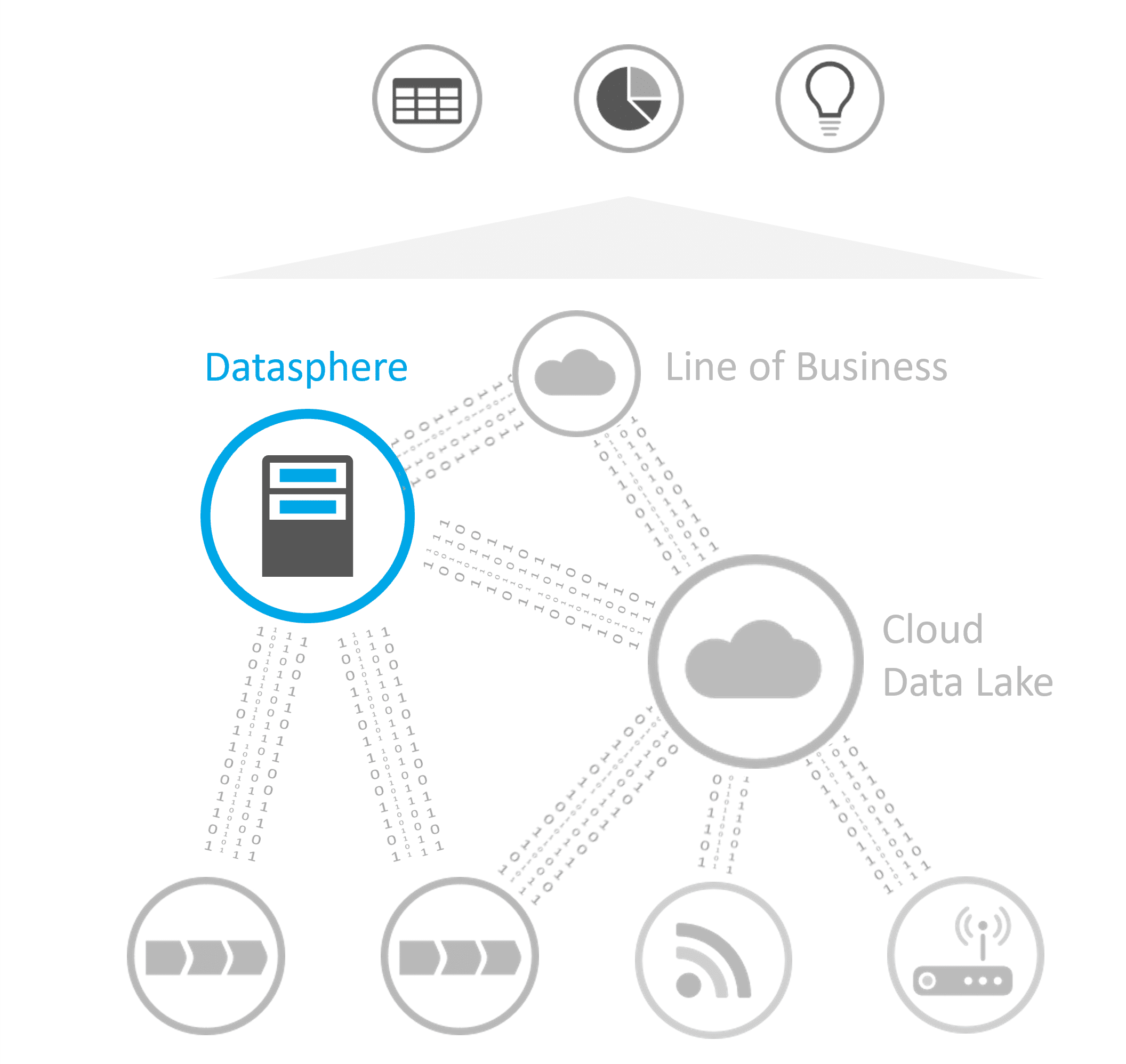
- Enterprise Data Warehouse Setting up an EDWH and making it available to the organization, e.g., as a centrally governed space
- Self-service data preparation for specialist departments User-friendly modeling for departments to independently expand the IT-governed EDWH—unlike isolated solutions, however, it is integrated into the same system environment as the EDWH.
- Cloud-based software solutions
- On-premise systems These can be operational systems, but also existing data warehouse solutions.
- Data lake(s) Either directly integrated as a HANA data lake or through integration of external data lake solutions with Datasphere
- External data and sharing data with third parties The Data Marketplace is a marketplace for data. The basic idea is that it allows publicly available data to be quickly and easily integrated into your own data models and analyses. At the same time, the Sharing Cockpit allows you to make your own data available to other definable Datasphere tenants (e.g., your own customers or local subsidiaries).
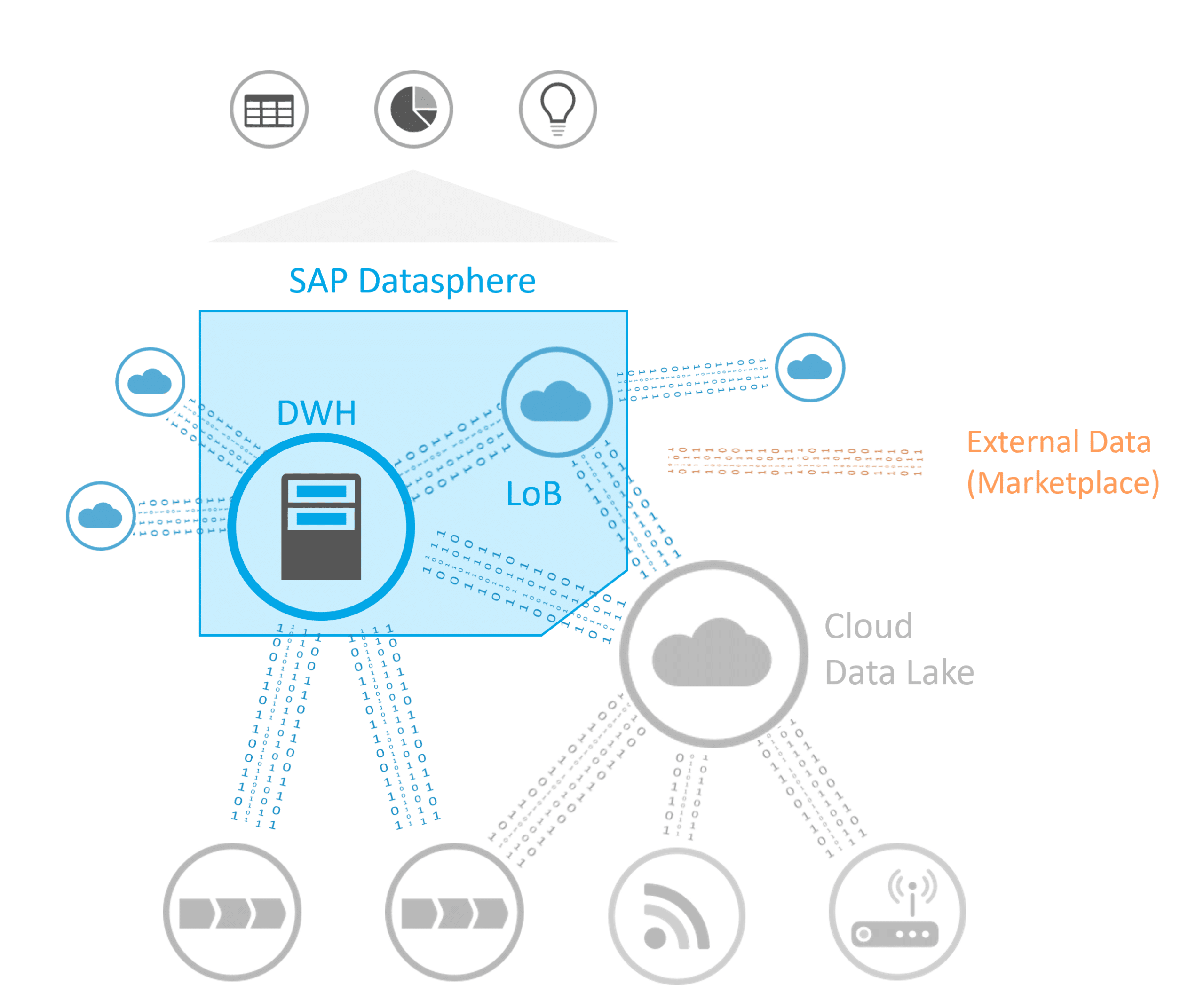
In contrast, the business layer, based on the data models of the data layer, can be used to provide cross-system, uniform semantics for analytics tools. The datasphere then functions as a central data virtualization layer for reporting.
Is Datasphere already suitable for building a complex enterprise data warehouse?
However, the assessment of the EDWH use case does not mean that Datasphere is generally not ready for use in companies. The evaluation must always be made in the context of the use case. Customers with a relatively simple architecture and corresponding use cases, as well as those who want user-friendly modeling, will potentially already be able to map their requirements with Datasphere today. In our view, Datasphere can also complement the Analytics Cloud and existing DWH solutions very well to provide self-service data preparation options for specialist departments. Opportunities may therefore lie in hybrid architectures, where Datasphere can bring its strengths to bear.
What opportunities do hybrid architectures offer in conjunction with the datasphere?
Datasphere as a self-service platform
The Datasphere is very well suited for simple and user-friendly data modeling. The possibility of SQL script and data flows from Data Intelligence also opens up several ways to implement logic. In the example below, the coordinated and harmonized standard data models are provided in a governed space in the EDWH. In companies, we often encounter more than one solution that performs DWH tasks. These other possible distributed solutions can also be provided in a governed space. In the Datasphere, departments can access the quality-assured area to expand the data models as desired (for example, with external data from the Data Marketplace). The advantage of this architecture is that the departments gain or retain flexibility in an integrated architecture where a certain level of governance can be maintained. Looking ahead, we can also well imagine the Datasphere functioning as a virtual semantic layer across all systems. This would then enable a uniform technical view of different data sources and offer it to front-end applications.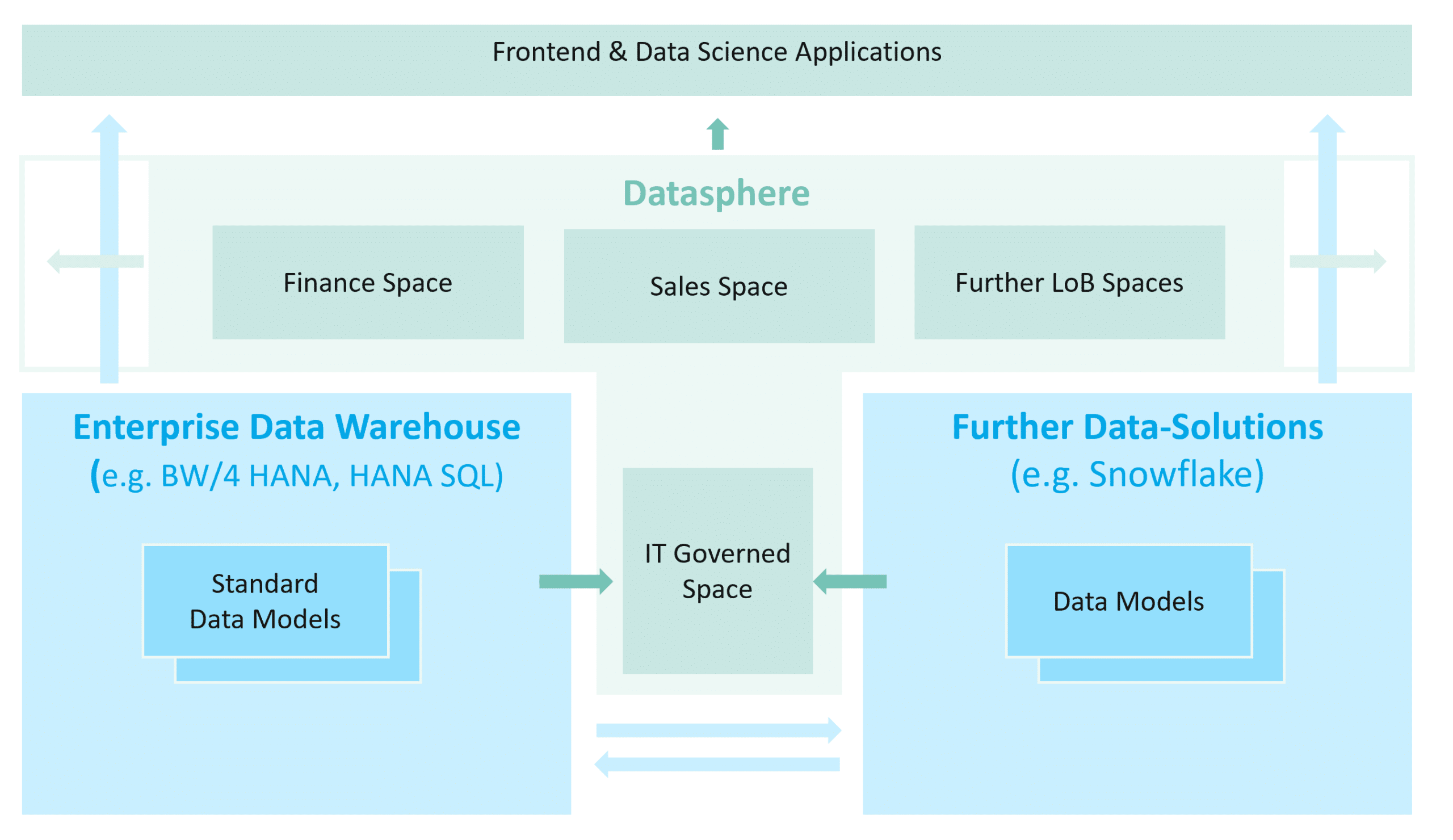
SAP BW/4 HANA and Datasphere
BW/4HANA exhibits weaknesses in the area of self-service data preparation. BW Workspaces have never been an optimal option. We identify numerous opportunities in a hybrid architecture combining BW/4HANA with Datasphere. From a technical standpoint, various options exist for integrating these solutions.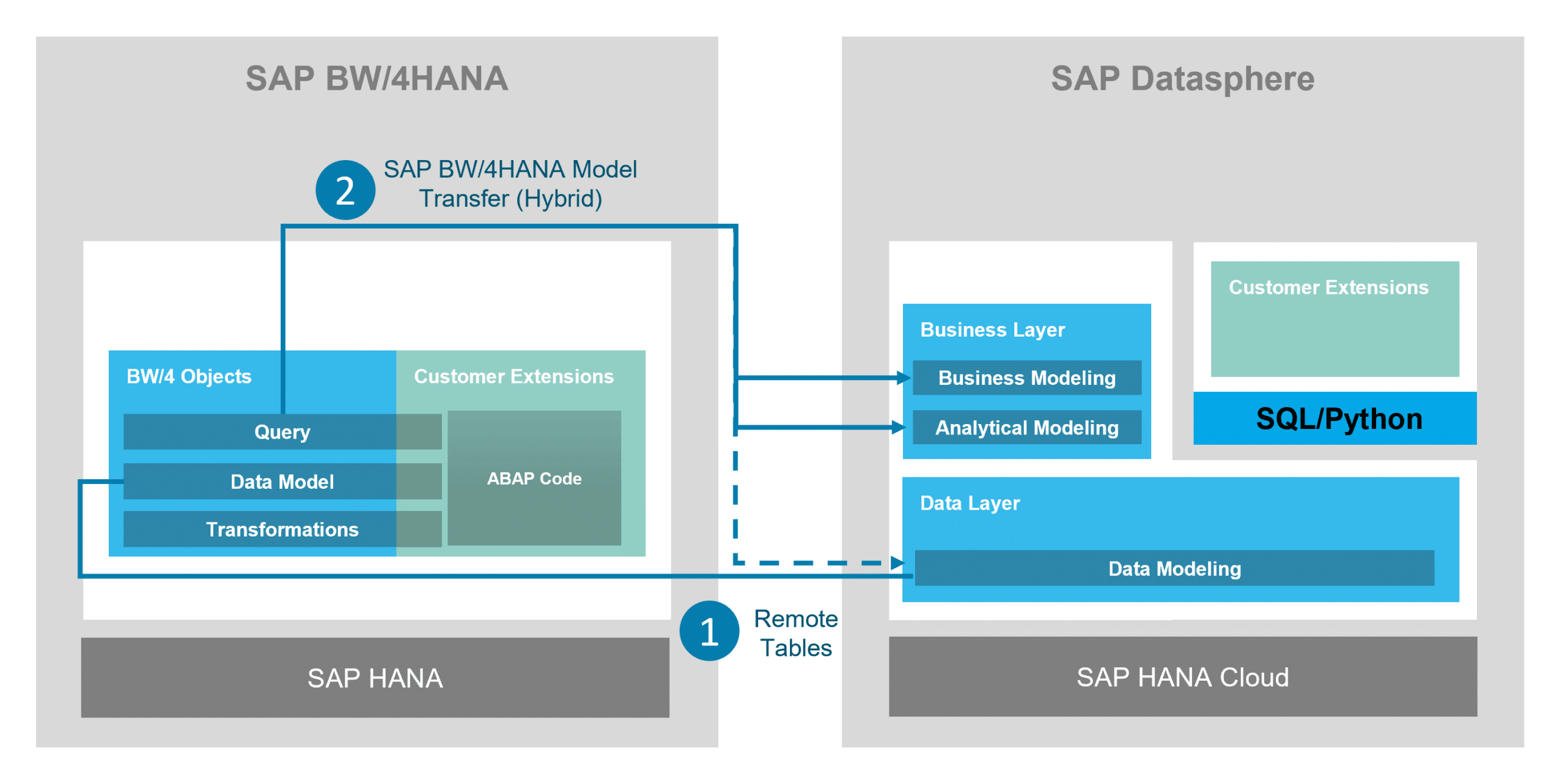
1. Remote Tables / Database Connection
In this scenario, BW/4 HANA is connected in the data layer and used as a remote source. This allows access to data in the BW system. On the one hand, this scenario is very quick and easy to implement. On the other hand, the Datasphere has no knowledge of the semantics of the BW/4 HANA system. If you only follow this hybrid approach, you have to manually recreate the semantics in the Datasphere. This is the simplest form of integration for quickly making data models available in the Datasphere so that specialist departments can carry out enhancements.
2. BW/4 HANA Model Transfer
In contrast to a simple database connection, the Model Transfer Connection links the BW Query. Datasphere not only reads the necessary database connection but also extracts the semantics, creating the required objects in the Business Layer. This type of connection offers the significant advantage of eliminating the need for manual Business Layer modeling. Conversely, the first option provides greater flexibility in modeling if a business entity needs to be defined differently from BW/4HANA, for example, by extending BW data for an entity with external data.
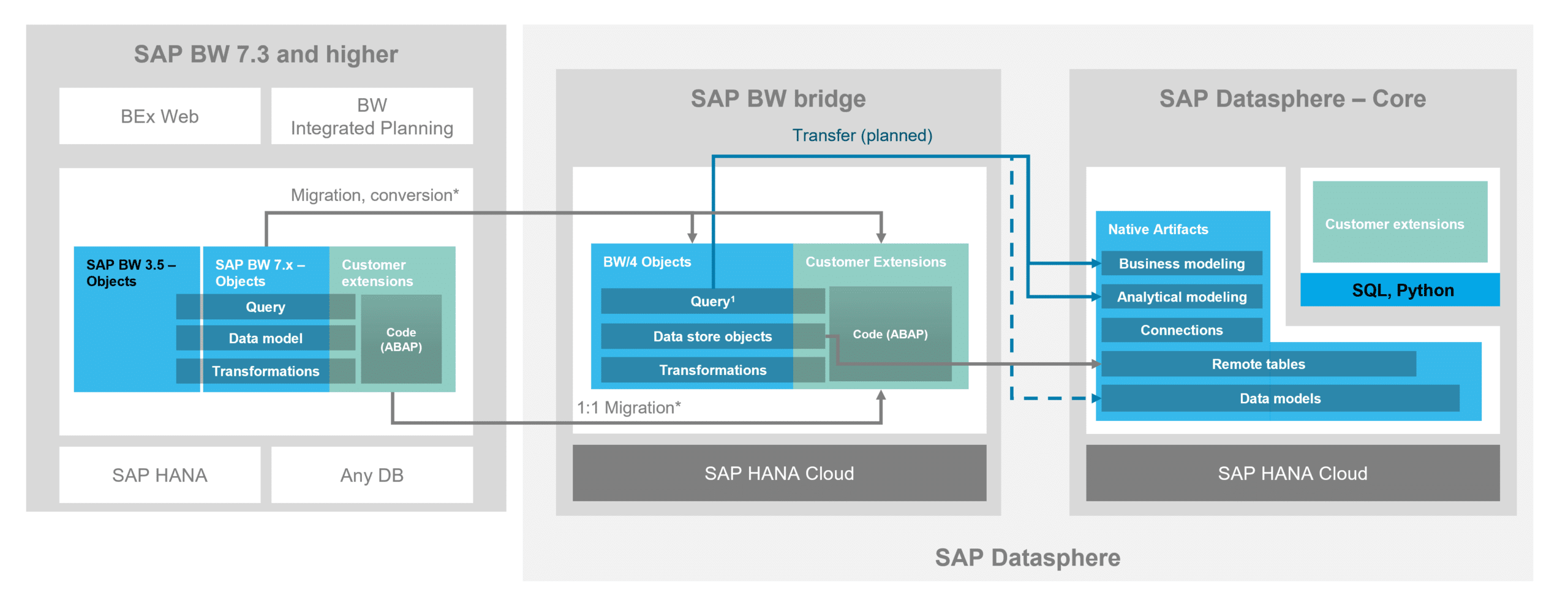
3. BW Bridge
The BW Bridge is a BW/4 HANA environment created in the Datasphere environment. The bridge provides the Datasphere with BW data models in a "bridge space" – so there is no native BW integration into the Datasphere modeling objects. From a BW perspective, the BW Bridge offers limited functionality. For example, only ODP data sources can be connected, not all provider types are supported, and the "analytical layer" (e.g., query) is missing. Details on the possibilities and limitations are described in Note 3117800.
The BW Bridge does not integrate existing BW/4 HANA systems into the Datasphere. However, with the BW Bridge, BW customers have the option of transferring or migrating their BW systems to the Datasphere environment. Theoretically, this makes it possible to migrate existing systems. However, the functional scope of the bridge is very limited from a BW perspective, meaning that many things would have to be recreated manually in the native "core" area of the Datasphere. In the future, the bridge will offer the same two integration functions (remote tables + model transfer) as described above.
From Datasphere's perspective, however, BW Bridge opens up a number of possibilities. ODP-enabled SAP source systems can be connected to the Datasphere via the Bridge. The Bridge can act as a kind of ingestion layer here. At the same time, BW/4 HANA content is available, so the Bridge should be set up and filled with data relatively quickly. The content's InfoObjects also act as accelerators for building SAP-based data models in the Datasphere.
SAP HANA SQL DWH, BTP, and Datasphere
HANA SQL DWH, in BTP or on-premise, has a very high level of integration with Datasphere, which is only natural since Datasphere is ultimately based on HANA Cloud. There are basically two options for integration: via the Open SQL schema or via HDI containers. Integration is easy in both directions.
The exchange via HDI containers is particularly interesting. This makes it easy to integrate structures and content into the Datasphere that were developed on the HANA Cloud with Business Application Studio or on HANA on premise with WebIDE. This also works in the other direction, making it easy to deploy from the Datasphere to the HANA Cloud or HANA on premise.
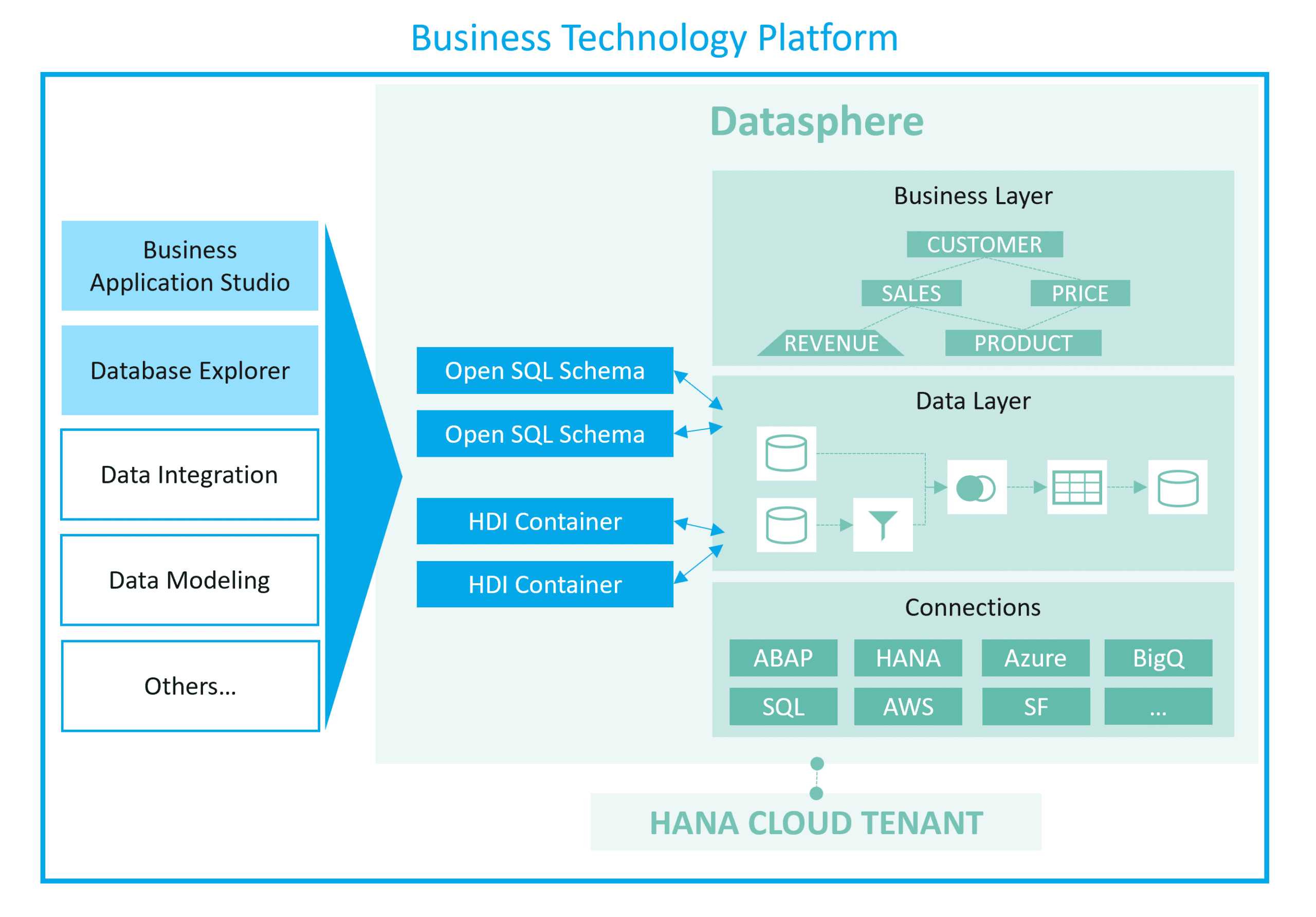
This makes it easy to set up a scenario in which, for example, the enterprise data warehouse is built in BTP (HANA Cloud native), where complete enterprise readiness is already in place. The LoB-oriented part, with its strengths in self-service, is then located in the Datasphere.
Further information can be found here:
SAP BTP Showcase – Access the SAP HANA Cloud database underneath SAP Datasphere | SAP Blogs
What should companies facing DWH modernization do?
- BW/4 HANA is a highly sophisticated data warehouse product that is being used very successfully. You can be sure that the product is very well suited for building an enterprise data warehouse. There will be few functions and features that the product still lacks.
- At the same time, there is a roadmap for BW/4 HANA and a commitment from SAP that BW/4 HANA will continue to exist until at least 2040. That's 18(!) years, which is a (very) long-term confirmation of investment security.
- With BW Bridge, SAP has created a (public) cloud perspective for BW customers in 2021. The bridge is a (streamlined) BW/4 HANA development environment that runs in the Datasphere environment. It gives customers the opportunity to migrate at least parts of their BW architectures to Datasphere. We will explain what BW Bridge actually is and what possibilities it offers in a separate article.
- The tools are SAP tools, as used in SAP HANA Application Development. They are therefore subject to the respective SAP product strategy.
- The corresponding methods are strictly based on general DWH development standards, meaning that the HANA SQL DWH approach differs only slightly from the structure of other SQL-based DWHs, such as those in a Microsoft environment.
Conclusion
SAP BW/4 HANA and HANA SQL are no longer available, but BW/4 HANA, HANA SQL, and Datasphere are here to stay!
This is how we could briefly summarize the conclusion of our article. It is clear that Datasphere is SAP's primary strategic DWH product. There should be no illusions about this. The central element of the strategy is the HANA Cloud. This means that the HANA SQL DWH approach is also part of the strategic portfolio.
Does this mean the end of BW/4 HANA? Not (yet). The life cycle of BW/4 HANA will end in 2040 at the earliest. With BW Bridge, there is also a cloud perspective for parts of BW/4 HANA developments. At the same time, no further major investments will be made in SAP BW.
outlook

Christopher Kampmann
Head of Business Unit
Data & Analytics
christopher.kampmann@isr.de
+49 (0) 151 422 05 448