
Enterprise content management
Enterprise Content Management
The director of your data landscape
Think of enterprise content management (ECM) as the director of a film. It controls the flow and structure of your data, organizes and stores it efficiently, and ensures that the right information is available at the right time. Like a director, it coordinates documents, emails, and other content, monitors security and data protection, and thus ensures the harmonious interaction of all information within the company.
Table of Contents
- What is ECM? Enterprise Content Management Definition
- What advantages does ECM offer?
- What components does an ECM?
- ECM vs. DMS
- Future trend: ECM in the cloud
- Why is enterprise content management important for companies?
- In which areas of the company can enterprise content management be used?
- Process using the example of a construction company
- Five steps to the optimal introduction of an ECM system
- How can we support companies?
- Your Point of Contact
What is ECM? Enterprise Content Management Definition
The abbreviation ECM stands for Enterprise Content Management and refers to the organization of content, i.e., content from documents that contain business-relevant information. This includes strategies, methods, and technologies that aim to ensure that all types of content—be it documents, texts, images, videos, or contracts—are efficiently captured, stored, organized, edited, and shared.
A key objective of ECM is to structure the flood of information within a company and facilitate access to relevant data. By using ECM systems, companies can centrally manage documents and other content, thereby organizing workflows. All employees can also quickly access the information they need. ECM systems also ensure that all data, documents, and information are stored properly in accordance with applicable regulations (e.g., GDPR).
In summary, ECM helps companies organize information efficiently, increase productivity, and improve collaboration within the organization.
What are the benefits of ECM?
An enterprise content management (ECM) system brings considerable added value to companies. The following overview outlines the most important advantages.
Enterprise content management reduces paper-based workflows, thereby search times and and enabling employees to access access information .. For this reason productivity canwithin a company be strengthened and personnel costs reduced .
ECM systems enable the automation and optimization of business processes. The processing of contentn and information is more efficiently, which leads to better coordination of business processes and and increased competitiveness.
The digitization and automation of documents and content can reduce the workload for employees by eliminating time-consuming manual tasks. The time saved can then be used for essential and strategic tasks, wwhich the efficiency of work processes is significantly increasedwhile simultaneously reducing operating costs. reducedreduced ..
ECM systems promote teamwork by allowing multiple users to access and work on the same content simultaneouslyeffectively(er) . This strengthens not only the harmony within the team,, but also supports also improved internal communication and transparency. All information is stored centrally stored, so every employee knows where to find the information, putting an end to the endless search for the right information.
LePowerful security features such as access controls and encryption are provided by enterprise content management systemsto protect confidential information. At the same time, they enable compliance with current legal requirements and reduce risks through improved monitoring and control of document access.
Digitization through ECM systems serves as a growth driver for companies by effectively strengthening their competitiveness. This enables companies to respond to changes in the market in a more targeted and effective manner and secure their position in the long term.
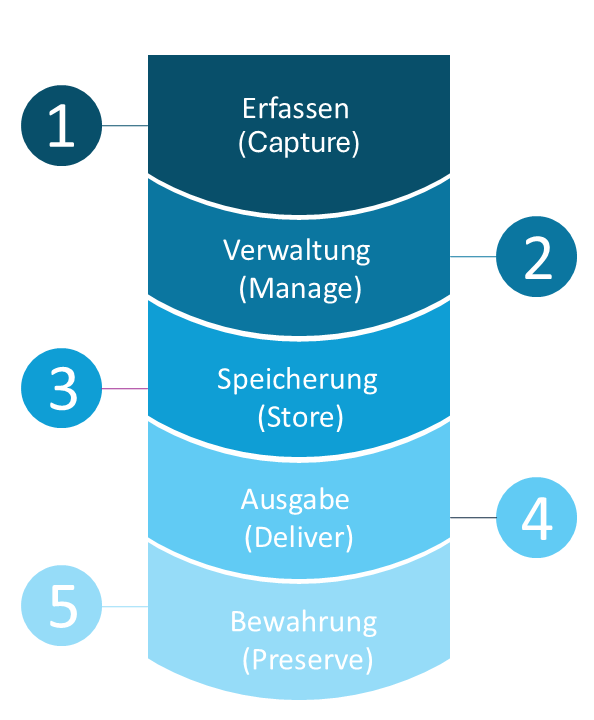
What components make up ECM?
- Capture:
Capturing information from documents and data from systems is the first step in every process. In ECM, digitizing this data is important, and input management organizes its capture, processing, and distribution.
The information and data are maintained and structured, including classification, definition of access rights, and archiving. Suitable software is required for a successful process.
The storage component stores structured and unstructured data such as documents, emails, images, and videos in electronic archives and ensures their accessibility, audit compliance, and protection against loss.
- Output (Deliver):
The data is provided in a specific environment in order to make relevant content available in a user-friendly and targeted manner.
- Preserve:
The preserve aspect encompasses the storage and archiving of data for future access and compliance with legal requirements. A retention solution also enables the automated deletion of data to reduce the data load.
- Capture:
ECM vs. DMS
Comparing differences and possible applications
The comparison below between enterprise content management (ECM) and document management systems (DMS) shows that both approaches help companies organize data, information, and documents efficiently. It is important to understand that DMS can be considered an essential part of ECM. Nevertheless, there are differences between the two terms.
ECM
Enterprise content management (ECM) offers much more than just document management. It encompasses the detailed regulation of all types of information —including documents, emails, digital media, web content, and more. By capturing, organizing, storing, and utilizing all of this data, ECM enables seamless integration with other enterprise systems such as CRM or ERP. This enterprise-wide software solution ensures secure management, structuring, and digitization of information and is also capable of independently managing unstructured data. This enables centralized access to all relevant information and has a positive impact on decision-making and workflow.
Enterprise content management (ECM) is like a company's nervous system. It not only coordinates individual documents, but also regulates the flow of all types of information—from emails and digital media to web content. Similar to the nervous system, which sends signals to different parts of the body and processes information, ECM captures, organizes, and stores all data for integration into other systems. Centralized management and structuring of information ensures that it is accessible anytime, anywhere, which in turn significantly improves decision-making processes and workflows.
DMS
A document management system (DMS) optimizes the entire document management process—from creation to archiving. It enables efficient capture, classification, storage, and retrieval of documents, as well as their targeted distribution. With integrated functions such as versioning, workflow management, and access controls, the DMS improves accuracy and efficiency in handling document-based information. It supports the intelligent processing and distribution of documents, manages data input and output, and ensures structured archiving. With a DMS, documents can be found and organized quickly, which increases productivity and reduces administrative effort.
A document management system (DMS) acts like a tour guide, leading you through the maze of information. It creates a clear itinerary for documents and ensures that the best stops with the most valuable information can be reached quickly and efficiently. At the same time, it offers the possibility of accessing previous versions of documents at any time, so that nothing is lost. With intelligent search functions and structured storage, the DMS ensures that the information you need is always at your fingertips. This way, you can maintain an overview of your data and reach your destination effortlessly, without getting lost in the flood of information.
Future trend – ECM in the cloud
The trend in ECM is increasingly moving toward cloud-based solutions. Digital transformation requires companies to optimize their documentation, workflow, and archiving processes. Cloud ECM systems offer a flexible and scalable solution that enables access to content regardless of location or time and facilitates collaboration. This not only enables greater mobility and user-friendliness, but also allows documents and data to be stored and shared securely, which is often beyond the capabilities of traditional solutions. The trend toward the cloud in small and medium-sized businesses reflects the increasing acceptance of modern technologies and highlights the need to digitally transform fundamental business processes.
One aspect that has long been considered an obstacle, especially in Germany, is the security of data in the cloud. Many companies have decided against cloud solutions because they had concerns about dependence on third parties and control over their data. However, with technological advances and increasing openness to cloud solutions, security standards and certifications such as ISO 27001 are becoming increasingly important. These standards ensure that data in the cloud is not only stored securely, but can also be reliably protected and controlled.
With the increasing complexity of workflows and the need to manage large amounts of data efficiently, the demands on ECM systems are also growing. The integration of automation and artificial intelligence (AI) is therefore becoming increasingly important in order to simplify the capture, organization, and management of documents and content. In practice, this means that modern ECM systems are increasingly able to handle complex data processing tasks autonomously, giving human users more scope for strategic and creative activities. At the same time, the combination of automation and AI helps to make information management more transparent, traceable, and secure, which is particularly important in highly regulated industries.


ECM systems are more than just tools for document management—they are strategic drivers of digitization that help companies increase their competitiveness, easily meet legal requirements, and respond flexibly to market changes in order to secure their position in the long term.
Stefan Jamin
Division Head | Business Process Automation
Why is enterprise content management important for companies?
In today's business world, the effective handling of information and documents is crucial to a company's success. Enterprise content management plays a central role in this. It combines various software solutions into a comprehensive system that works through seamless interfaces and integrated workflows. This makes processes more efficient and allows information to be used intelligently.
The speed at which content grows and changes poses major challenges for companies. So-called "content chaos" —the lack of structured, digitized content—is a widespread obstacle. A well-implemented ECM system helps to overcome this chaos by linking and optimizing the various aspects of content management.
An ECM system enables companies to effectively structure, store, and retrieve their content. This not only increases productivity, but also creates the basis for informed decisions. In an age where information is growing and changing exponentially, an ECM system is no longer just a tool; it is also an essential part of a company's digital transformation.
Through the integration of automation and artificial intelligence (AI), modern ECM systems are able to perform complex tasks independently. This leads to more transparent and secure information management and helps companies to effectively adapt to the challenges of digital transformation.
In which areas of the company can enterprise content management be used?
Enterprise content management offers numerous advantages for various areas of a company by optimizing document management and processes. Here is an overview of how ECM can be used in different areas of a company:
accounting
Invoices are automatically captured, archived, and processed by enterprise content management, regardless of whether they are digital or paper-based. This simplifies the workflow and ensures compliance with tax law requirements.
human resources
The management of payroll, vacation requests, and other documents improves human resources management. Digital processing of these documents and compliance with data protection requirements, including monitoring of deletion periods, can thus be ensured.
sales
Version management for quotations can be optimized with the help of an ECM system, which simplifies document access and speeds up the sales process. This leads to cost reductions, time savings, and improved cash flow.
Purchasing and Legal Department
Comprehensive contract management, including template and version management as well as approval processes, ensures secure archiving and monitoring of deadlines while assigning precise access rights.
Process using the example of a construction company
In the dynamic world of construction, efficient document management is crucial to the success of projects. An international construction company specializing in numerous large-scale projects in various countries faces the daily challenge of managing a large number of documents. Construction plans, contracts, permits, and reports must not only be created, but also organized and made available. Since these documents are stored in different formats and at different locations, accessing the required information often becomes a tedious task. Delays result when information is not available in a timely manner or when different versions of a document are in circulation.
To proactively address these challenges, the company decides to implement an enterprise content management system (ECM). This system enables the centralised and structured storage of all documents. By enriching files with specific metadata, employees can search for the information they need in a targeted manner. What used to take several hours, such as searching for a construction plan or a permit, can now be done in a matter of minutes.
Another key advantage of the ECM system is improved collaboration between different locations and departments. Site managers, project managers in the office, and engineers all have simultaneous access to the same documents, can add comments, and track changes in real time. This leads to a significant reduction in errors and misunderstandings, as it is always clear which version of a document is the current one and who has made which changes.
In addition, the system helps the company to better comply with legal requirements. Documentation for all construction projects must be archived for years, and the ECM system facilitates long-term storage and quick access to this information.
By introducing the ECM system, the construction company is significantly optimizing its project management. Document processing efficiency is increasing, leading to faster project completion and reduced costs. At the same time, communication and collaboration within the company are improving, which has a positive impact on the quality of construction projects and customer satisfaction.
5 steps to the optimal introduction of an ECM system
Introducing an ECM system in a company can be complex, but with a structured approach, this process can be designed to achieve the desired results. Here are five tips for successfully introducing an ECM system:
Start by introducing ECM in the department that will benefit most from it. Quick wins increase acceptance and demonstrate the advantages to other departments.
Before implementation, a detailed analysis should be carried out to identify weaknesses and determine the order of implementation. This minimizes resistance and lays a solid foundation.
Set specific, measurable goals for the ECM implementation. This will clarify what needs to be improved and make it easier to measure success later on. In addition, the team that that everyone involved knows what is expected of them and makes it easier to measure success later on.
Choose future-proof, scalable software that has proven itself. Check certifications and customer reviews to avoid unexpected costs.
Connect the ECM system to the existing IT infrastructure and integrate integrate digital workflows into itwithoutoverwhelming . The focus should be on significant improvements in workflows and the efficiency of these .
Start in the right department
actual analysis
clear goal definition
Selecting the right ECM software
Careful configuration
In the area of enterprise content management, we rely on these
TECHNOLOGIES



We offer the following consulting services
Enterprise Content Management




How do we provide concrete support to enterprises?
With more than 30 years of process expertise, business process management and the development and implementation of cross-vendor ECM solutions for document logistics (including input, workflow, and document management systems) are integral parts of our comprehensive range of services. This puts us in an ideal position to combine all aspects of business process management end-to-end. With the help of our solutions, we support you in designing, optimizing, and implementing your processes efficiently and effectively. Our approach is to implement and optimize your individual processes with modern and smart applications.
Get in touch with us now
We would be pleased to advise you.

Stefan Jamin
Head of
Document Logistics
stefan.jamin@isr.de
+49(0)151 527 45 157