E-Invoice
Background, requirements, and our
software solution for your company!
In January 2025, mandatory e-invoicing came into effect in Germany. Electronic invoices (e-invoices) must be received and processed in the future. This means that companies must completely digitize their invoice processing in order to meet the new legal requirements. Our software solution helps you meet these requirements and make your invoice processing efficient and effective.
Legal basis and requirements of the German Federal Financial Supervisory Authority (
) E-INVOICES IN GERMANY
An electronic invoice (e-invoice) is an invoice that is created and transmitted digitally and complies with the legal requirements of Section 14a of the German Value Added Tax Act (UStG). This regulation requires companies in Germany to receive and process only electronic invoices from 2025 onwards. The obligation to issue electronic invoices applies exclusively to services provided between domestic German companies (B2B). This applies to both service providers and service recipients who are based in Germany.
An e-invoice must be transmitted electronically in order to comply with the digital invoicing requirement. This means that the invoice may not be printed on paper, but must be sent exclusively electronically. This requirement ensures that the invoice is transmitted securely and efficiently and that recipients can process the invoice without any additional actions.
An e-invoice must be machine-readable in order to be processed by computers. This means that the invoice must be created in a structured format. This requirement ensures that the invoice can be processed automatically and efficiently without the need for human intervention.
An e-invoice must be media-consistent to ensure that the invoice does not switch between different media. This means that the invoice does not switch from one medium (e.g., paper) to another medium (e.g., electronic), but remains in a single medium.
An e-invoice must be able to be processed automatically in order to make invoice processing efficient and effective. This means that the invoice can be processed by computers without human intervention.
White paper on e-billing
BACKGROUND INFORMATION, FACTS, AND GUIDELINES
Get ready for the 2025 e-invoicing requirement! Our white paper has all the important info, from legal stuff to benefits to a handy checklist for switching over. Get started now and save time and money!
Mandatory e-billing—why exactly?
THE ADVANTAGES IN A NUTSHELL
The introduction of electronic invoicing (e-invoicing) in Germany heralds a new era in accounting. Although e-invoicing is now mandatory, the advantages of this new technology should not be dismissed. Despite the legal obligation to use e-invoicing from 2025, there are numerous advantages that are relevant for companies.
E-billing eliminates the need for OCR extraction of content, which reduces the error rate. In addition, processing times and delivery are possible in real time, which increases time efficiency.
E-billing reduces postage and paper costs, as physical invoices are no longer required.
E-invoices can be transmitted digitally and securely, ensuring correct transmission and protection of your confidential data.
Each step of the process can be tracked precisely, ensuring greater transparency. The status and history of a transaction can be viewed at any time, and digital documents such as e-invoices are archived automatically in a space-saving manner, remain legible indefinitely, and any changes are logged.
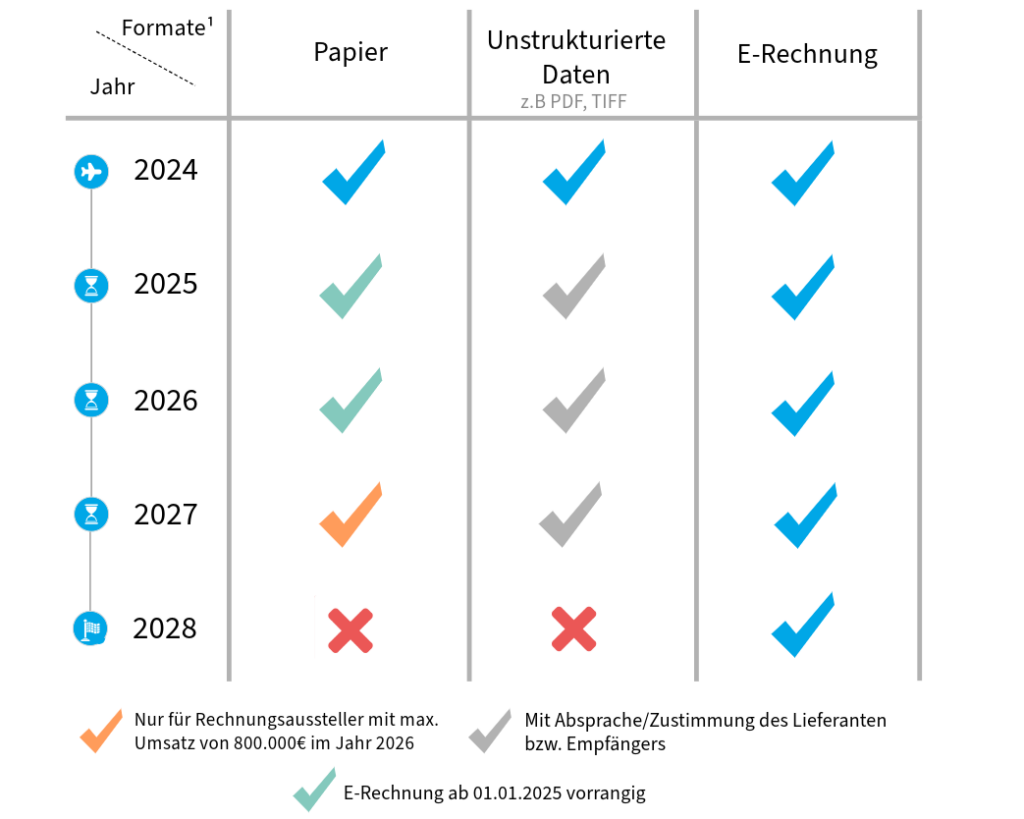
What applies from when?
TRANSITION PERIODS IN GERMANY
The following deadlines apply until e-invoicing becomes mandatory in Germany in 2028
Until the end of 2024, companies that are not yet able to issue e-invoices can continue to use paper invoices.
From January 1, 2025, companies must be able to process e-invoices. Until the end of 2026, paper invoices or electronic invoices that do not comply with the new format may still be sent for B2B transactions carried out in 2025 and 2026.
Until the end of 2027, paper invoices will still be permitted for transactions between companies taking place in 2027. Digital invoices that do not comply with the new format will also be permitted, provided that the issuer of the invoice has a maximum turnover of EUR 800,000 in the previous year.
From January 1, 2028, all invoices must be e-invoices and comply with the new requirements.
). to process e-invoices !
Acceptable invoice formats
AND WHICH ONES WILL (SOON) NO LONGER BE ACCEPTED?
The introduction of mandatory e-billing in Germany also brings with it new requirements for invoice formats. From 2025, only certain electronic invoice formats will be accepted, while other formats will no longer be valid. It is therefore important to know which formats are permitted and which must be discontinued in order to comply with the new legal requirements.
It is processed directly in the invoice receipt process and is machine-readable. To ensure readability for humans, the XML file is often sent together with a PDF file. This PDF file is for human readability only and is not legally binding. These formats can be used across industries in the B2B and B2C sectors, which facilitates the digitization of invoice processing in many areas.
In this format, the data is structured in XML format and is machine-readable but not immediately "human-readable." XRechnung has been used in the German public sector (B2G) since November 2020 in accordance with the ERechV (E-Invoice Regulation).
According to the Federal Ministry of Finance, work is currently underway (as of June 14, 2024) to find a way to continue to enable use in compliance with the law. However, with regard to the e-invoicing requirement, it must be ensured that the information required for sales tax purposes can be extracted correctly and completely from the invoice format used.
A PDF invoice is not an e-invoice in the true sense of the word, as it is not machine-readable. From 2025 onwards, invoice data must be available in a structured format that can be processed directly by computers.
Read more about the e-invoicing requirement in Germany at
.
Digital invoice processing
RELY ON THIS TECHNOLOGY!
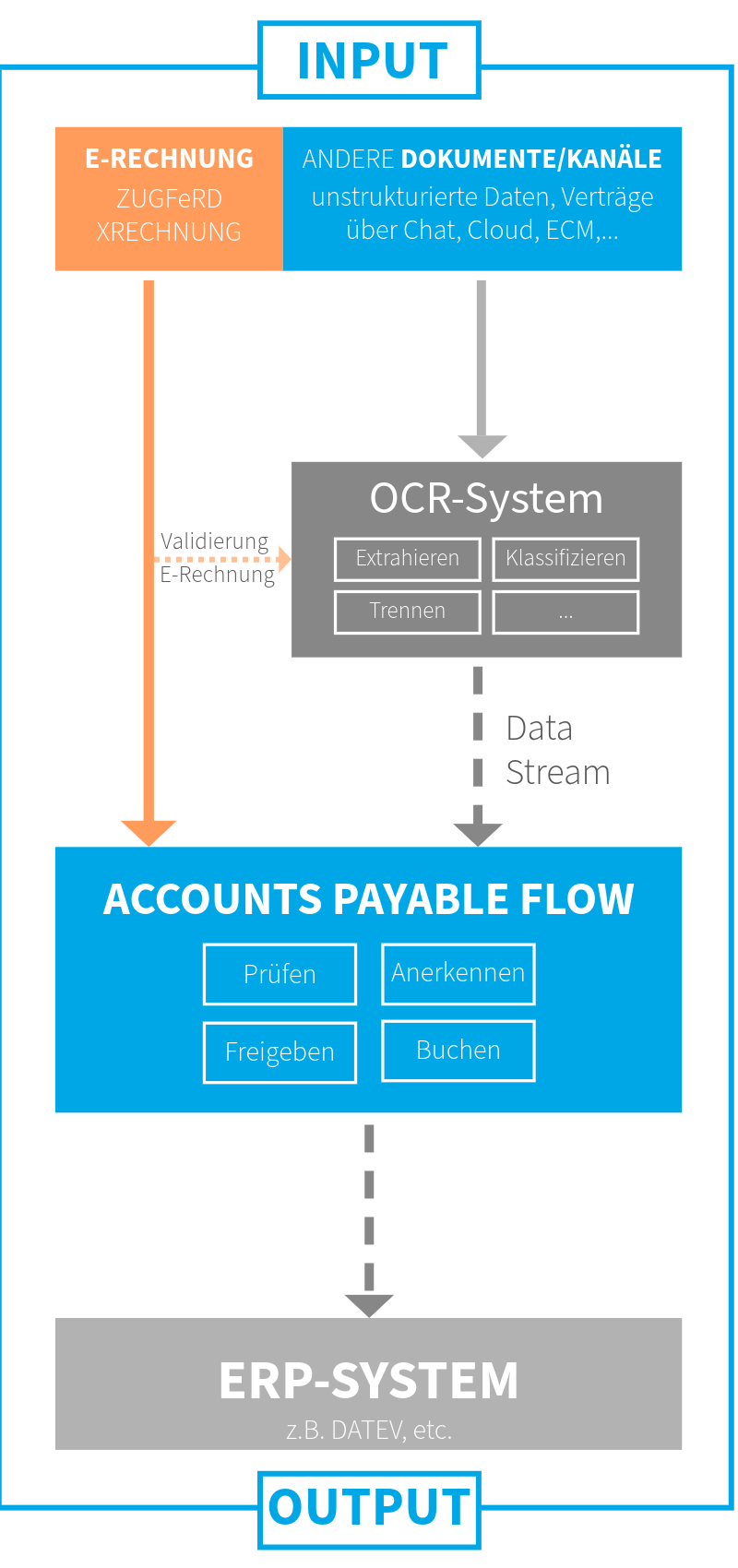
To fully leverage the benefits of e-invoicing and ensure smooth invoice processing, we rely on innovative technologies that are revolutionizing digital invoice processing. Whether you want to process e-invoices directly from January 1, 2025, or digitize your analog invoicing process using IDP during the transition period, we can help.
We have over 20 years of experience in digitizing documents and processes in accounting and have developed a combination of our in-house solutions Buildsimple and Accounts Payable Flow to create the efficient, automated accounting of tomorrow, enabling end-to-end digital processing of invoices. Our solutions at a glance:
Accounts Payable Flow
Our solution for digital invoice processing
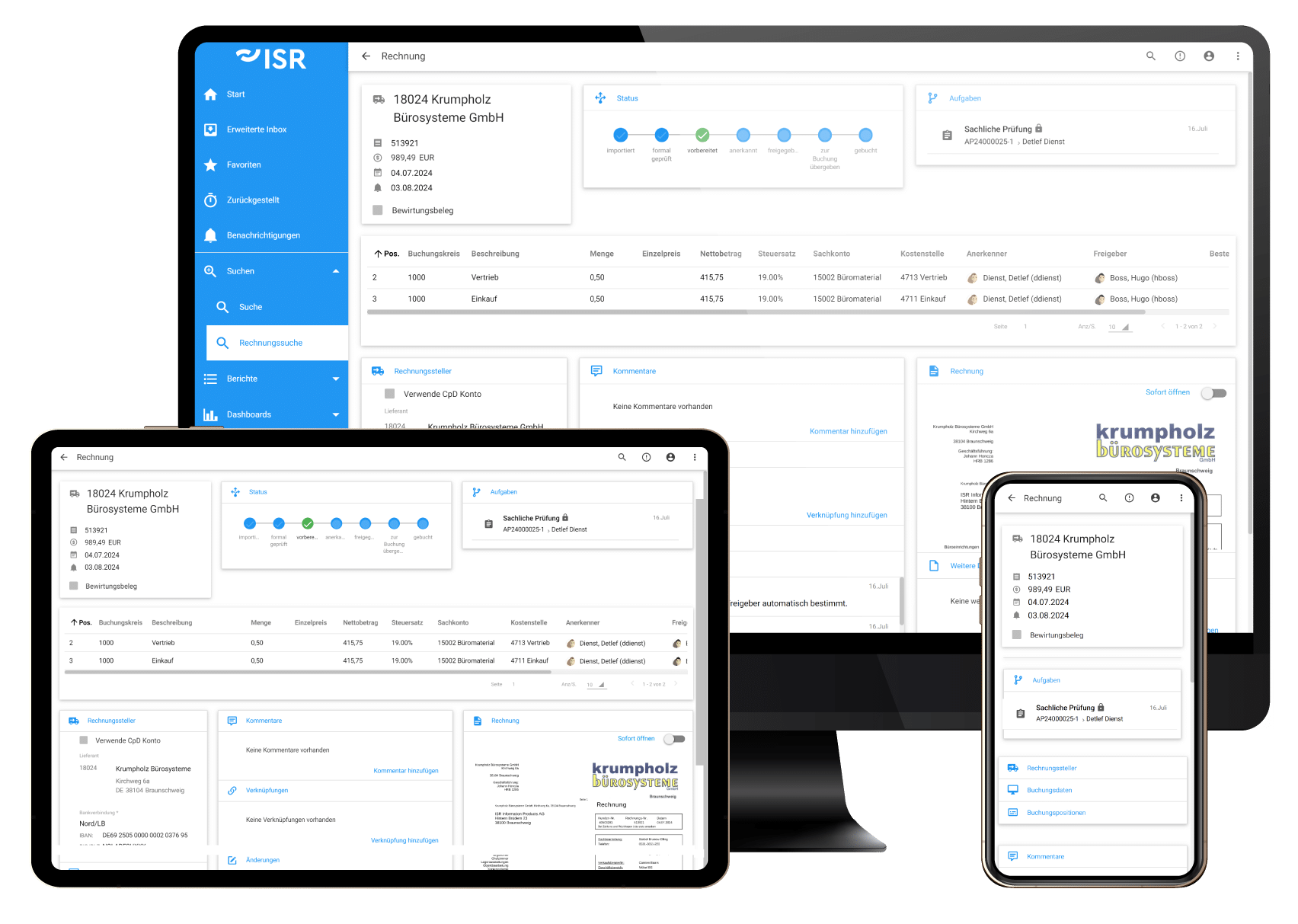
Automate your invoice processing procedures. From invoice receipt to verification and approval to posting, our specialized Accounts Payable Flow application provides you with comprehensive support for digital invoice processing, compliance with cash discount deadlines, and automation of approval processes.
- low error rate
- fully digital
- Transparency and compliance
- Cost Savings
- On-premises, SaaS
Frequently asked questions (FAQ) about the e-invoicing requirement in the German Federal Tax Authority (
)
The issuance of an e-invoice (in a B2B context) is not subject to the consent of the invoice recipient. All domestic business invoice recipients must be able to receive and process e-invoices from January 1, 2025. For invoices to end consumers (B2C), their consent remains a prerequisite for electronic invoicing.
Previously, invoices had to be legible to humans. In the case of a hybrid format, the human-readable part took precedence in case of doubt. With the new e-invoicing requirement coming into effect on January 1, 2025, the following will apply: In case of discrepancies, the"machine-readable part"of the hybrid e-invoice format willtake precedenceover the human-readable part.
All tax regulations applicable to conventional invoices in accordance with the Sales Tax Act (UstG) also apply to electronic invoices. The authenticity of the origin, the integrity of the content, and the legibility of the invoice must be guaranteed. The Federal Ministry of Finance's tax administration has not specified any specific audit obligations or control measures for corresponding audit procedures. However, it is recommended that the invoice sender and the invoice issuer introduce their own audit mechanisms to ensure that the content of both invoices is identical.
If one of the companies involved is not based in Germany or in one of the areas specified in Section 1 (3) of the German Value Added Tax Act (UStG), there is no obligation to issue an e-invoice. In this case, the invoice can continue to be issued on paper or as an e-invoice.
Ready to introduce e-billing?
WE ARE HAPPY TO ADVISE YOU!
Would you like to introduce e-billing in your company? With our many years of experience, we are here to advise and assist you in completely digitizing and automating your billing process.
See for yourself how our innovative all-in-one solution for your e-invoice workflow with ISR Accounts Payable Flow can help you. If you have any questions or would like to learn more about our consulting services or software, please feel free to contact us!
Jens Brettschneider
Head of Business Unit
Application Management
jens.brettschneider@isr.de
+49(0)151 422 05 425