Project Escalation: Universally recognized, yet universally disliked.

Share post via

Project escalations are not entirely uncommon for IT projects. What are the typical causes and what indicators point to a project escalation?

Managing escalations – that's no longer a problem today, right? What is artificial intelligence for? Let's ask Chat GPT what we need to do when a project escalates. The answer:

Project escalation can occur when a project is not going according to plan and those involved are having difficulty resolving the issues. Successful escalation requires a quick response and careful planning. Here are some steps you can take to manage project escalation.

Chat GPT then lists the classic points that are also taught in every project management training course: identifying the problem, communicating with the team, developing and implementing an action plan, reporting on progress, and learning from experience.

Okay, we can see some good approaches, but does that really help? Wouldn't it be better to learn about indicators that could point to a possible project escalation, so that we can then apply specific methods to counteract it?

What can be the causes of project escalation?

Everyone knows it, no one likes it—project escalation. But how does it happen in the first place? In the course of our projects, we have identified various reasons for escalation that we would like to share.

Communication issues

The main problem from our point of view: insufficient, missing, or incorrect communication in the project. Unfortunately, it is often observed that people like to talk about others rather than with them. This is a smoldering ember in the project that can quickly develop into a fire. Introverted project members, for example, may tend not to comment on disruptions in the project (technical or personal). Delayed or no response to disruptions can herald the start of a project escalation. But even if project members are unstoppable in their communication, this may not be beneficial for the project. This is especially true when people like to talk about project problems and the people who cause them, but not with people about potential solutions.

Stakeholder dissatisfaction

Another reason for escalation can be stakeholders' goals being too far apart. We are talking here about resources, the project scope, but of course also about costs. Employees are not given enough time to collaborate, the goals differ from the goals of the business, or the client exceeds the originally estimated project costs. In an agile project in particular, the project goals are defined, but the path to achieving them is not clearly defined at the start of the project. Detours in the project can cause delays and the work may not progress as well as expected. All of these circumstances can lead to escalations – unless they are identified and addressed in a timely manner.

Unclear responsibilities

There are different roles in a project. However, the tasks associated with these roles are not always clear. If decisions are made by the wrong person or not made at all due to a lack of responsibilities, this can become a problem. Finger-pointing and unclear project situations can be the result.

Conflicts within the team

As the saying goes, "You can't choose your family." But this also applies to the world of work and projects. Teams are usually put together based on criteria such as professional suitability. However, it can happen that certain people in a project don't get along with each other. Interpersonal relationships can then influence the course and success or even failure of a project. In international teams, cultural differences can be both a great asset and a stumbling block. There are prejudices and "strange" behaviors that lead to misunderstanding or narrow-mindedness. If there are no common rules, nothing stands in the way of a "clash of cultures."

Unhealthy error culture & lack of expertise

The same applies when employees are overwhelmed by a project. People feel uncomfortable when something isn't going well and are afraid of making mistakes or admitting to mistakes they have made. It would be better if it were clear from the outset that mistakes are accepted and perhaps even desired. After all, our grandmothers already knew that "you learn from your mistakes."

Are project escalations normal?

Yes and no. Escalations in a project are definitely valuable and should be used when tensions between project members or stakeholders have escalated to such an extent that the project is at risk. Nevertheless, it makes sense to plan and set up projects in such a way that they run as smoothly as possible. It would therefore be good if we could recognize a smoldering conflict early on and extinguish it. To do this, there would need to be indicators and methods that can be used in the project to avoid escalations.

Further information on escalation management and the various phases can be found in our blog article "Project management methods. Today: Escalation management in projects."

Indicators of project escalation – or: How can I tell when the traffic light is turning yellow?
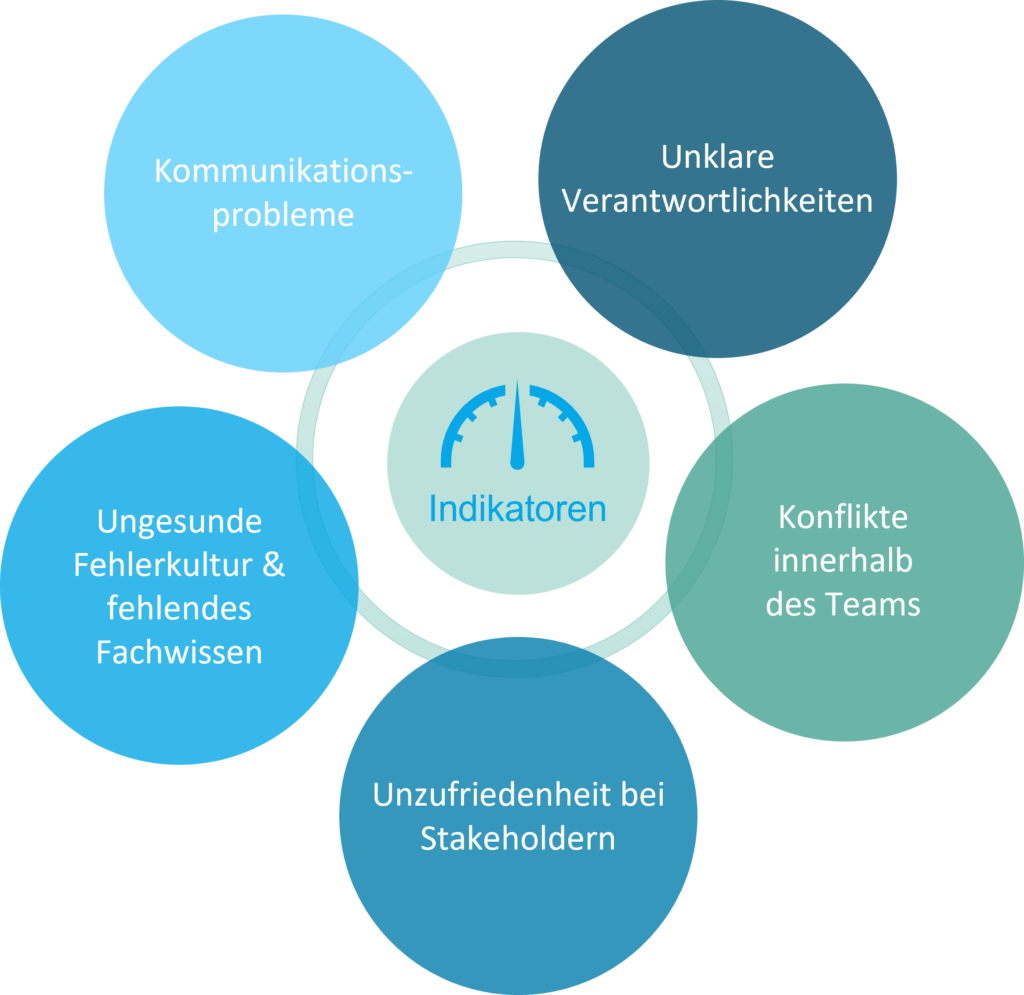
We have now heard a lot about the causes of project escalation, but are there any early warning signs in the project that should make you sit up and take notice? In our view, there are indicators for each cause that help to identify an impending project escalation at an early stage during the course of the project:
Project escalation - causes - indicators
Figure 1:Causes of project escalation and its indicators | isr.de

Indicators of communication problems

Communication is paramount in the project. Normally, we notice very quickly when something goes wrong with communication.

If, for example, emails are ignored or there is an inadequate response to emails or phone calls, the warning light should flash yellow. The same applies if we observe significant differences in the level of knowledge within the team. This is often observed in combination with group formation.

Indicators of dissatisfied stakeholders (costs/results/time)

Regular communication with and support from stakeholders is essential for the project to progress. If stakeholders only attend meetings sporadically, the project seems to lose focus, which indicates potential project risks.

Another indicator of dissatisfied stakeholders is their refusal to make binding statements. In most cases, the project is subject to stakeholder approval towards the end of the project. Under certain circumstances, this approval may also be refused. In some cases, stakeholders increase the pressure on project participants by, for example, questioning results, no longer accepting the duration of the project, or complaining about potentially increased costs. Increased pressure from stakeholders poses a risk to the project, which requires a response from the project team.

However, stakeholders have other ways of expressing their dissatisfaction: constant discussions about substantive issues, deliberate changes to objectives, and a lack of support are just a few examples.

Indicators of unclear responsibilities

"You wanted to do that" or "I'm not responsible for that" – ever heard those phrases? At the start of a project, everyone involved is often enthusiastic and eager to get involved. When tasks need to be assigned, people willingly raise their hands and work together. This situation can change, and it can often be recognized by the phrases mentioned above. Employees no longer feel responsible for the progress of the project, or disagreements arise because those in charge have different opinions and it is unclear which line of action should be followed.

Indicators of conflict within the team

Every person is different—and that's a good thing. Different personalities are valuable and beneficial to a project. After all, a project is about working together to achieve a common goal. However, it becomes difficult when project members are not honest with each other. Do you notice that people are lying within the project? Most of the time, this is done to protect oneself, but a lack of openness and honesty is an indication of conflict within the team.

Another indicator is changing email distribution lists. Suddenly, supervisors or other "important" people are copied in on emails. This can result in unpleasant feelings, discomfort, and uncertainty.

Sometimes, however, conflicts are also played out openly. Team members are verbally attacked during meetings. At this point, at the latest, alarm bells should start ringing.

Indicators of an unhealthy error culture and lack of expertise

A lack of expertise is not always immediately apparent, as every project member is keen to keep up appearances. If, during the course of the project, assigned tasks are not completed or are only partially completed, everyone should take a closer look. Is the employee simply not interested, too busy with other things, or lacking the necessary expertise? If task priorities are downgraded or the availability of team members declines, this can also be an indicator of a lack of expertise. Covering up mistakes is often the last resort for people who need training.

Methods in project escalation: Forewarned is forearmed

Not every minor issue needs to be blown out of proportion, but if you notice some of the indicators mentioned above, you should continue to monitor the project closely and respond accordingly. You can take targeted countermeasures using the following tools and methods:

Regular exchange within the project

Exchange ideas regularly within the project. It is important to ensure that every team member has a say and that there is an open project culture. Regular communication can help keep the team motivated and engaged, and it provides an opportunity to learn new skills and build expertise. Start each communication session with a feedback round—this gives all team members the chance to openly communicate and identify conflicts.

documentation

A clear and consistent description of the project requirements helps to keep sight of the goals. All project participants can better understand what is to be achieved in the project. In addition, documentation can facilitate smooth communication between team members and other stakeholders involved in the project. This can help to resolve conflicts within the team.

feedback sessions

In addition to the planned, regular exchanges, we recommend feedback rounds, which can improve mutual understanding and help identify problems at an early stage. These rounds should not focus on the project content, but rather on the project culture and project cooperation. How do the team members feel about the project? What is expected of other team members? What has bothered the project participants (personally and professionally)? What has the project participants noticed positively? Cooperation, openness, and mutual respect will help to promote the commitment and motivation of team members and positively influence the way they work together.

Open error culture

Mistakes in projects are desirable and helpful. This may sound unusual at first, but a positive error culture promotes openness, transparency, and a willingness to learn when dealing with mistakes. Instead of covering up mistakes and hiding a lack of expertise, employees are encouraged to speak openly about mistakes and share their experiences. Mistakes are seen as an opportunity to learn from them and avoid them in the future.

You can read more on this topic in our blog article "Failing cheerfully in a project: problems arise, solutions emerge." Click here.

stakeholder management

If you notice that stakeholders are losing interest in the project, now is the time to start stakeholder management. Communicate regularly, promptly, and transparently about the vision, project progress, changes, and risks to secure the support of your stakeholders. Regularly ask your stakeholders about their expectations, needs, and requirements, and make sure that they feel involved in the project process. It is even better if stakeholder management is planned from the outset and is an integral part of your project.

Training and continuing education measures

Do you recognize that your team members lack expertise? Respond quickly and actively offer training measures. Learning from mistakes alone is not enough here. You can try to build up expertise from within the team or the company.

However, we would recommend using external training measures. This has the advantage of drawing on expert knowledge and opening up new perspectives on a topic. New approaches and ideas for project work often emerge. Employees also feel valued when they are offered this opportunity. In addition, this approach conserves internal resources, as the service is purchased externally.

Define a "project empath"

A "project empath" is not a common term in traditional project management. However, we have found that this "role" should be filled. It is an extremely empathetic team member who, in addition to working in the team, is also used as a confidant. The task of a "project empath" is to perceive emotions and moods in the project, recognize indicators, and reflect these back to the team in a neutral manner. Project empaths can be very helpful in identifying and resolving conflicts and creating positive group dynamics.

Project escalation and ISR

As an IT consulting firm, we naturally have to deal with project escalations from time to time. As you have now read, there are many different triggers for this. It is impossible to completely rule them out in project business. But with the necessary sensitivity and a few tricks, such moments can usually be managed well, or the risk of escalation can be minimized. Projects stand and fall depending on how those involved in the project work together. Thanks in part to our regular project management training courses, our experienced project managers have already brought many a supposedly "damaged project ship" back on course.

What is your experience in this regard? Let's share our experiences.

About ISR

Since 1993, we have been operating as IT consultants for Data Analytics and Document Logistics, focusing on data management and process automation.
We provide comprehensive support, from strategic IT consulting to specific implementations and solutions, all the way to IT operations, within the framework of holistic Enterprise Information Management (EIM).
ISR is part of the CENIT EIM Group.

Visit us virtually on these channels:

News Categories
News Archive

Latest Publications

Upcoming ISR Events

[tribe_events_list limit=”3″]