
From order to invoice:
Many companies lack a common thread. Media breaks and silos cause costs and delays—a consistent order process workflow creates clarity and efficiency.
Ordering processes are under pressure today: budgets are shrinking, requirements are increasing, and there is a shortage of skilled workers. When information is shuttled between email, Excel, and ERP systems, avoidable friction losses arise—from unclear responsibilities and duplicate data entry to missed discount deadlines.
Table of Contents:
1. From email overload to a clear process
2. Separate islands, shared route – how continuous workflows overcome silos
4. One route, many stages – how purchasing, specialist departments, and finance come together
5. Less effort, more control – get your order workflow on track
6. Step by step to digital workflow in the ordering processworkflow in the ordering process
7. Typical work gains for employees in the ordering process workflow
8. From individual process to digital ordering process workflow with ISR
From email overload to a clear process
A consistent workflow in the ordering process brings order to this complex network. All steps—from the requisition to invoice approval—mesh seamlessly. Information flows automatically, tasks are assigned to the right people, and decisions are documented transparently. What used to get stuck in coordination loops now runs digitally, traceably, and controllably. This gives purchasing, specialist departments, and finance a noticeable boost in speed, quality, and transparency.
Separate islands, shared route – how continuous workflows overcome silos
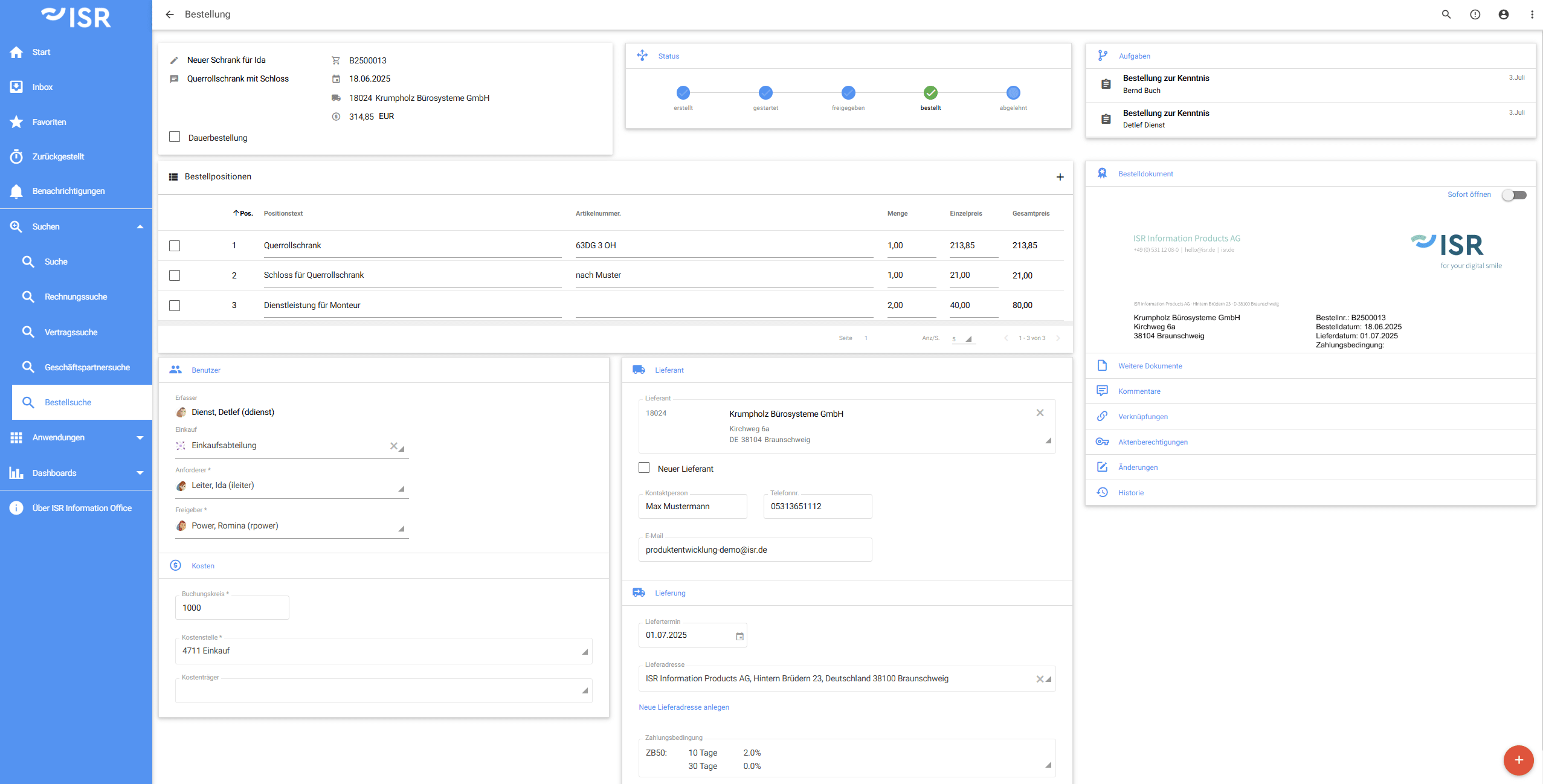
In many organizations, each department works at its own pace: the specialist department reports its requirements, the purchasing department creates the order, and the finance department checks the invoice later—often without any shared context. There is a lack of insight into status, documents, and history, queries are handled via email threads, and decisions are poorly documented. This costs time and unsettles those responsible.
Digital order management connects what was previously separate:
- Order search instead of mail search – information is available centrally instead of disappearing into mailboxes
- Structured comments instead of CC loops – communication takes place where it belongs: in the process.
- Clear links between orders, goods receipts, and invoices —every step is traceable, every purchase transparent.
A complete audit trail builds trust, while defined roles, proxy arrangements, and approval processes ensure clear responsibilities. This transforms parallel work into a coordinated workflow.
Reaching your goal with clear rules – step by step toward a digital procurement process
An efficient ordering process workflow does not happen by chance, but rather through clear rules. Defined processes provide guidance and ensure that each step follows smoothly from the next.
It all starts with standards: What types of orders are there? Which mandatory fields are relevant? Who is authorized to approve—finally, provisionally, or with conditions? These rules form the foundation for the digital approval process. Checks on budget, product group, value limit, or contract reference run automatically in the background. Notifications and tasks keep those responsible up to date, while escalations ensure deadlines are met and keep the process moving.
All information is bundled centrally in the order file—including documents, comments, and history. Content can be viewed directly without switching between applications.
Once approved, the three-way comparison between the order, goods receipt, and invoice ensures fast, audit-proof processing. Changes remain versioned, and roles and permissions are clearly defined. This creates a transparent, secure, and consistently digital workflow—from the initial requisition to final approval.
One route, many stages – how purchasing, specialist departments, and finance come together
A digital workflow in the ordering process is like a well-planned route—each stage flows seamlessly into the next. The department specifies the requirements, adds all relevant information, and stores documents or contract references. If a supplier is missing, the supplier creation process can be started directly in the same system—without detours or media discontinuity.
The purchasing department then checks prices, quantities, and terms and conditions and initiates approval. Decision-makers automatically receive a notification, see all documents at a glance, and approve the order with a single click—either definitively or with comments for revision. Once approved, the order is sent directly, while reminders about incoming goods or pending checks keep the process moving.
As soon as the invoice arrives, the system automatically links all the information: the order, goods receipt, and invoice are reconciled, discrepancies are reported, and approvals are documented. This keeps the entire ordering process transparent, traceable, and controllable at every stage—like a route that updates itself when conditions change.
Less effort, more control – your procurement process on track
A consistent workflow is like a well-coordinated navigation system: it guides everyone involved safely to their destination, saves detours, and ensures that no turn is overlooked. Companies that digitally connect their ordering and invoicing processes gain significantly in speed, transparency, and controllability.
Speed & reliability:
Automated approvals and standardized processes shorten the time between the request for payment and the actual payment. Discounts can be reliably used, and approvals run without delays.
Quality & Compliance:
Clear rules, validations, and three-way matching (order – goods receipt – invoice) minimize errors. Every decision is documented, every check is traceable – audit-proof and compliant.
Transparency & control:
Centralized order files, status overviews, and intelligent search functions provide clarity. Progress, bottlenecks, and responsibilities are visible at all times.
Relief & focus:
Manual reconciliations and duplicate data entries are no longer necessary. Teams gain freedom for strategic tasks—such as supplier management or controlling.
: Uniform governance ensures that processes remain stable even as complexity increases. This allows the system to grow without losing control.
Step by step to a digital workflow in the ordering process
Focus on evolution rather than a big bang. Those who approach change in ordering systems in a structured manner will achieve their goals more sustainably.
analysis
The first step is to take stock: Where are friction losses currently occurring? Which process variants are most common, and which cause the greatest effort? From this, priorities can be derived in order to start where the effect is greatest.
standards
The next step is to create standards —through uniform templates, mandatory fields when creating new orders, and clean supplier master data. This creates the basis for reliable processes.
Transparency
This is followed by the transparency phase: digital order files, centralized document displays, and automatic notifications ensure that everyone involved knows what needs to be done and when—without detours or information gaps.
Automation
Once the structures are in place, approvals can be automated. Rules for approvals, substitutes, and escalations keep processes flowing, even when someone is on vacation or deadlines are looming.
integration
Finally, invoice verification is integrated —with a three-way comparison between the purchase order, goods receipt, and invoice. Discrepancies are immediately apparent, and rework is minimized.
Optimization
And like any good navigation system, a digital ordering process workflow also needs regular monitoring and fine-tuning: measuring throughput times, analyzing exceptions, adjusting governance. In this way, initial quick wins grow into a stable, efficient process—step by step, but with a clear direction.
Typical work gains for employees in the ordering process workflow
For employees, an optimized workflow is particularly noticeable in everyday life:
Fewer queries
All relevant information, documents, and decisions are bundled in the order file. This largely eliminates the need for inquiries by email or phone.
No double data entry
Data is entered once and reused throughout the entire process—from order request to invoice verification.
Clear status at a glance
Pending approvals, missing goods receipts, or blocked invoices are immediately visible. Tracking replaces inquiries.
Structured communication
Comments and notes are documented directly on the order—traceable, easy to find, and not hidden in email threads.
Automatic checks instead of manual controls
Budget, value limit, or contract checks run in the background. Errors are detected early on, significantly reducing the need for rework.
Faster invoice processing
Automated 3-way matching means discrepancies are spotted right away and sorted out properly.
Representation without friction losses
Thanks to clear roles, histories, and representative regulations, the process remains stable—even during vacations or illness.
More time for value-adding tasks
Instead of routine administrative tasks, there is now time for coordination with specialist departments and suppliers, or for process improvements.
From individual process to digital ordering process Workflow WITH ISR
The procurement process is structured in such a way that it functions consistently—clearly regulated, transparent, and controllable. Individual work steps are combined to form a binding workflow, and implicit agreements are transformed into a comprehensible set of rules.
This makes the ordering process independent of individual coordination, email correspondence, or personnel bottlenecks. Responsibilities are clearly defined, decisions are documented, and information is available at all times. The process remains controllable—even with increasing complexity, new requirements, or organizational changes.
In short: we ensure that procurement is not only digitally mapped, but also runs reliably. The digital workflow becomes the stable backbone of purchasing—transparent, scalable, and ready for everyday use.


Jens Brettschneider
Head of Business Unit
Application Management
jens.brettschneider@isr.de
+49(0)151 422 05 425