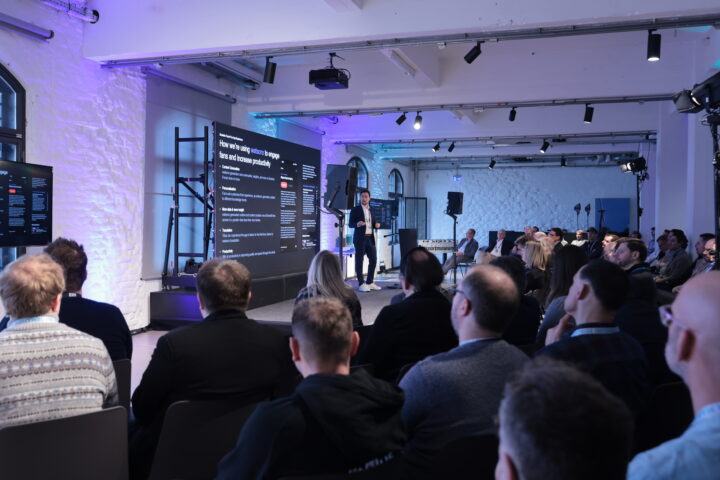
André Vogt in conversation with
Dr. Ulrich Kampffmeyer and René Weseler.
Part 1/3
AI is not intelligent—it calculates, it automates.
But does it really understand?
In the first part of the series of discussions with André Vogt (ISR spokesperson), Dr. Ulrich Kampffmeyer, and René Weseler (Buildsimple), they reflect on the development of input management and why automation is much more than just technological progress.
In the past, hardware was the bottleneck in input management: paper, scans, manual indexing. Today, the focus is on something else—the intelligent processing of information from a wide variety of channels: email, apps, voice, structured data.
Despite all the technological advances, the goal remains the same: automating processes, ensuring data quality, and making knowledge usable.
But with the rise of AI, a new misunderstanding has emerged:
We humanize machines and expect understanding where only calculation takes place.
"AI is not intelligent. It calculates—it doesn't understand anything."
This sentence sums up the core message: True intelligence arises where humans take responsibility—for data, processes, and decisions.
The conversation shows
- Why automation is the goal and not just the means to an end
- why information is more valuable than algorithms,
- and why companies often fail due to the same bottlenecks as 20 years ago, despite digitalization.
The entire discussion about the fundamentals of intelligent process automation and why true intelligence begins with humans can be found here:
Part 2/3
Between trust and responsibility: Why AI is no substitute for human judgment.
In the second part of the discussion series with André Vogt (ISR spokesperson), Dr. Ulrich Kampffmeyer, and René Weseler (Buildsimple), they shed light on the downside of the AI hype: the loss of focus, transparency, and responsibility.
Many companies hope that AI will finally enable them to manage the flood of information.
But the reality is more complex: what used to fail due to a lack of data is now due to the unmanageable amount of information and the expectation that AI systems will deliver perfect results.
"We want to believe that the machine is right—because it's more convenient."
This sentence describes the dilemma: instead of critically examining results, we place blind trust in them. Yet the foundation remains just as important: structured, verified, and reliable information.
André Vogt and his conversation partners make it clear:
- Without quality assurance and information management, AI cannot function in a company.
- Large, generic models are not automatically better—small, specialized AI approaches are often more precise and resource-efficient.
- Success depends not on computing power, but on responsibility in handling data.
The entire discussion about realistic expectations, sustainable automation, and the question of how much decision-making we should leave to machines can be found here:
Part 3/3
AI is not an end in itself, but a tool whose value is determined by humans.
The third part of the discussion series with André Vogt (ISR spokesperson), Dr. Ulrich Kampffmeyer, and René Weseler (Buildsimple) focuses on what remains after the euphoria: responsibility, benefits, and healthy realism in dealing with AI.
Many organizations today face the same dilemma that accompanied earlier waves of technology:
People talk about the future instead of addressing the causes in the present.
The actual task remains unchanged: automating processes, improving information quality, and securing decisions. AI is a tool—not the goal.
"Many AI projects in recent years have been an end in themselves. Today, we call this AI (
), but the challenges are the same as those faced by knowledge or document management 20 years ago."
The conversation clearly shows:
- Technology cannot replace strategy. AI only reveals its value when it solves specific problems.
- Clean, structured information remains the key
to functioning processes. - Specialized, integrated solutions deliver more sustainable results
than generic models. - Humans remain responsible—for data quality, ethical boundaries
, and the actual benefits.
The entire discussion about the responsible use of AI, its actual benefits, and why AI should move from hype to a tool for real process intelligence can be found here: