
It's amazing how many parallels there are between raising children and the typical challenges we face in our IT projects. Read on to find out what they are and how we can address them.
But what does all this have to do with ISR and IT consulting?
No, we haven't suddenly expanded our business model to include psychological family counseling. Nevertheless, the holidays mentioned above got me thinking. As a marketing professional, I have some overlap with our IT consultants and have a little insight into their everyday professional challenges. And I've noticed that there are a surprising number of parallels between raising children and the typical challenges we face in our IT projects. Read on to find out which critical success factors determine not only our everyday life in IT consulting, but also our interactions with our children – smile included 😉
How do we start? Well, for the sake of simplicity, perhaps in the CLASSICAL WORLD, where we encounter the following phenomena, for example:

1. Because you don't know what you're doing – aka rolling planning
When planning a project on a rolling basis, the ultimate goal is often unclear. There are only rough ideas and concepts of what the project might look like. Just like raising children, the goal of achieving the perfect result is often vague and full of uncertainties. As parents, we want our children to grow up to be wonderful people, but exactly how that will happen often remains a mystery.
Deep down, as project managers in the chaos of everyday life, we simply want a minimum level of planning quality and prioritization: homework first, then gaming! For a while, we have the upper hand and can enforce this as parents, but for how long? Discussions are inevitable. And not just there.
Because apart from prioritization, we simply want a rough plan for the week that also accommodates our own wishes. But our spontaneous, naive kids seem to think differently. So today, instead of going to the skate park and then preparing the presentation for school, they want to chill at Jonas's house and then go to the movies? And then hop into the waiting parent taxi around the corner?
Probably the kids just have to accept certain unchangeable milestones like Grandma's birthday, and we as parents have to adjust to planning in shorter intervals, in line with the step-by-step approach. Ultimately, it's all about compromise.
And, just like in an IT project, this requires flexibility, a dash of improvisation, and the ability to adapt to unpredictable situations.
2. Keeping the family business running – aka incident management
Whether we are trying to raise our children or manage incidents, one thing is certain: chaos is inevitable. Just as children can be unpredictable, incidents cannot always be foreseen. They arise unexpectedly and bring with them a fair amount of chaos. In both cases, it is important to keep a cool head and focus on solving the problem while everything is going haywire in the background. Disruptions in daily life are virtually "normal," ranging from harmless events such as a forgotten school bag, to more serious occurrences such as lost house keys, to serious incidents such as picking someone up from the drunk tank after their graduation party – such "disruptions in daily life" are probably normal on the road to adulthood.
If weaknesses are inherent in the system and occur repeatedly, we end up in problem management. Then it's time for constructive feedback instead of complaining. Act quickly and with appropriate leniency and solve the identified problem sustainably and in the long term so as not to jeopardize the family infrastructure. And in a few years, laugh together with your (then grown-up) children about the anecdotal missteps.
3. Children are champions of change—aka change management
Our children's development itself is subject to a constant process of change. This happens during their "growth spurts," but also simply in everyday life, as described above. This makes me think. What about us? Do we as parents live with traditional and very narrow, entrenched ideas about how things should be done? With static patterns? Do we suffer from the fact that our assumptions about time requirements, costs, and scope of services are constantly being exceeded?
Children grow up inexorably and develop continuously. From their first steps to their own opinions and interests, we as parents experience constant change—they are masters of the change process! The situation is similar in Change ManagementWhat does change management mean? Change management encompasses all... More of projects. New requirements, changing priorities, and evolving goals require continuous adaptation. But how good are we as "parents" or project participants in the change process? I think we all know the answer.
But even children are not immune to problems in the change process. Of course, it's hard to stay cool when a plan that has been carefully thought out and discussed (first review for tomorrow's test, then shopping for jeans and school supplies together, followed by ice cream and grocery shopping on the way home)
is thrown out the window (postpone review, eat ice cream first, buy the eighth pair of sneakers instead of jeans, then bump into a friend, kid gone, grocery shopping alone).
Communication plays a crucial role when it comes to coping with change. When raising our children, we need to convey our messages clearly and understandably, while at the same time being open to their needs and perspectives. In change management, it is just as important to ensure clear communication so that everyone involved is on the same page and understands the changes. Open dialogue and mutual understanding are the keys to successfully dealing with change, for young and old alike. Only in this way can we become and remain trusted companions and advisors.
4. Participation in housework – aka service level agreement
The service level agreement (SLA) is one such thing. Most (expectant) parents already consider during pregnancy that "great happiness" also goes hand in hand with the SLA, which is to allow the new life to grow up as protected and healthy as possible. And so, in the first few months (and with our first child), we respond to every acoustic signal, eliminate code smells immediately, take care of nutrition, and continuously try to activate sleep mode, which makes life easier for everyone. But there comes a point when we, as parent service providers, reach our limits. Recurring demands that our existence as guardians later brings with it alongside the "job project" then overwhelm us. This is because the tasks of safety, feeding, cleaning the environment, and physical care are then expanded to include mental support (keywords: bullying, heartbreak, self-discovery). And that's every day! Although we parents repeatedly try to inform our kids, as soon as they outgrow toddlerhood, in a transparent, comprehensible, and understandable way about our overload as service providers, an improved level of service is continuously expected.
But eventually, the day comes when something changes—at least on a small scale. At some point, our children grow older. We then realize that it is now up to us to define binding scopes of services as well as response and processing times within the framework of their obligations to cooperate. What does that look like? For helping with garbage disposal, emptying the dishwasher, or setting the table, an agreement for weekly pocket money can be established in addition to covering many essential needs as mentioned above. Advantage: Avoiding arguments. Disadvantage: Only children in particular, who quickly settle into their new role as contributors, tend to define themselves as service providers and, after a short time, try to drive up the spiral of benefits and prices in their favor due to a lack of competition.
And so there are many aspects to ponder here. Newer approaches assume that traditional methods simply do not work. Then many parents—er, project managers—swear by
AGILE methods. But what does that mean?
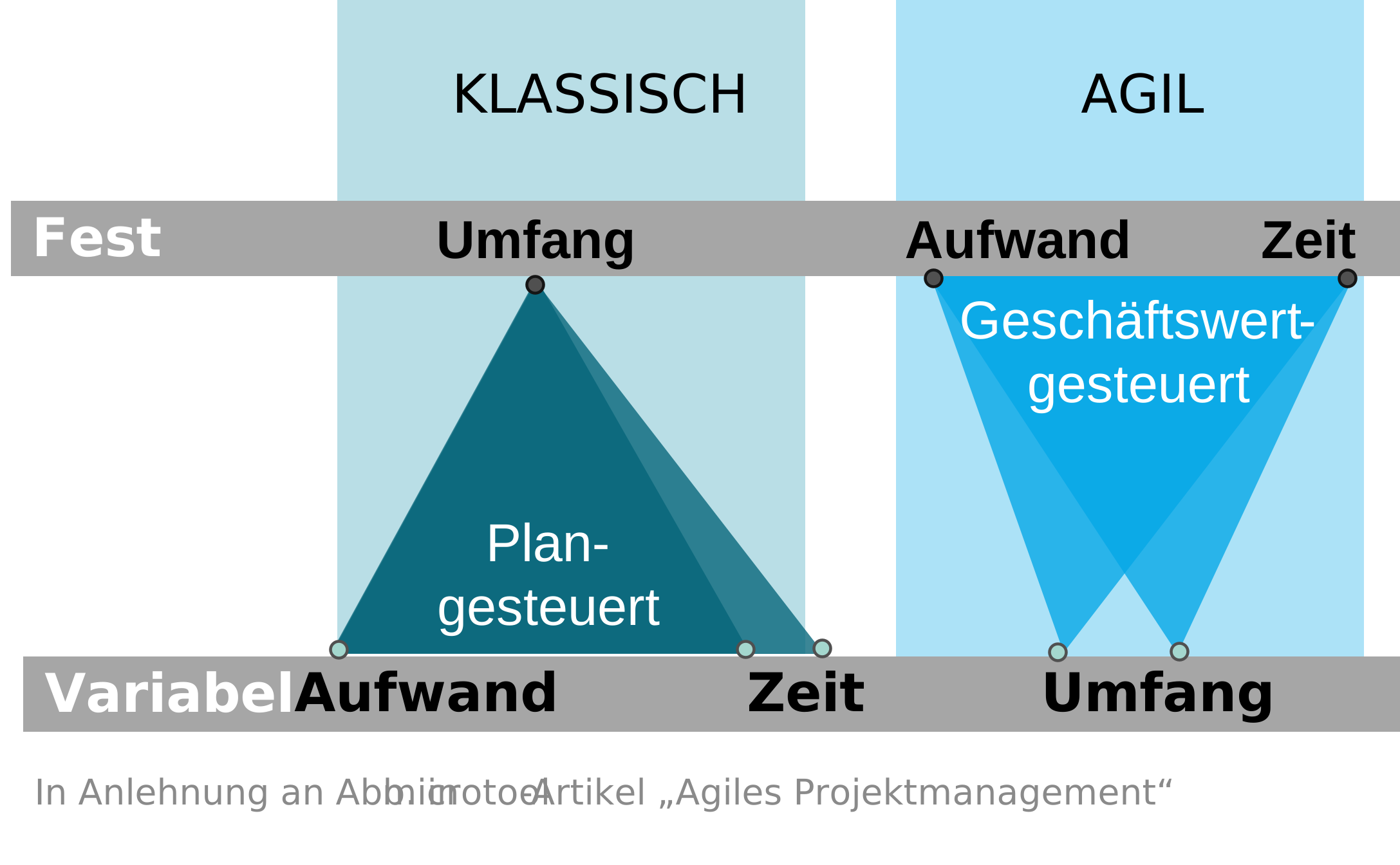
We exchange clearly defined planning constants of "what" you want to do for the planning constants "effort" and "time," and voilà, now it's agile. Depending on the project, there are different fixed and variable variables.
However, from a parent's point of view, the project "Passing high school exams with good grades," whose scope and content are set in stone by the Ministry of Education and Cultural Affairs of the respective federal state, should be approached in the traditional way. The quality (i.e., final grade) will certainly also increase with the amount of time spent studying. And fortunately, studying itself does not even require any expenditure, but actually saves money.
For the project "We're going to an amusement park," on the other hand, which is at the top of the teens' wish list, we choose the agile approach, in which it is not the scope but the time and effort that are fixed. So if we limit the financial outlay to a maximum budget of €200 for the family and the time frame to one Sunday, it must be clear that only one visit to Heidepark is possible, even if the children tell us with shining eyes about the special offer for three days at Disneyland Paris.
Parents at ISR: What parallels are there between raising children and your job?
The parallels between parenthood and working life: not always immediately apparent, but definitely there. Here is a brief insight.
CONCLUSION
The project of raising children is a particularly
challenging one, in which you learn at least
as much as you would in managing a multi-year, complex
IT project, both as a person and as a mother or father. We can try to fall back on proven methods, structure processes,
define rules, and get everyone around the table. In the end, however, mutual consideration, cooperation, understanding, and
optimal communication will lead to the goal.
The project "Raising Children" is a particularly challenging one, in which you learn at least as much as in the supervision of a multi-year, complex IT project.

Jenny Dornberger
Team Lead
Corporate Marketing
marketing@isr.de
+49(0)151 422 05 250