Business Process Management Because smooth processes are no coincidence
Imagine having a guide that reveals the course of all your business processes— beyond assumptions and guesswork. You could clearly see how processes really work, where paths diverge, and what connections in the background keep operations running. What if you could use these insights to improve your processes in a targeted manner and make them more efficient? That's exactly what Business Process Management – your key to greater transparency and control in your company.
Definition of business process management. What is it?
Business Process Management (BPM) enables companies to systematically design their business processes. The focus is on the continuous optimization of processes in order to increase the efficiency of the company.
Whether it's processing customer orders, invoicing, or internal approval processes, business process management ensures that these procedures remain adaptable. By carefully analyzing existing processes, weak points can be identified and eliminated, unnecessary steps avoided, and procedures digitized or automated.
The aim of process management is to create transparent processes that not only save time and money, but also improve the quality of work and help companies respond quickly to change. This makes the company as a whole more future-proof.
Benefits of Business Process Management
A professional business Process management offers much more than just internal process optimization. Used correctly, it creates tangible added value—not only for your company, but above all for youryour customers. This is because structured and efficient processes have a direct impact on service quality, reliability and speed.
Here are the key advantages of Business Process management:
Reliable processes: Standardized processes ensure consistently high quality. Your customers can rely on your performance.
Higher service quality: BPM helps minimize sources of error and design customer-oriented workflowsto achieve a better overall experience ..
Clear communication: BPM creates clear responsibilities and processes and improves communication with customers and partners.
Shorter turnaround times: Whether it's a quote, delivery, or feedback, optimized processes significantly reduce waiting times for customers.
Reliable scalability: As your business grows, your operations remain stable. Your customers benefit from consistent quality, even with larger volumes.
This strengthens process managementnot only internal structures, but also makes companies more more customer-oriented partner.
Why is business process management important for companies?
Business process management is more important than ever for companies today because it forms the basis for efficiency, quality, and competitiveness.
In an age of rapidly changing markets and high customer expectations, it is crucial not to leave internal processes to chance. This allows resources to be used in a more targeted manner, errors to be reduced, and response times to be shortened. Companies that actively manage their processes are not only better organized—they are also more agile, more customer-focused, and better prepared for growth.
In short: Business process management makes companies more efficient. It ensures that work steps are clearly defined, measurable, and efficient—thus creating the conditions for digitalization, automation, and sustainable success.
Business Process Management: The 3 BPM Tools
Business process management can be divided into three main types, depending on what is at the center of a process: systems, people, or documents. This distinction helps companies to use process management in a targeted manner and select the appropriate technologies and methods.
1. Integration-oriented BPM:
Integration-oriented BPM focuses on processes in which IT systems communicate with each other. It ensures smooth data exchange—for example, between ERP, CRM, and accounting systems—enabling an automated, media-break-free process chain.
2. People-oriented BPM:
Person-oriented BPM is used when human interaction is central. It structures processes such as application reviews, approvals, or customer service requests that require decision-making, communication, and collaboration.
3. Document-oriented BPM:
Document-oriented BPM is used wherever information is processed in the form of documents, such as invoices, contracts, or forms. It controls the flow, storage, and processing of this content throughout its entire lifecycle.
This understanding enables companies to optimize their processes in a more targeted manner—and ensure that every process fits the right strategy.
Optimizing business processes is a complex task—especially when terms such as BPA, RPA, and BPM are often used interchangeably or incorrectly. But this is precisely where "the devil is in the details." In our article, we explain what these terms mean, how they differ, and why a clear understanding of the methods and technologies is crucial for successful process automation.
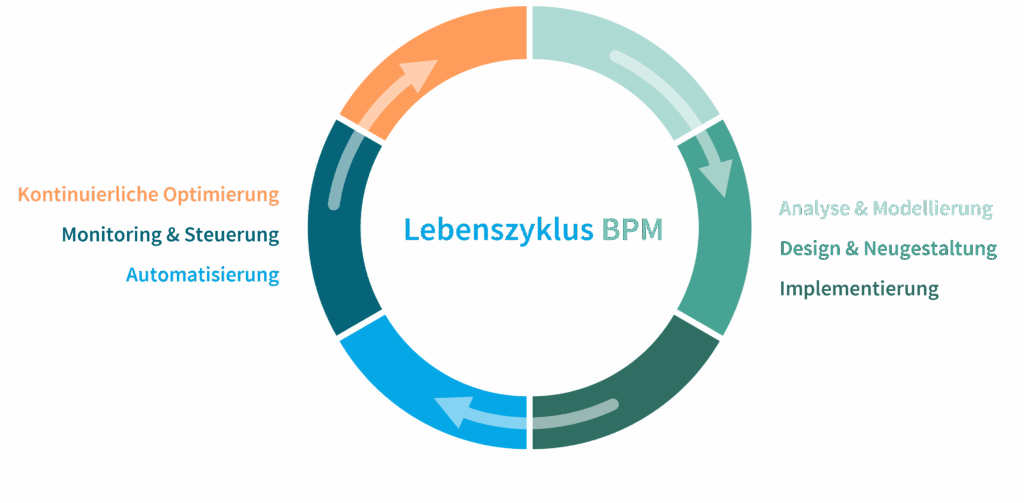
The life cycle of business process management explained simply
Fig.: Business Process Management Life Cycle
The optimization process typically includes six phases:
Analysis & modeling: Existing processes are analyzed, visually represented, and documented. The goal is to achieve a common understanding of workflows, roles, and potential weaknesses.
Design & redesign: Based on the analysis, optimized or redesigned processes are created—more efficient, transparent, and customer-oriented.
Implementation: The new processes are transferred into everyday operations—with clear responsibilities, tools, and rules.
Automation: Where appropriate, processes are partially or fully automated—e.g., through workflow systems, business process automation (BPA), or robotic process automation (RPA). The goal: fewer manual steps, higher speed, and lower error rates.
Monitoring & control: Ongoing processes are continuously monitored—using KPIs, dashboards, or process mining—to identify deviations and bottlenecks at an early stage.
Continuous optimization: Processes are regularly reviewed and improved based on the data obtained. The cycle begins again.
This cycle enables companies to continuously develop and adapt processes to changing requirements, new technologies, or market conditions.
Digitization in document management A successful practical example in industrial insurance
A leading provider of industrial insurance had a widespread problem : claims processing was complex, non-transparent, and heavily paper-based. There were repeated delays in reviewing claims, responding to customer inquiries, and coordinating between departments.
The cause was a fragmented process with many manual interfaces. Claims were received by email, fax, or letter, had to be entered manually, and assigned to the respective policies. Documents were stored in different systems, and the flow of information between claims management, underwriting, and customer service was often not traceable.
Solution: The use of business process management has fundamentally improved the entire claims process:
All incoming reports are now centrally recorded and automatically classified.
Claims files are created digitally and linked to the corresponding policies.
Workflows control the review, queries, and approvals in a process-driven manner by the specialist departments.
Documents, emails, and expert reports are stored in an audit-proof and context-related manner.
Client companies receive structured status updates on the processing status.
The result: The processing time per claim fell significantly, and processing became more traceable and transparent—both internally and for customers. Specialist departments benefit from clear processes, fewer queries, and a noticeably faster processing speed.
This example shows how business process management helps to modernize even complex processes in industrial insurance—for greater efficiency, transparency, and customer satisfaction.
In the area of business process management, we rely on these technologies
An effective business Process management is the key to sustainable optimization of company-wide processes. We support our customers in holistically analyze and structure their processes and make them more efficient through the targeted use of digital technologies.
With extensive expertise and many years of experience we develop tailor-made BPM solutionsthat are tailored to the individual requirements of your company. The aim is to replace manual, error-prone, and time-consuming activities with automated workflows—for greater transparency, speed, and quality in your processes.
Our solutions are compliant with current legal requirements, including data protection and audit-proof documentation. Thanks to scalable technologies, they adapt flexibly to growing requirements and enable long-term process optimization.
In addition to increasing efficiency, our BPM strategies also contribute to cost reduction — for example, by reducing media discontinuity, administrative effort, and storage costs. We support our customers through all phases of change: from analysis and implementation to change management.
As reliable partner , we not only offer technical solutions, but also actively support digital transformation and promote continuous improvement of business processes. Whether as a pilot project or a comprehensive process initiative, we will work with you to develop the right approach.