

Guest Author Contribution
by Jörg Kremer
mip Management Informationspartner GmbH
Head of Consulting / Delivery Manager

Guest Author Contribution
by Jörg Kremer
mip Management Informationspartner GmbH
Head of Consulting / Delivery Manager
The cloud is considered a forward-looking IT infrastructure, but its adoption is not a foregone conclusion. Companies must weigh technological potentials such as scalability and efficiency gains against risks and complexity. This article provides an overview of the strategic questions that should be addressed before a migration.
Scalability Meets Reality
The cloud is considered a forward-looking IT infrastructure, but its adoption is not a foregone conclusion. Companies must weigh technological potentials such as scalability and efficiency gains against risks and complexity. This article provides an overview of the strategic questions that should be addressed before a migration.
Migrating analytical infrastructures to the cloud is more than an infrastructure project – it is a strategic decision with far-reaching implications. For IT architects in data analytics, the opportunity lies primarily in the elasticity and modularity of modern cloud services. These services provide the technical foundations for scalable data processing, flexible integration of AI tools, and agile project development.
But how can these potentials be unlocked securely, performantly, and economically?
Agility Through Cloud Infrastructures – A Paradigm Shift
The typical development paths of classic analytics systems – monolithic, cumbersome, static – quickly reach their limits in the era of data-driven innovation. Cloud technologies support modern architectural paradigms such as:
- Containerization (Kubernetes, Docker)
- CI/CD Pipelines for Analytics Models
- Automated Scaling of ETL Jobs
This creates significant latitude for Data Scientists and DevOps teams in their daily work. Prototypes can be rapidly implemented and iterated – without extensive lead times or resource conflicts.
Flexibility, Not Without Complexity
However, with freedom comes responsibility. Cloud-based analytics environments are highly complex: they necessitate well-architected networks, robust governance policies, stringent identity management, and efficient FinOps processes. A poorly conceived architectural decision can prove costly in the long run – both technologically and economically.
Key Questions Before Migration:
- How do I/O-intensive workloads behave in the cloud?
- How can performance be ensured with massive data volumes?
- How can costs be realistically predicted and controlled?
A well-optimized Hadoop cluster or an in-memory database like SAP HANA will only perform well in the cloud if it is tailored to the respective platform.
For Data Analytics Architects, the cloud is a tool – not an end goal. Those who plan meticulously, evaluate thoroughly, and prioritize governance gain scalability, speed, and strategic advantage. Conversely, those who migrate without due consideration risk uncontrollability and cost escalation. Therefore, view the cloud as an architectural opportunity – demanding maturity.
Jörg Krämer
Decision Criteria for Workloads in Typical Analytics Infrastructures
Not all clouds are created equal – and not every analytics component belongs there. Here are some decision-making guidelines:
| Component | Recommendation | Cloud-Native Pipelines | Ideally Suited |
|---|---|
| Legacy DWH Systems | Critical, High Adaptation Effort |
| Real-time Analytics | With optimized infrastructure |
| Sensitive Data (e.g., GDPR) | Only with hybrid models |
Learn More?
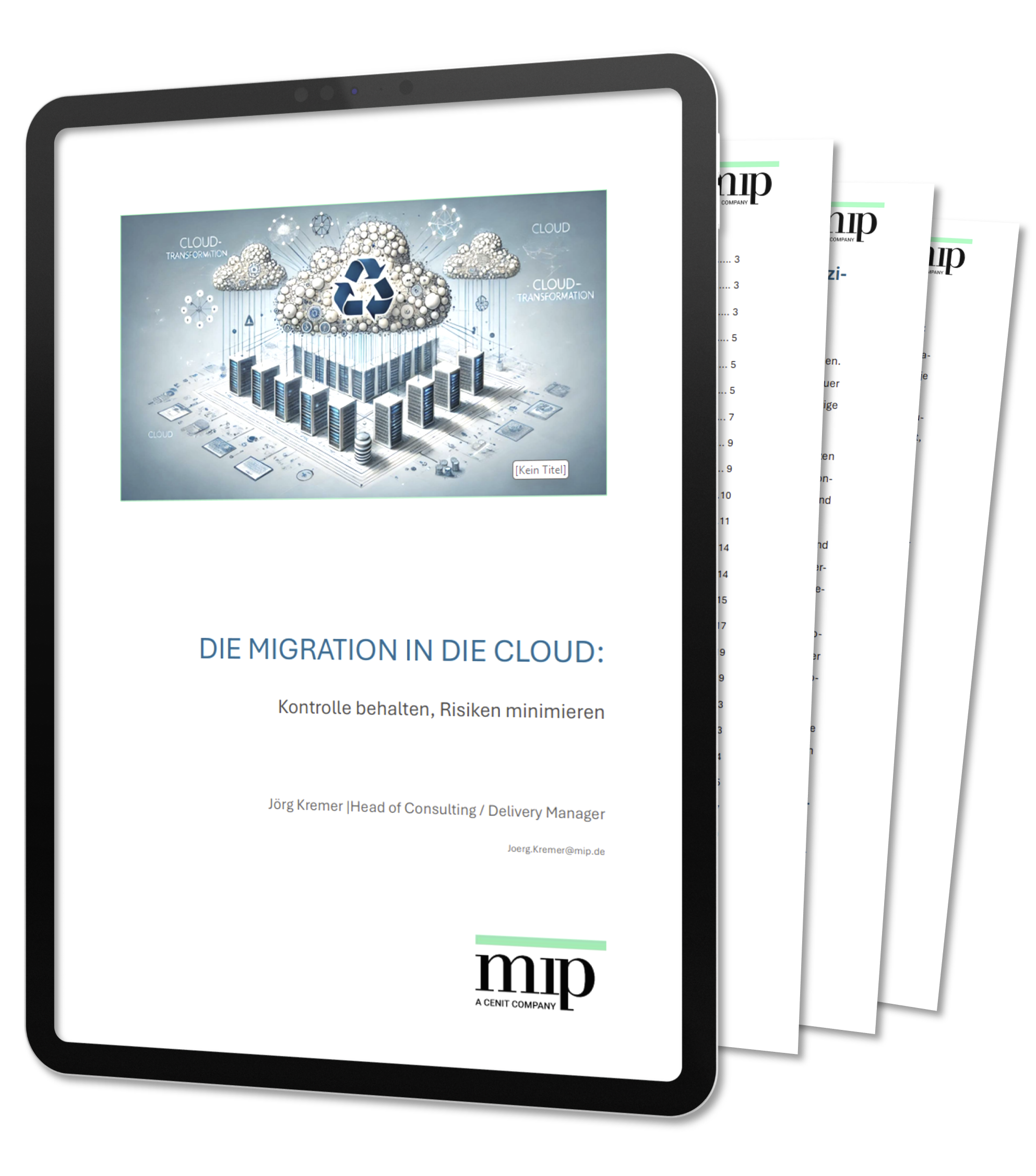
mip Whitepaper
Cloud Migration
In the whitepaper from our partner mip, discover how to strategically transform your analytics architecture to the cloud, with a focus on performance, security, and cost-effectiveness.

Wilhelm Hardering
Senior Executive Manager