
Guest Author Contribution
by Jörg Kremer
mip Management Informationspartner GmbH
Head of Consulting / Delivery Manager
Cloud technologies are now firmly established, especially in the field of data analytics. They form the basis for scalability, efficiency, and innovation. But with growing importance comes greater responsibility: governance, cost control, and sustainability must go hand in hand to ensure long-term success.
IT architects who build or operate data analytics platforms face the challenge of combining technological flexibility with regulatory security and environmental responsibility.
This article highlights the key factors involved—and how they can be implemented in practice.
Governance: The foundation for control and legal certainty
Clear cloud governance is essential for the secure and compliant operation of cloud services. It helps to ensure compliance with legal requirements, internal guidelines, and industry-specific standards.
Clear responsibilities
Governance establishes clear responsibilities. It defines who manages cloud services, performs security checks, and is responsible for compliance monitoring. Regular audits and standardized contract reviews help identify risks and prevent violations at an early stage.
compliance monitoring
In many companies, the General Data Protection Regulation (GDPR) is a key reference framework. Cloud contracts must clearly regulate data protection, access restrictions, and liability issues. The location of data centers is also crucial. Providers that process data within the European Union often better meet data protection and transparency requirements.
Contract management
Consistently implemented governance strengthens security, improves the traceability of decisions, and facilitates collaboration between IT, compliance, and specialist departments. You should therefore regularly review your cloud contracts for data protection, SLAs, and exit clauses.
Risk Management & Monitoring – From Control to Prevention
Cloud technologies are changing the risk profile of an IT landscape. New risk categories must be taken into account: from cyberattacks to performance failures and compliance violations to process interruptions due to faulty configurations.
IT architects should systematically record, evaluate, and manage these risks.
Structured risk management documents risks, assesses their probability of occurrence, and defines appropriate countermeasures.
Continuous monitoring is the next logical step. Performance indicators, security mechanisms, and compliance requirements should be monitored on an ongoing basis. Modern tools such as SIEM (Security Information and Event ManagementEvent management, as the most important component of base maintenance, ensures... More) record security-related events and report deviations in real time.
Companies that also use AI-supported analyses can identify patterns in large amounts of data at an early stage and respond to potential disruptions or attacks. This keeps the cloud environment stable, transparent, and trustworthy.
For example, we use machine learning models to monitor access to the data lake of a customer in the retail sector. Unusual access patterns are reported immediately, and potential security incidents can be stopped in minutes rather than days.
Good monitoring therefore not only serves to prevent errors, but also to ensure the quality of the entire analytics infrastructure.
Change management – People as the key to cloud expertise
The introduction of cloud solutions is not only a technical change, but also an organizational one. Without the active involvement of employees, success will be limited.
Change management creates acceptance, transparency, and targeted skills development. Employees should be informed about goals, benefits, and consequences at an early stage. Open communication reduces uncertainty and encourages participation.
Training courses and practical workshops not only impart technical skills, but also an understanding of new responsibilities. Regular feedback sessions help to evaluate experiences and initiate improvements.
Companies that systematically train their employees benefit from greater process reliability and more efficient operational procedures. A learning-oriented organization makes optimal use of cloud technologies and continuously develops them further.
Green IT & Sustainability – Efficiency Meets Responsibility
Sustainability is becoming a key success factor in modern IT strategies. The cloud offers particular opportunities in this regard: shared infrastructures reduce energy consumption and material costs.
Cloud providers that rely on energy-efficient data centers, modern cooling systems, and the use of renewable energies are drivers of green IT and contribute significantly to reducing CO₂ emissions. When selecting their providers, IT architects should look for certifications such as ISO 14001 or information on power usage effectiveness.
Your own usage can also be made more sustainable. This includes—
- regular analyses of resource utilization,
- Shut down unnecessary instances
- Use of energy-efficient applications.
Regular reporting on electricity consumption, CO₂ emissions, and utilization makes progress visible and improves measures in a targeted manner. The cloud can therefore be a lever for sustainability for IT architects—if it is used consciously.
Future-proof cloud strategies are tailor-made, not "off the shelf."
Every company has its own requirements, processes, and security specifications. Standardized cloud offerings rarely meet these requirements in full. Individual cloud architectures ensure flexibility and control and prevent dependencies (vendor lock-in).
Hybrid or multi-cloud models and open standards enable tailor-made implementation. Strategic partnerships with providers who develop customer-specific solutions increase efficiency. Regular reviews of the cloud strategy ensure adaptability to new technological and regulatory developments.
A customized cloud strategy combines governance, cost control, and sustainability into a holistic approach. It creates transparency, security, and efficiency and enables responsible innovation.
Conclusion
A sustainable cloud strategy combines governance, risk management, change, and green IT into a closed system. Strategically combining these factors creates the basis for long-term stable, secure, and responsible use of cloud technologies in the field of data analytics.
Learn More?
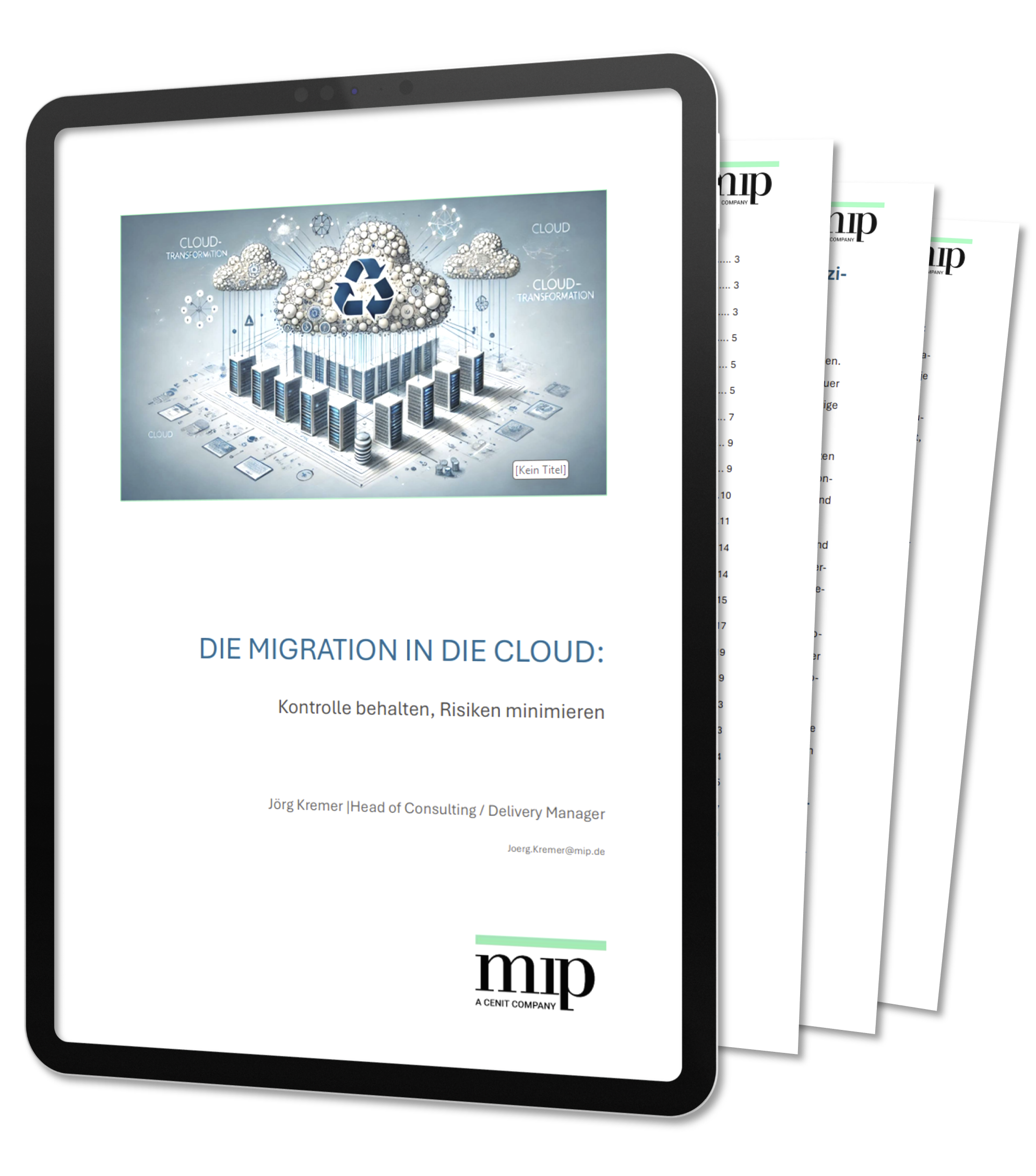
mip Whitepaper
Cloud Migration
In the whitepaper from our partner mip, discover how to strategically transform your analytics architecture to the cloud, with a focus on performance, security, and cost-effectiveness.
Access the other parts of the blog series here:
Which analytics systems belong in the cloud – and which do not
Guest Author Contribution by Jörg Kremer, mip Management Informationspartner GmbH Head of Consulting / Delivery Manager: The Migration...

Technical Risks in the Cloud Migration of Analytics Infrastructures
Guest Author Contribution by Jörg Kremer, mip Management Informationspartner GmbH Head of Consulting / Delivery Manager: Cloud Migration: A Comprehensive...
What Data Analytics Architects Must Consider During the Cloud Migration of Their Infrastructure
Guest Author Contribution by Jörg Kremer, mip Management Informationspartner GmbH Head of Consulting / Delivery Manager: Guest Author Contribution...
Do you have any questions? Please feel free to contact us!

Wilhelm Hardering
Senior Executive Manager