

Guest Author Contribution
by Jörg Kremer
mip Management Informationspartner GmbH
Head of Consulting / Delivery Manager

Cloud Migration: Abundant in Opportunities, Yet Not Without Risks
The cloud offers analytics teams immense opportunities: horizontal scaling, pay-per-use models, automation, and continuous integration of new services. However, this very versatility also conceals potential pitfalls. For IT architects responsible for data analytics infrastructures, it is crucial to understand that without well-founded architectural decisions and proactive risk management, the cloud's promise can quickly evolve into a strategic challenge.
Table of Contents
Data Sovereignty and Regulatory Pressure
Many analytics projects process sensitive data – such as personal information, transaction-based events, or privacy-relevant log data. With the migration to the cloud, the physical and legal control over this data shifts. This data leaves secured corporate networks and is stored in external data centers, which are often operated across national borders.
Problems arise when storage locations are not clearly defined, access possibilities have not been fully documented, or regulatory requirements such as the GDPR have not been fully considered. In practice, this can lead to serious consequences.
For example, a healthcare company migrated its analytics reports to a public cloud environment – only later did it become apparent that the underlying servers were located in the USA. The re-migration to an EU region was technically feasible, but proved to be organizationally and contractually complex.
Vendor Lock-in in the Analytics World
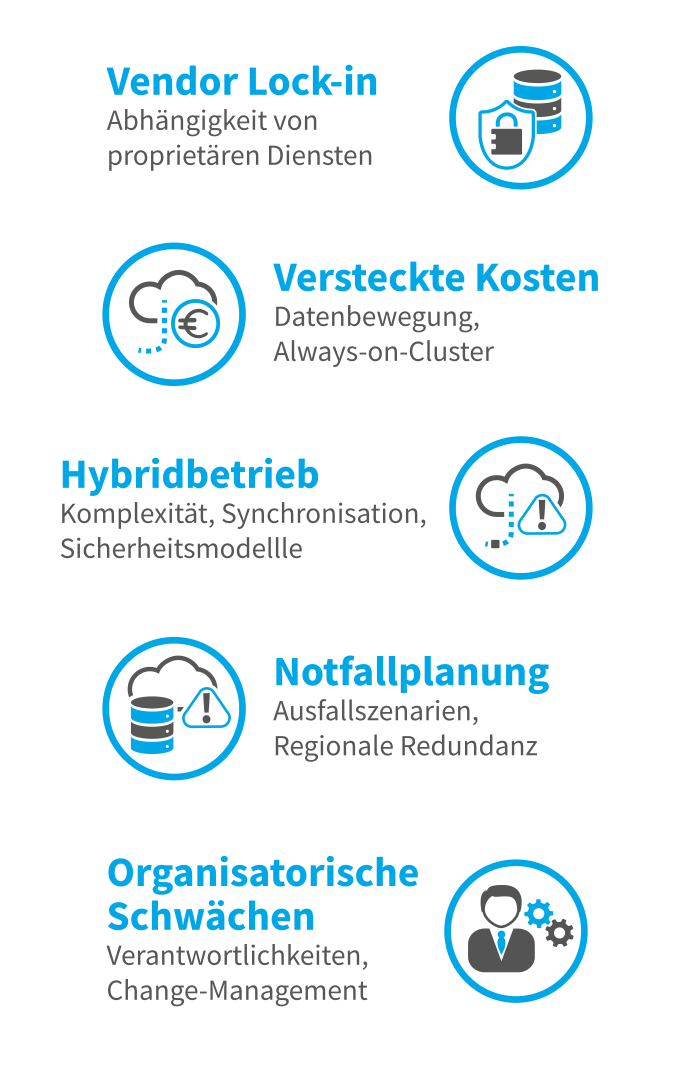
Another often underestimated risk lies in the creeping dependence on specific providers and their proprietary services. While cloud-native tools such as BigQuery, AWS Glue, or AzureWhat is Azure? Azure is a cloud computing platform from Microsoft. It... More Synapse offer enormous performance and integration convenience, they also create a strong dependency on their respective platforms.
The more an analytics stack relies on such services, the more difficult and costly a later migration becomes – whether for economic, technical, or strategic reasons. To prevent this dependency, it is advisable to consciously adopt open standards. Technologies like Apache Airflow or Kubernetes enable greater portability. APIs should be designed to be modular and abstracted enough so that a vendor change remains realistic, at least in the long term. The choice of data formats can also set the course for the future: opting for open formats like Parquet or ORC increases independence and minimizes conversion costs in the event of migration.
The Hidden Costs in Data Processing
Analytics platforms often involve significant data movement – not only internally, but also across network boundaries. While such processes incur minimal costs in classic on-premises environments, the same operation can quickly become expensive in the cloud.
Many teams underestimate, for example, how high egress costs for data exports can be or how significantly always-on clusters – for instance, for Spark processing or data warehousing – can impact the budget. Redundant computations or poorly planned queries in pipelines can also lead to cost spikes.
The answer to these challenges lies in early cost awareness – and in structured FinOps processes. Responsibility for cloud spending must not rest solely with the controlling department, but must be an integral part of architecture and deployment responsibilities. Only through this approach can processes be optimized and cost traps avoided.
Availability and Error Susceptibility of Pipelines
When central ETL or streaming pipelines fail, this usually has immediate effects on downstream processes: reports remain empty, dashboards provide outdated data, and machine learning models are no longer reliably trained.
In the cloud, new sources of error emerge, such as network delays, service disruptions, or changing API behaviors. It is therefore even more crucial to build resilience into the architecture. This means implementing retry logic, defining fault tolerances, utilizing monitoring solutions like Prometheus or cloud-native tools, and establishing Service Level Indicators (SLIs) or Service Level Objectives (SLOs). Only through these measures can risks be identified early and systematically mitigated.
Hybrid Operations – Opportunities with Unintended Consequences
Many analytics systems are operated in a hybrid mode today: on-premises databases feed cloud dashboards, and local Hadoop clusters provide input for cloud-based visualizations or model training. While this flexibility appears sensible at first glance, it introduces complexity.
The challenges begin with data synchronization: real-time or near-real-time synchronization between two infrastructures requires highly precise orchestration. Different security models quickly lead to access issues, especially if role and rights concepts are not unified. Monitoring becomes more difficult because metrics and logs are distributed across multiple platforms.
Unplanned continuous operation in hybrid mode is therefore risky. From the outset, a target vision should exist that defines which systems will eventually be migrated to the cloud, which will remain on-premises – and how the transition will be specifically implemented. Without such a target vision, there is a risk of perpetual provisional solutions, leading to technical debt.
Disaster Recovery Planning: The Underestimated Discipline
The failure of a cloud service is rarely the biggest problem for a company; rather, it is the lack of preparation for precisely such an event. What happens if the region where the cloud DWH is operated is temporarily unreachable? How long do systems remain available if no data pipeline is running? Which data states can be restored?
A professional disaster recovery plan must define recovery objectives – both in terms of time (RTO) and data integrity (RPO). Geo-redundant deployments, tested restore procedures, and escalation protocols are just as necessary as a communication plan for internal and external stakeholders.
Analytics architects are particularly crucial here: they must define which reports and KPIs are business-critical in an emergency – and which can be tolerated with a delay.
Organizational Weaknesses – Cloud Without Cultural Change
Technically well-migrated systems are of little use if the organization does not follow suit. Responsibilities are often lacking: Who manages FinOps? Who ensures compliance? Who trains analysts for the new tools?
Further training, clear governance models, and communication strategies are essential not only to enable a migration, but also to successfully shape lasting change.
The introduction of a cloud analytics platform represents a cultural shift. Roles shift, processes change, and new competencies become necessary. Without structured change management, inefficiencies, frustration, or shadow IT are imminent.
Jörg Kremer
Conclusion
Analytics architectures are highly susceptible to cloud risks, even more so than traditional IT systems. This is due to their processing of business-critical data, direct linkage to operational decisions, and highly dynamic nature. Consequently, architects designing cloud solutions today must not only demonstrate technical excellence but also effectively manage economic, security-related, and organizational risks.
Learn More?
mip Whitepaper
Cloud Migration
In the whitepaper from our partner mip, discover how to strategically transform your analytics architecture to the cloud, with a focus on performance, security, and cost-effectiveness.
Here you can find the first part of the blog series:

What Data Analytics Architects Must Consider During the Cloud Migration of Their Infrastructure
Guest Author Contribution by Jörg Kremer, mip Management Informationspartner GmbH Head of Consulting / Delivery Manager: Guest Author Contribution...

Wilhelm Hardering
Senior Executive Manager