by Jörg Kremer mip Management Informationspartner GmbH Head of Consulting / Delivery Manager
The migration of analytical systems to the cloud is no longer a peripheral concern but is central to strategic IT decisions. Promises of elasticity, scalability, and increased agility are made – all crucial factors for data-driven enterprises. However, practical experience quickly reveals that not every system fully realizes its potential in the cloud. Some applications benefit immensely from migration, while others lose efficiency and stability or are not even viable from a regulatory perspective.
For IT architects responsible for data analytics system infrastructures, the fundamental question thus arises:
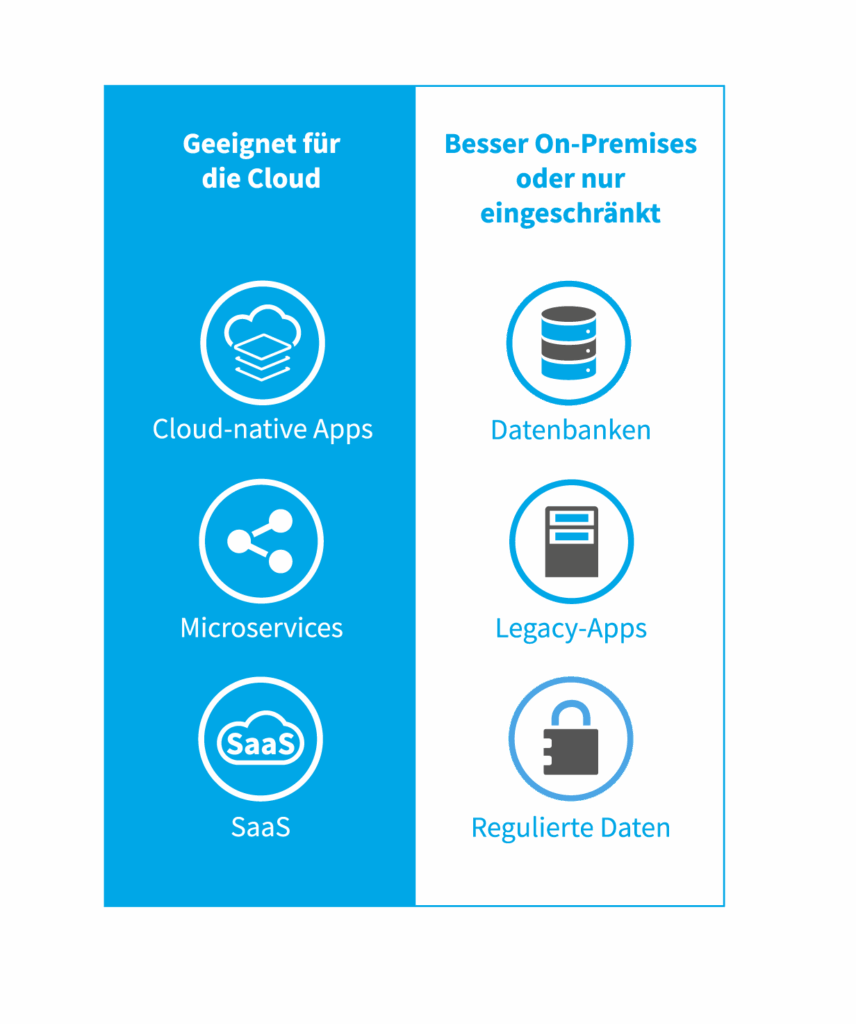
Which systems are suitable for the cloud – and which are better retained on-premises?
Overview: Which Analytics Systems Belong in the Cloud and Which Do Not | ISR
The situation becomes significantly more complex with performance-critical applications, such as highly optimized databases or specialized ERP systems. These systems are frequently tailored in intricate detail to a specific on-premises environment.
An ill-considered cloud migration can therefore entail several risks:
Performance degradation, as hardware-optimized structures are not 1:1 reproducible in the cloud.
Limited configuration options, preventing the adoption of optimizations such as buffer pool adjustments or storage strategies.
Increased costs, if inefficiently operating systems suddenly consume more resources.
The key takeaway is that extensive testing is indispensable prior to migration. Only through pilot projects and detailed benchmark analyses can it be accurately assessed whether performance and stability meet the requisite standards in a cloud environment.
Data Warehouse Databases: Why the Cloud Often Imposes Limitations
Existing data warehouse databases represent a particularly critical case. Systems such as IBM Db2 or SAP HANA have frequently been optimized for on-premises environments over many years. The challenge here lies not in the technology itself, but in the potential loss of configurations. Cloud database services often permit only restricted settings, leading to the forfeiture of painstakingly developed performance tuning measures. A practical example: A highly optimized Db2 database operates seamlessly on-premises but experiences significant performance degradation in the cloud – simply because central optimizations cannot be replicated. For IT architects, this implies that without meticulous analysis and, if necessary, a redesign, migration carries substantial risk.
Legacy Systems: Pitfalls from the Past
Legacy systems are seldom cloud-friendly. They often rely on outdated operating systems or middleware components that are simply incompatible with cloud platforms.
Furthermore, these systems are frequently optimized precisely for specific hardware. Consequently, transitioning to a standardized cloud environment almost invariably results in performance degradation. Remediation typically necessitates extensive adaptations – an undertaking that often renders the cost-benefit ratio questionable.
Custom Developments: When Individuality Becomes a Challenge
Highly optimized custom developments present a double-edged sword. On-premises, they facilitate finely tuned solutions with comprehensive control over system parameters. In contrast, the cloud environment imposes stricter standardizations and offers limited intervention capabilities.
In daily operations, this can translate to reduced flexibility, declining performance, and restricted scalability. Organizations contemplating the migration of such custom developments must carefully assess whether the advantages of the cloud outweigh the compromises in control and adaptability.
Regulatorily Sensitive Applications: Compliance is Decisive
Another domain demanding particular attention from IT architects involves applications handling highly sensitive or regulatorily mandated data – for instance, within the healthcare or financial sectors. Here, two primary risks apply:
Data Protection and Compliance – adherence to GDPR or industry-specific standards must be unequivocally guaranteed within the cloud environment.
Loss of Control – organizations must rely on cloud providers to fulfill all security and compliance requirements.
Consequently, the migration process for such systems necessitates not only technical analyses but also comprehensive risk assessments and approval procedures conducted by internal data protection officers.
Practical Examples: Lessons Learned from Real-World Projects
Theory and practice often diverge – making concrete experiences all the more crucial:
Retail Success Story: An e-commerce platform successfully migrated to the cloud, enabling it to manage peak loads such as Black Friday without outages. Result: increased customer satisfaction and reduced costs.
Critical Database Migration Example: An industrial enterprise experienced significant performance degradation during a Db2 migration to the cloud. Only costly post-optimization efforts stabilized the system – a classic case of insufficient preliminary testing.
Financial Sector: A bank leveraged a multi-cloud strategy to meet regulatory requirements more efficiently. Result: optimized compliance processes and reduced operating costs.
Failed Project: A major service provider failed due to a lack of change management. Team resistance led to shadow IT, compliance risks, and high follow-up costs.
Successful cloud transformations result from thorough planning, meticulous technical execution, and active change management.
Jörg Kremer
Conclusion: Cloud, Yes – But with Prudence
The cloud is not a panacea, but a tool. Cloud-native applications and scalable web platforms are clear candidates for migration. Highly optimized databases, legacy systems, or applications with sensitive data, however, require intensive preliminary analyses – and, if in doubt, are better kept on-premises or within hybrid architectures.
For IT architects in the Data Analytics domain, the most crucial recommendation is therefore: Before every migration, review, test, and weigh options – and never solely rely on the perceived simplicity of cloud services.
Learn More?
mip Whitepaper Cloud Migration
In the whitepaper from our partner mip, discover how to strategically transform your analytics architecture to the cloud, with a focus on performance, security, and cost-effectiveness.
Technical Risks in the Cloud Migration of Analytics Infrastructures
Guest Author Contribution by Jörg Kremer, mip Management Informationspartner GmbH Head of Consulting / Delivery Manager: Cloud Migration: A Comprehensive...
Since 1993, we have been operating as IT consultants for Data Analytics and Document Logistics, focusing on data management and process automation. We provide comprehensive support, from strategic IT consulting to specific implementations and solutions, all the way to IT operations, within the framework of holistic Enterprise Information Management (EIM). ISR is part of the CENIT EIM Group.