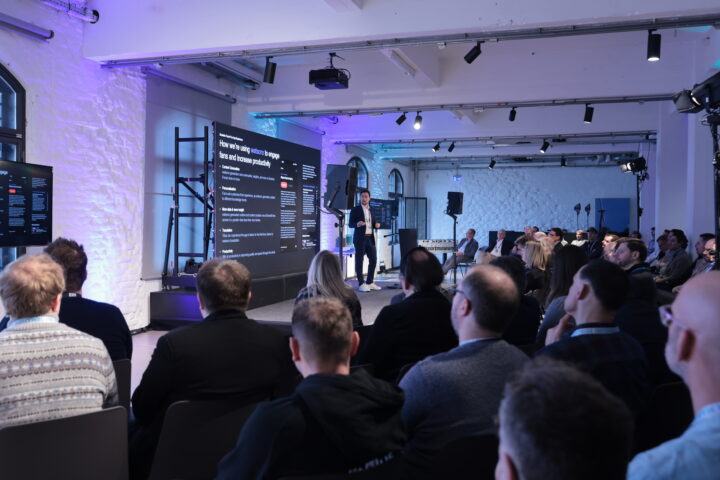
The users. They are a key factor in the successful implementation of a business intelligence strategy that contributes to the long-term success of the company.
It is not uncommon for consideration and discussion of the topic of BI strategy to quickly shift toward a discussion of IT strategy, system landscapes, and technical aspects. Cloud? Software-as-a-Service? Big data lakes? HANA migration? From the user's perspective, these are topics that play a rather subordinate role. Not every new technology or software provides users with the added value that the marketing brochure initially promises.
With its mature and, in some cases, highly dynamic business intelligence portfolio, SAP offers a wide range of approaches and applications that do not always make it easy to decide on the right strategy for the future. However, it is also clear that a consolidation and simplification strategy has been pursued for some time now, with an increasing focus on user needs. One example of this is SAP Analytics Cloud, SAP's new strategic flagship in the area of BI & Analytics, which combines a wide range of functionalities and approaches familiar from on-premise solutions in a fully web-based, lean, and easy-to-use interface.
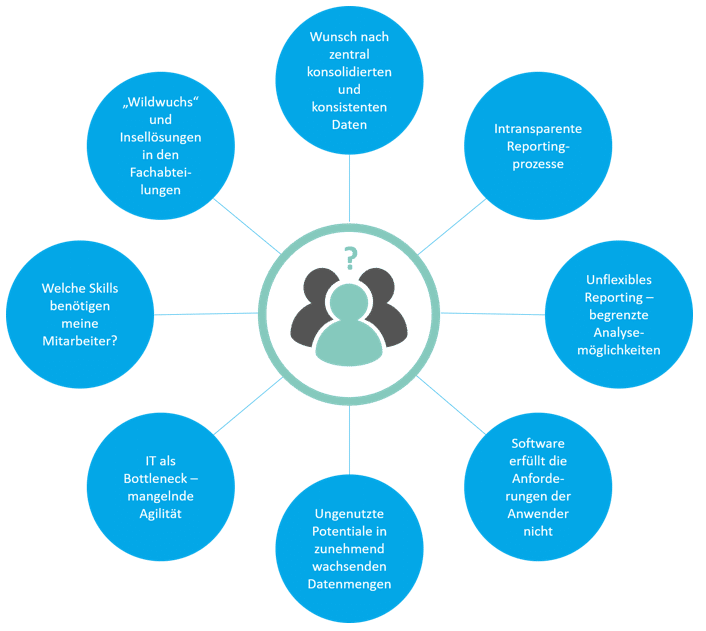
Opaque reporting processes and key performance indicator definitions, local information silos, a lack of integration between departments, and insufficient data quality are just a few examples of problems that repeatedly arise in the area of reporting and BI strategy, not only from the company's perspective, but especially from the user's perspective.
As experts in data and processes in their field of work, users increasingly want more self-service, data sovereignty, and agility, and often feel that existing technologies and applications limit their analysis options. Simply consuming information from rigid, inflexible reports is no longer sufficient. IT is quickly seen as a bottleneck that cannot keep up with user requirements and daily business needs, or, worse still, no longer understands them sufficiently.
Data discovery, modern visualizations, interactive dashboards, and the flexible use and personalization of data for the targeted acquisition of information and new knowledge are requirements that a modern BI landscape should meet.
Desire for a unified, modern platform for reporting, planning, and advanced analytics
Users of business intelligence solutions can only make effective and sound decisions if they have easy and understandable access to the required scope of relevant data in the right quality and format at the right time. The usability, user-friendliness, and performance of the technologies and applications provided must be tailored to the business processes and needs of the users.
A purely IT-driven switch to new front-end tools or technologies rarely leads to success if users are not sufficiently involved and included. Established procedures and requirements in day-to-day business must be adequately analyzed and taken into account when making a selection. New technologies also offer opportunities to uncover previously untapped potential in existing data volumes and improve the company's success with new usage scenarios.
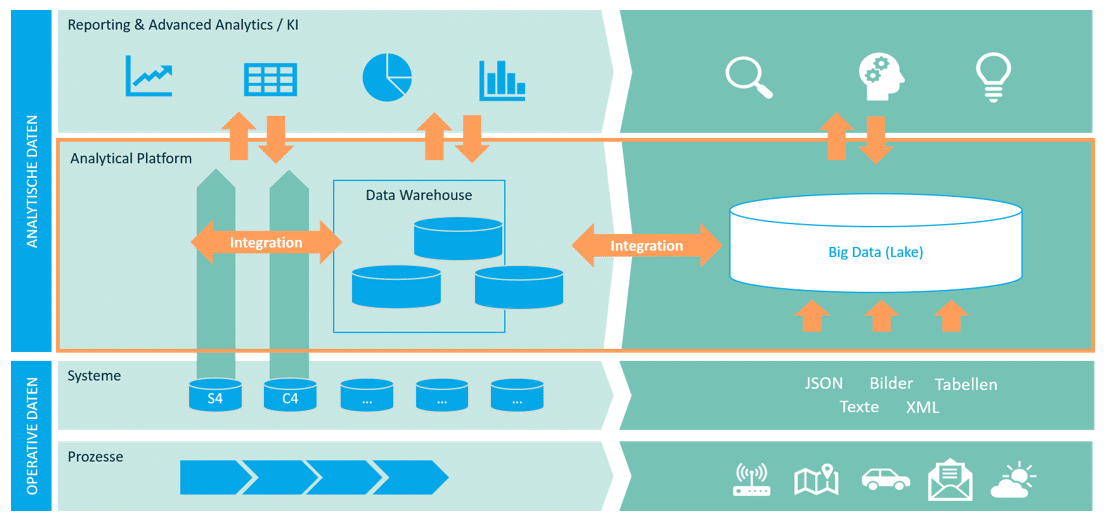
Key questions you should ask yourself in connection with an ideal BI strategy
- How can I best align my BI strategy with the needs of the company and its employees?
- How can BI contribute more specifically to better decision support and corporate management?
- How can I ensure that I am investing in the right technologies and applications, and how can I evaluate SAP's roadmap?
- How can I help users uncover hidden treasures in the vast amount of available data—how can I increase the value added from data?
- In addition to technical changes, how can organizational changes help? And how do I manage the change?
How can you approach the change process?
Users need to be able to evaluate the right data at the right time and provide management with data analyses at short notice. To meet these requirements, a quality-assured and reliable data warehouse solution is needed. Due to digitalization and improved data storage and access options, legacy data warehouse solutions cannot always meet these requirements. We identify weaknesses by analyzing the BI architecture (link or reference to Quick Check Architecture). Together, we develop possible solutions and action plans. The proposed solutions can be so-called "quick wins" (e.g., improved data provision, optimization of data access) or more far-reaching measures, such as the introduction of a reporting tool or adjustments to reporting processes.
If you are facing specific challenges, such as migrations, training or testing concepts, or the implementation of new reporting or planning scenarios, we are happy to share our knowledge with you:
The diversity of BI solutions using SAP Analytics tools and BI systems creates opportunities to find the optimal and tailor-made architecture for each of your questions. However, it also carries the risk of quickly losing track of the big picture.
As an SAP Gold Partner with many years of experience in a wide variety of BI projects, we have the expertise to assist you with your specific questions and find the best possible answers for your future decisions. We offer the following services to solve your BI strategy issues (please refer to the respective workshops/services):
- Strategy consulting Business Intelligence
- Actual analysis & positioning of your BI landscape
- Support Tool selection, e.g., with our SAC BI beginner workshop
- Demos / Proof of Concepts / Rapid Prototyping
- Migration and training concepts

Wiebke Schulz
Managing Consultant
SAP Information Management
Wiebke.Schulz@isr.de
+49 (0) 151 422 05 422