SAP Business Data Cloud
Analytics and AI from SAP?
The BDC as a central data platform
In an age of complex, distributed data landscapes, SAP is setting a new milestone with its Business Data Cloud (BDC). The SaaS platform enables homogeneous and heterogeneous data to be seamlessly connected, centrally managed, and made available for AI-supported analyses. SAP BDC combines existing SAP technologies with new functions in a unified environment. The connection to Databricks enables advanced AI analyses and an open data architecture. BDC thus creates a trustworthy "single source of truth" for all business data and provides departments with context for more informed decisions.
What is the SAP Business Data Cloud?
SAP Business Data Cloud (BDC) is a fully managed SaaS platform from SAP that helps companies centrally integrate, manage, and utilize heterogeneous and homogeneous data landscapes. The goal is to generate standardized, high-quality data products from various data sources that can be efficiently reused and used for analysis, planning, and AI applications.
As a strategic enhancement , BDC combines the powerful capabilities of SAP Datasphere, SAP Analytics Cloud, and SAP Business Warehouse with new cloud components such as managed SAP Databricks services, Insight Apps, and SAP-managed data products.
SAP is thus creating a platform that ensures a uniform data infrastructure while offering the highest standards for data quality, security, and governance. BDC is SAP's response to the growing challenge of consolidating data from a wide variety of sources and making it consistently usable. It provides departments with context-related information for informed decision-making.
More interfaces & integrations:
The BDC architecture
Architecturally, the Business Data Cloud is based on what is known as a business data fabric. The graphic illustrates the components of the architecture, which, according to our information, is planned for Q3 2026:
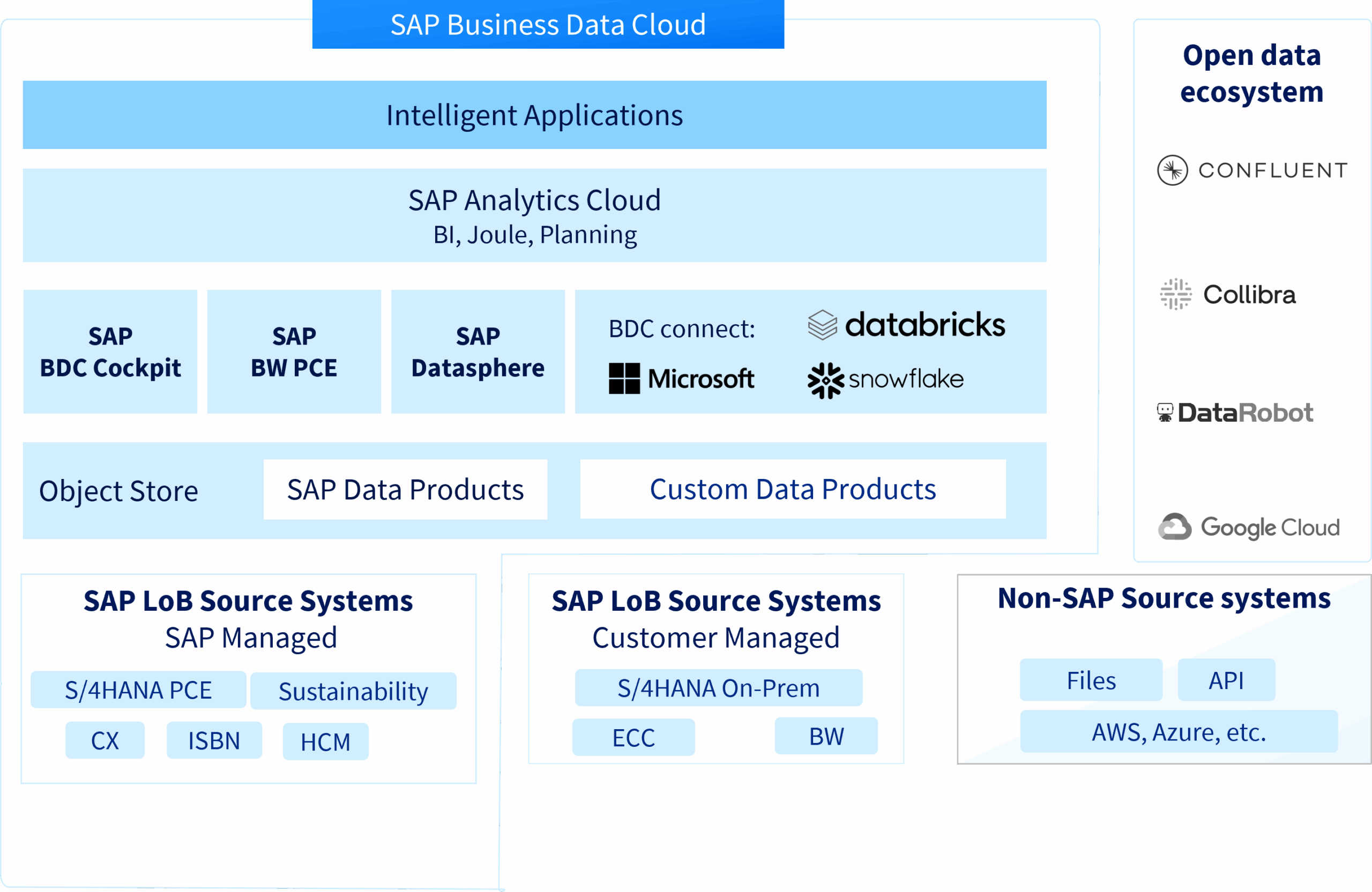
BDC is designed as an open data ecosystem : it integrates closely with SAP DatasphereandSAP Analytics Cloud, but also supports hybrid scenarios with third-party providers. Standardized interfaces and APIs facilitate access to all data, allowing existing IT landscapes to be modernized step by step and external tools to be integrated.
BDC Connect enables bidirectional data exchange between BDC and external data lake platforms (e.g., SAP Databricks or Google Cloud – keyword: Delta Sharing) without duplication. In the future, Microsoft Fabric will also be able to access data products stored in the BDC and vice versa. This allows for a seamless connection of structured and unstructured data sources, which is particularly advantageous for machine learning and advanced analytics applications.
As an open data ecosystem, SAP BDC includes a fully managed Databricks Lakehouse environment that enables advanced data analytics, machine learning, and data engineering on SAP data. Looking ahead, BDC will continue to expand: Snowflake data and AI functions will be integrated directly into BDC in the future, allowing customers to choose the optimal data framework without sacrificing central governance or semantic context. Microsoft Fabric is also set to be added as an integrated data partner in the future. This means that BDC covers all important data and AI platforms. As a result, the optimal data framework can be used within BDC without sacrificing central governance.
The BDC offers a wide range of AI/ML tools. The "Joule" AI co-pilot can automate cross-functional tasks, answer queries in natural language, and summarize decision-relevant information based on business data. In addition to the AI co-pilot, other AI/ML-supported developer aids and predefined insight apps are also in the pipeline to make business processes even smarter. Databricks integration allows you to create your own ML models, but you can also use ready-made AI models from SAP's AI Core/AI Foundation. This enables companies to develop generative AI applications based on their trusted business data and put them to productive use.
This close integration of business AI with the data platform opens up completely new automation and optimization potential, allowing routine tasks to be performed using AI. The Business Data Cloud creates a reliable, responsible environment in which AI results remain traceable and relevant thanks to semantically enriched data.
The countdown is on...
Migrate existing BW by 2030
For existing SAP BW 7.5 or BW/4HANA users, the Business Data Cloud represents the future-proof path to the cloud. BDC enables BW modernization without a hard cut: Existing on-premises BW systems can be migrated unchanged to the Private Cloud Edition (PCE). SAP guarantees support for BW on HANA in BDC-PCE until 2030, giving you more time for strategic modernization of your data landscape.
Integration is similar to before – BW objects are integrated into SAP Datasphere as remote objects and can continue to be used there. In addition, BW offers a tool in the BDC for transferring BW data to data products. This means that existing BW models and the business logic they contain can still be used, but now in a modern lakehouse architecture. This strategy protects BW investments and enables gradual modernization instead of having to redevelop everything at once. The SAP Business Data Cloud is the target platform for all SAP BW customers to continue using their proven data in a cloud environment while gaining access to state-of-the-art analytics and AI tools.
Technological added value for your business
Features of the BDC
Uniform data integration
BDC enables the end-to-end consolidation of information from SAP systems such as SAP S/4HANA or SAP SuccessFactors, as well as from non-SAP sources such as Oracle, Microsoft SQL Server, Salesforce, or Amazon S3. This creates a consistent database for company-wide analyses.
Data fabric principles
BDC offers uniform, cross-system access to distributed data sources—including their metadata and business rules. This effectively reduces data silos and creates more efficient access to all relevant company data.
Zero-copy data sharing
The use of Delta Sharing eliminates the need for multiple data replication. This not only reduces storage and management costs, but also simplifies the provision and use of data across system boundaries.
Apps for analysis and planning
Preconfigured applications support analysis, planning, and forecasting in areas such as finance, HR, and procurement. They offer automatically generated dashboards and reports, require no manual cleanup, and can be seamlessly connected to SAP Analytics Cloud for real-time evaluations.
Data products for added value
Data products are at the heart of BDC: data, metadata, and interfaces are provided as reusable, secure products without duplication and can be shared across systems. Data sets managed by SAP can be used immediately; with Databricks, they are ideal for AI analyses and faster decisions.
BDC
What is the difference between this and Datasphere?
What is the difference between this and the Datasphere?
The SAP Business Data Cloud (BDC) is much more than just a renaming of the SAP Datasphere. Although it is technically based on the proven infrastructure of Datasphere — for example, in the data catalog, semantic layer, and data integration — but it consistently expands on this with new functions and technological partnerships. With BDC, SAP is pursuing an open data fabric approach that opens up new possibilities for data provision, analysis, and exchange, particularly through the deep integration of external platforms.exchange . the so-calledBDC Connect BDC Connect mechanism, data products can be shared across systems – bidirectionally, without duplication, based on delta sharing. In addition, SAP is taking the concept of data products to a new level: Preconfigured data sets maintained by SAP are provided in the BDC, which can be used immediately for analytics and AI-based applications. For existing customers of Datasphere , this does not mean a break, but rather a forward-looking enhancement that protects existing investments and paves the way to a modern, networked data architecture.
ISR Webinar
SAP Business Data Cloud
SAP Business Data Cloud
The SAP Business Data Cloud is evolving rapidly—with new features, strong partnerships, and innovative data services. In this webinar, you'll get a concise overview of the most important innovations of recent months and learn where the SAP Business Data Cloud roadmap is headed. Stay up to date and discover the opportunities that current developments offer your company.
s for Business Data Cloud FAQs
SAP Business Data Cloud (BDC) is a fully managed SaaS platform that extends existing SAP technologies (e.g. Datasphere and Analytics Cloud) with new features in a unified environment. It ensures a unified data infrastructure in the sense of a business data fabric and, for the first time, brings together data warehouse and data lake approaches in a common lakehouse architecture. Unlike previous solutions, BDC relies on an open data ecosystem: Through close integration with SAP Analytics Cloud, SAP Datasphere , and partner technologies, companies can flexibly use both SAP and non-SAP data. Standardized interfaces and APIs facilitate data access and allow existing IT landscapes to be modernized step by step. This creates a trustworthy "single source of truth" for all business data, providing departments with consistent information in the right context for informed decisions.
SAP clarifies that existing SAP Datasphereand SAP Analytics Cloud (SAC) investments are protected. These services remain central building blocks of the BDC strategy. Current users can continue to use their solutions without interruption and, over time, will have the option to seamlessly transition to the fully managed BDC. In other words, no immediate change is required—existing cloud data services will gradually be integrated into the Business Data Cloud without any loss of functionality.
The BDC uses a zero-copyarchitecture for SAP data sources. Data from SAP S/4HANA is transferred in near real time via delta queues to the BDC's central object store. The key feature is that the source application itself provides this data, eliminating the need for additional replication – the information is immediately and consistently available in the BDC. Technologically, this is achieved using established mechanisms such as CDS views, tables, or extractors; however, the crucial factor is that the provisioning is harmonized and does not involve redundant copies. For classic on-premisespremisessystems, the tried-and-tested approach still applies: data is loaded via CDS views or extractors. The important thing here is clean coreprinciple – i.e., no modifications to the source system – is important in order to ensure future cloud compatibility.
The SAP Business Data Cloud is designed as an open data ecosystem and includes strategic partner integrations with third-party providers such as Databricks and Snowflake. Standardized interfaces allow such external platforms to be seamlessly connected, meaning that data products can not only be used within the SAP world, but also made available in external tools via APIs. SAP is introducing BDC Connect : a bidirectional data exchange between the BDC and external data lake platforms without duplicating of data. Technically, this is based on Delta Sharing, a technology that enables secure, redundancy-free exchange of data objects across system boundaries. This makes it possible, for example, to use a data product created in Microsoft Fabric directly in the BDC – and vice versa.
Deep integration with SAP Databricks is already part of the platform (a fully managed lakehouse environment within the BDC), and Snowflake's data and AI functions are also set to be integrated directly into the BDC in the future. This allows customers to integrate the optimal data framework without sacrificing central governance or semantic context. This openness in the BDC architecture enables hybrid scenarios and partner integration on an equal footing, so that SAP and third-party data can be used equally for analytics and AI.
The Business Data Cloud seamlessly integrates AI functions into the data platform. With "Joule" , SAP provides a generative AI co-pilot that automates cross-functional tasks, answers queries in natural language, and summarizes decision-relevant information based on business data. The integrated DatabricksLakehouse environment, companies can also use their own machinelearning models on their BDC data or use ready-made AI models from SAP's AI Core/AI Foundation . For example, companies can use their own generative AIapplications can be built directly on the trusted business data of the BDC and put to productive use. Through this close integration of data platform and AI tools, the BDC opens up completely new automation and analysis potential. At the same time, it creates a responsible environmentin which AI results remain traceable and relevant thanks to semantically enriched data.
BDC is offered exclusively as a cloud service (SaaS), the licensing model is based on actual usage. Costs are calculated based on various factors, including the amount of data managed amount of data, the function modules used, and the number of connected data sources. SAP offers flexible options for this: from purely usage-based rates to enterprise subscriptions for more extensive environments. Specific pricing details can be obtained directly from SAP or are determined during individual contract negotiations. In practice, this means that existing cloud customers (such as those using SAP Datasphere) are likely to receive a customized BDC offering structure that fits their current scenario.
Customized IT Monitoring for Maximum Service Quality
Our Expertise – Your Advantage
Our Expertise - Your Advantage
Successful IT monitoring commences with a detailed requirements analysis, where we jointly determine which systems and applications are to be monitored and in which environments they operate – be it on-premise, in the cloud, or within hybrid infrastructures. Based on this, we develop a suitable solution scenario that enables a tailored implementation of the monitoring solution. We also consider the costs for software licenses and services to design a transparent and efficient monitoring strategy.
With well-planned IT monitoring, we help minimize outages, optimize IT operations, and promote high service quality.
SAP BDC & Datasphere
Latest news articles
Customer Exit Variables Explained in Datasphere
With SAP Datasphere, SAP consistently advances its data platform towards a cloud-centric future. For many BW users…

SAP Datasphere: Health Monitoring
WHY STANDARD MONITORING FOR SAP DATASPHERE IS INSUFFICIENT AND CUSTOMIZED SOLUTIONS BECOME A NECESSITY. …

SAP Business Data Cloud – Revolution or Just Another Upgrade?
With the announcement of the SAP Business Data Cloud (BDC), SAP establishes a new milestone in…

Mapping Hierarchies from SAP BW to Datasphere: Here's How
How can complex hierarchies from SAP BW be represented in SAP Datasphere? Since its introduction…

How-To: Facilitating Data Transfer between SAP Datasphere and Python via hdbcli
The Python package hdbcli enables access to data within SAP Datasphere, thereby facilitating…

SAP Datasphere – The End of SAP Business Warehouse?
Does SAP Datasphere signify the end of SAP Business Warehouse? In August 2023, SAP...
Also read
OUR REFERENCE REPORTS
OUR REFERENCE REPORTS




Christopher Kampmann
Head of Business Unit
Data & Analytics
christopher.kampmann@isr.de
+49 (0) 151 422 05 448